400 students and teachers will have a better learning environment this school year after we rehabilitated 12 classrooms in Baghdeda's Mar Afram and Ashurbanipal Syriac schools! Thank you @StandWIraqiXns and OU CASA
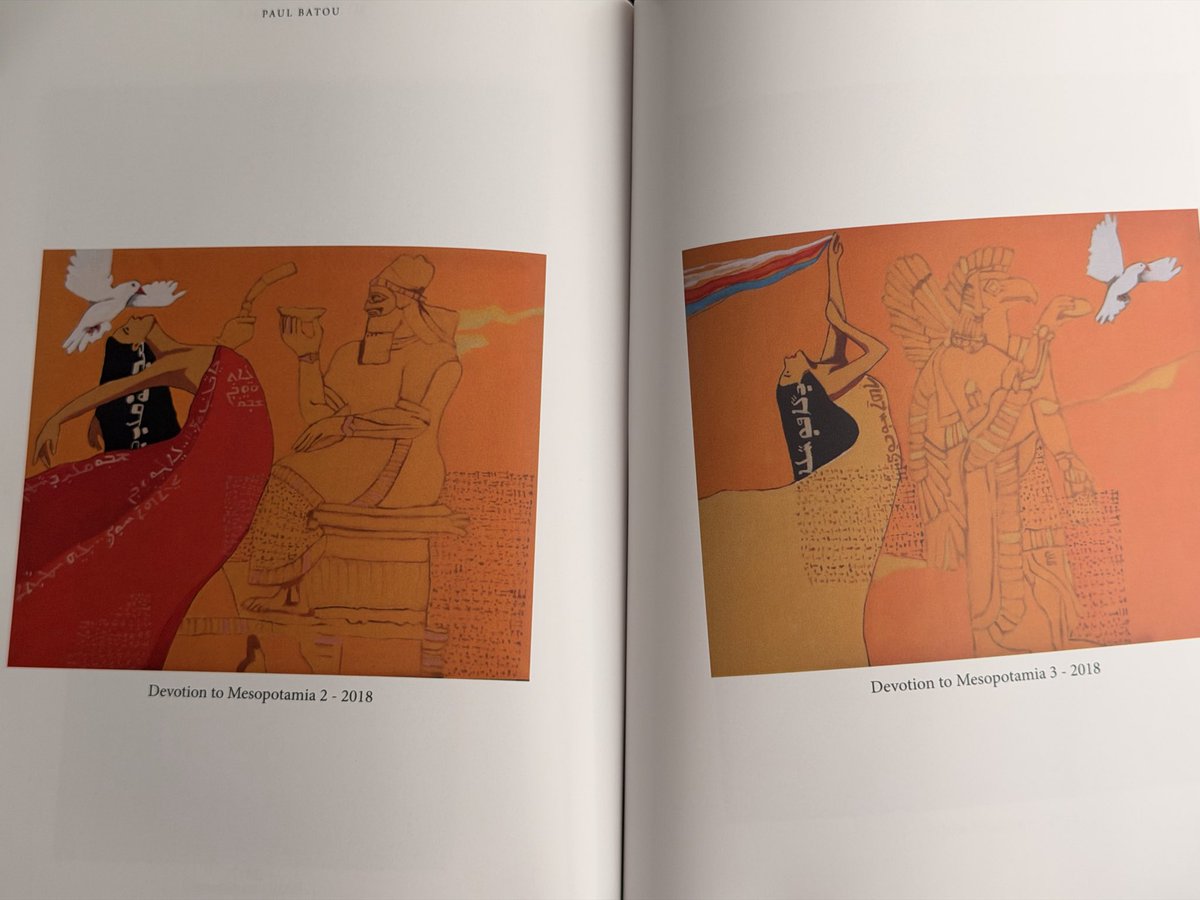
Book description: “My Art, My people The first Assyrian art book published by a native Assyrian artist; My Art, My People is a collection of paintings spanning the last 25 years. My journey began while living under oppression in Iraq. The long five years I served in the army during the Iraq-Iran war, the departure from my homeland to the west, and the struggle we endured building a new life in the United States.”
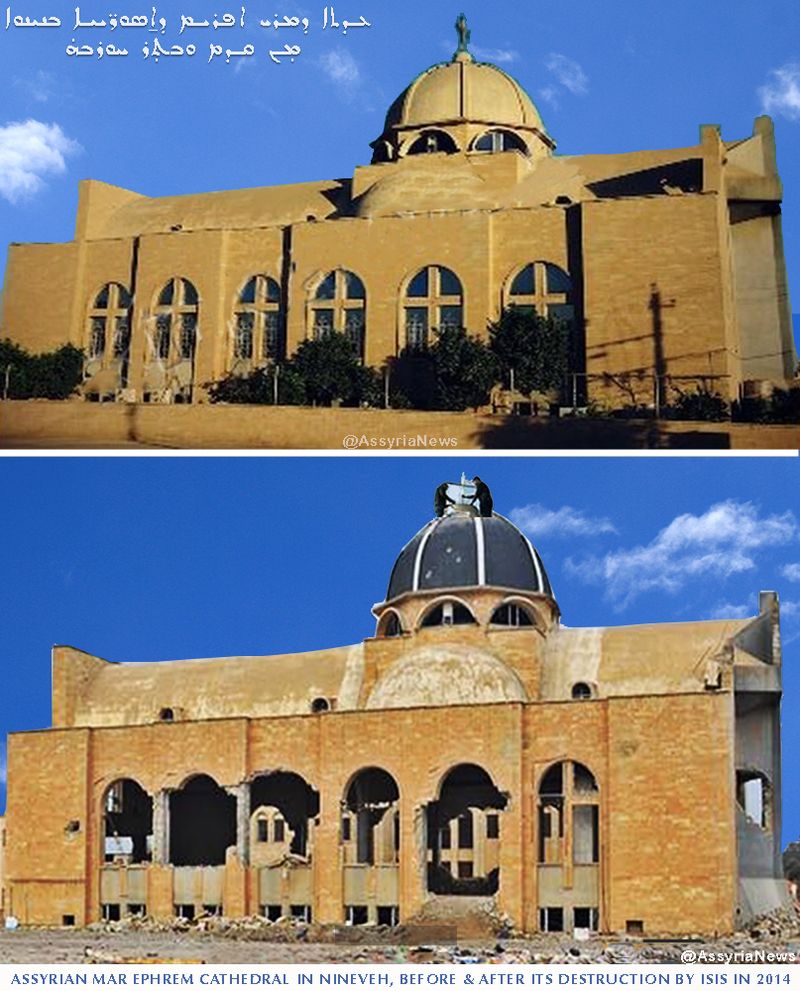
My work is a reflection of my people, the sanctions against Iraq, the invasion of my homeland, and the daily attacks against the Christian minorities. They faced the bombing of our churches, a century-long diaspora, and most recently the invasion of the radical Islamic groups like Isis leading to the desecration of Nineveh and Khabour. It's hard to believe all these events happened over such a short period of time.
This has not been a nightmare, rather a hard reality of oppression and terror for over a hundred years. We are from a land where the majority considers us infidels, which has justified the countless times our lands and homes have been stripped away. I narrate the genocide against my people using colors and a canvas. But I also illustrate our homeland Mesopotamia, our culture, and our love for peace and freedom.
About the Author: Paul Batou, a Mesopotamian Assyrian artist, received a pharmaceutical degree from the University of Baghdad; however, art always remained his most enduring passion. Batou's first art show took place in Baghdad in 1980. His career was on hold in 1982 after serving a mandatory five-year deployment as an Iraq Army medic during the Iran-Iraq war.
After the war ended in 1988, Paul left Iraq with his family initially migrating to Athens as refugees, and eventually made his way to Los Angeles. In the United States, Paul Batou continued his passion for creating art and writing poetry. In 2007, he published his first book, "My Last Thoughts About Iraq", which served as a personal reflection of war, sanctions, the fallof the great ancestral civilizations within Mesopotamia.
His work has beenfeatured in numerous publications and galleries across the world. This book, "My Art, My People", is his contribution to all those who love art and humanity.Celebrate the colors of Mesopotamia
✝️ THE DESTRUCTION OF ASSYRIAN CHRISTIAN CHURCHES — FROM MESOPOTAMIA TO EUROPE: THE WEST MUST LEARN FROM HISTORY!
⛪ Assyrian Christian Heritage Under Attack Since 2003
Assyrian Christians are among the world's oldest Christian communities, with roots in Mesopotamia dating to the earliest centuries of Christianity. Their churches, monasteries, and Syriac-Aramaic traditions form an important part of the religious and cultural heritage of Iraq and Syria.
Since the US-led invasion of Iraq in 2003, Assyrian Christian communities have faced increasing violence, persecution, forced displacement, and the destruction of churches and religious heritage, particularly at the hands of Islamist extremist groups.
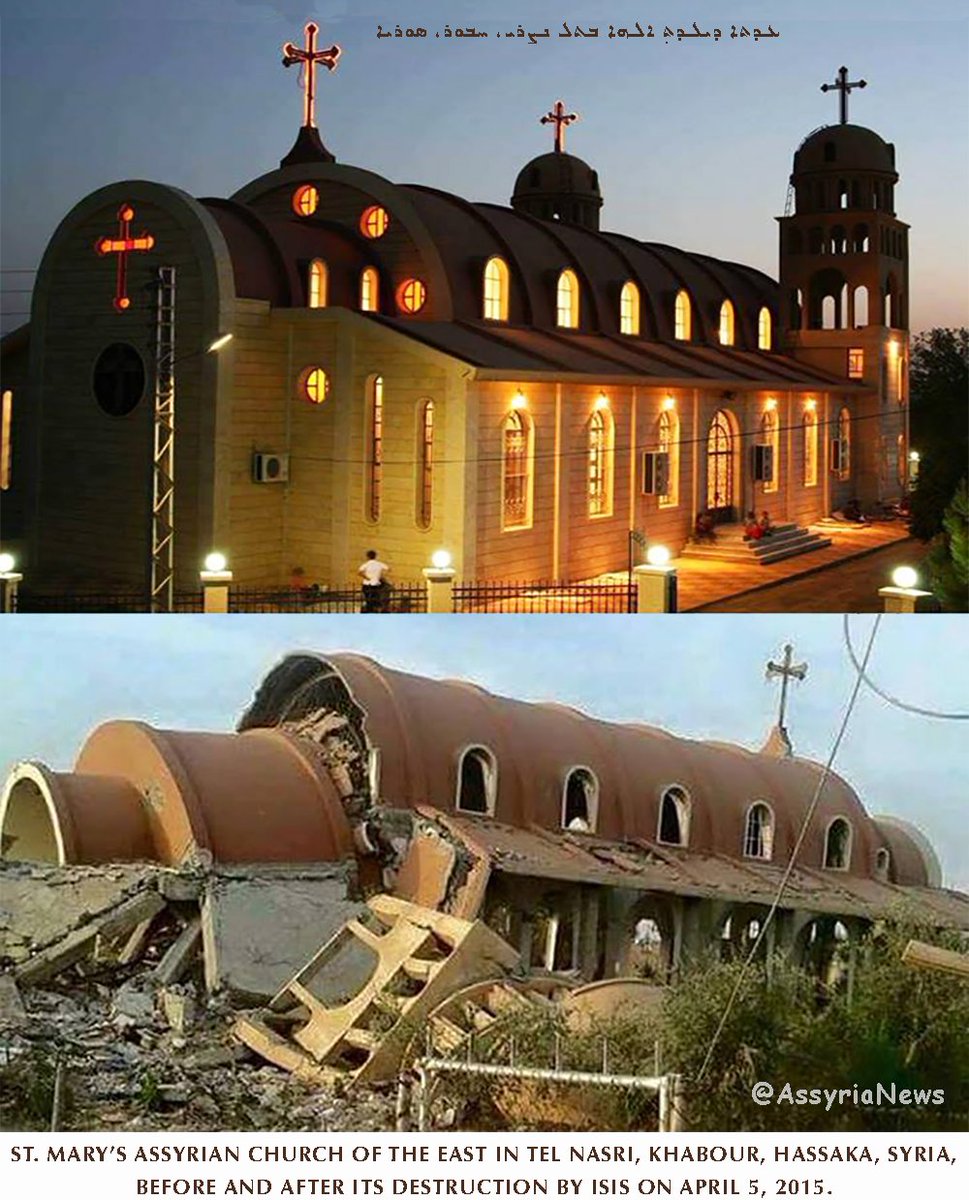
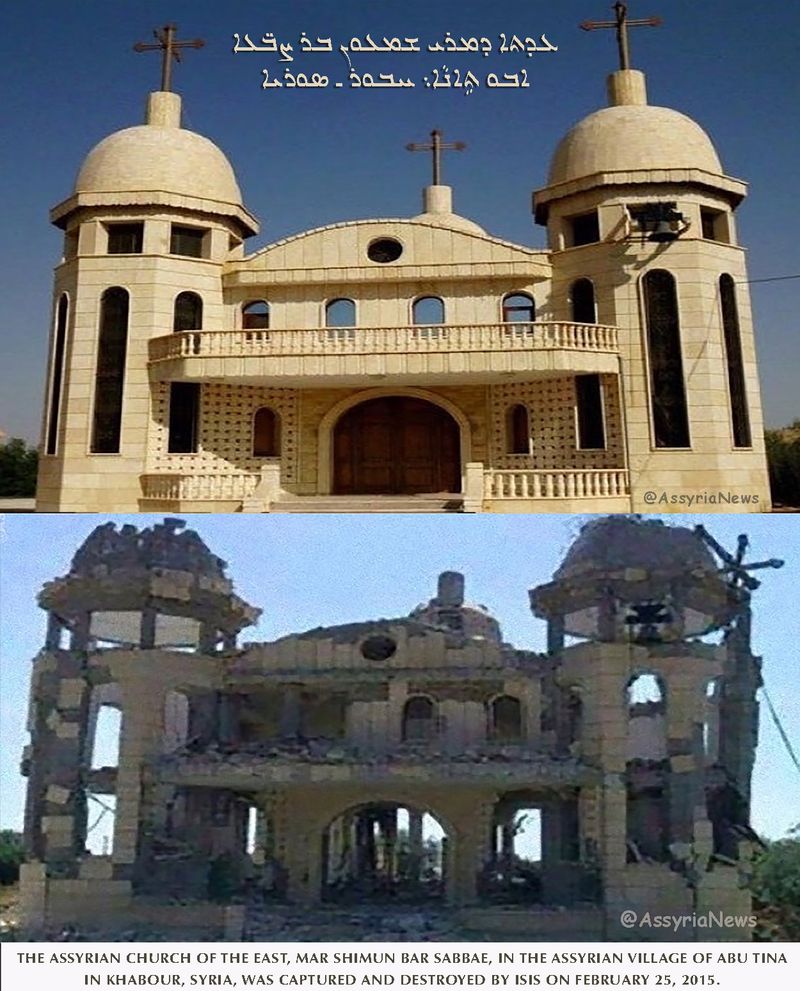
Between 2003 and 2017, more than 140 Assyrian Christian churches were reportedly damaged or destroyed across Iraq and Syria by ISIS and other Islamist extremist groups. This figure remains an estimate rather than an independently verified total.
📸 The four photographs illustrate only a small fraction of the destruction of Assyrian Christian churches.
🔥 Documented Attacks in Iraq and Syria
🇮🇶 Iraq, 2003–2017: Following the US-led invasion, Christian communities experienced church bombings, kidnappings, killings, threats, and mass displacement.
In 2014, ISIS occupied Mosul and large parts of the Nineveh Plains, including historically Christian towns such as Qaraqosh (Baghdeda), Bartella, and Karamlesh. More than 100,000 Christians fled their homes.
🇸🇾 Syria, 2015: ISIS attacked Assyrian villages along the Khabur River, abducted more than 200 Christians, and destroyed or damaged churches and homes.
⛪ Religious heritage: Among the affected sites were historic churches and monasteries, including Mar Behnam Monastery and St. Elijah's Monastery in Iraq.
These attacks contributed to the substantial decline of Christian communities in parts of Mesopotamia.
⚠️ Islamist Extremism and Attacks in Europe
Violent Islamist extremism has also been responsible for attacks against Christian worshippers and religious sites in Europe.
🇫🇷 France, 2016: ISIS-inspired attackers murdered Father Jacques Hamel inside a church in Saint-Étienne-du-Rouvray.
🇫🇷 France, 2020: Three people were killed in an Islamist terrorist attack at the Basilica of Notre-Dame in Nice.
🇫🇷 Lyon, September 2025: Ashur Sarnaya, a 45-year-old Assyrian Christian refugee who fled Iraq during the rise of ISIS, was murdered in Lyon, France, while broadcasting Christian content on TikTok. Ashur, who used a wheelchair, had sought safety and religious freedom in Europe. French anti-terrorism authorities investigated the killing, and a suspect was charged in connection with a terrorist enterprise. The case has been investigated as a suspected Islamist terrorist attack, although the motive has not been established by a final court judgment.
Churches in Europe have also experienced arson, vandalism, and desecration. However, these incidents have different causes, and they cannot all be attributed to Islamist extremists.
🕊️ Protection of Assyrian Christian Heritage
The destruction of churches in Iraq and Syria has affected not only religious buildings but also the communities, manuscripts, traditions, and cultural heritage associated with them.
Despite reconstruction efforts, displacement, insecurity, and emigration continue to affect the future of Assyrian Christian communities.
The experience of Assyrian Christians in Iraq and Syria provides an important lesson for Europe and the wider Western world: religious extremism must be confronted, freedom of worship protected, and historic religious monuments preserved.
Protecting Assyrian Christian heritage requires the preservation of historic churches and monuments, security for remaining communities, religious freedom, and support for displaced families wishing to return.
⛪ PROTECT ASSYRIAN CHRISTIAN CHURCHES, SACRED MONUMENTS, AND THEIR ANCIENT RELIGIOUS AND CULTURAL HERITAGE!
#AssyrianChristians #AssyrianHeritage #ChristianHeritage #Assyrian #Assyrians #Assyria #Mesopotamia #Nineveh #Khabur #Iraq #Syria #ReligiousFreedom #CulturalHeritage #JusticeForAshurSarnaya #ProtectHistoricChurches #StopReligiousExtremism
She wants Assyrians, Arabs, and Turkmen expelled from our homeland while enjoying the protections of a Western nation, but not its values. Poor France always importing the worst of the East opposite of their western values. Kurdish leaders lie and hide when they sell Kurdistan to the West as a feminist, secular, tolerant democracy. It’s a curious why she doesn’t want to live in the land of the Kurds.. The reality is Kurdish society is a conservative Sunni , tribal society where by UNICEF's count, FGM rates run about 37% versus under 1% in the rest of Iraq. and honor killings are still documented in their feminist progressive society.
They say , only a Kurdish state will bring peace" is what they tell the West. Their version of peace is chaos, ethnic cleansing, kidnapping, and violence. Past and present behavior are the best predictors, and her own post tells you what comes next. the expulsion of everyone who isn't Kurdish.
J’ai entendu dire que la France était finie, qu’il était trop tard pour la sauver.
Mais la France est toujours aussi belle, enviable même. Sa grandeur n’a pas disparu, elle ne demande qu’à renaître.
Nous avons surmonté en un an un problème cent fois plus grave, sans avoir les moyens dont dispose la France.
La France pourrait y arriver en une semaine.
The loss of indigenous languages is a devastating blow to ethnic identity.
Before Arabic, Lebanese spoke Syriac. Across Turkey and Lebanon, many Armenians can no longer speak Armenian. While both groups fiercely preserved their Christian faith, Islamic hegemony dealt a devastating blow to their native languages. Loss of language is cultural erasure.
# ✝️🌏 ASSYRIAN CHRISTIAN MISSIONARIES BROUGHT CHRISTIANITY TO CHINA AND ASIA CENTURIES BEFORE EUROPEAN MISSIONS 🇨🇳
✨ **Long before European missionaries sailed to Asia…**
🌍 Long before European colonial empires existed…
✝️ And long before much of Europe became fully Christian…
**Assyrian Christian missionaries of the Church of the East had already carried the Gospel across the Silk Road into Persia, Central Asia, India, Mongolia, and China.**
📜 This is one of the most extraordinary — and most forgotten — chapters in world history.
🏛️ **FROM ANCIENT MESOPOTAMIA TO THE FAR EAST**
Emerging from Mesopotamia, the ancient homeland of the Assyrian people in modern Iraq and surrounding regions, the Church of the East became one of the greatest missionary movements of the ancient Christian world.
These Christians worshipped in **Syriac, a form of Aramaic closely related to the language spoken by Jesus Christ Himself.** ✝️
✨ Driven by faith, scholarship, and missionary zeal, Assyrian monks, priests, scholars, and merchants traveled thousands of kilometers through deserts, mountains, and dangerous trade routes to bring Christianity to the peoples of Asia.
🛤️ **CHRISTIANITY ALONG THE SILK ROAD**
By the 7th century, the Church of the East had established communities across vast regions of Asia, with its influence eventually reaching:
📍 Mesopotamia
📍 Persia (Iran)
📍 Central Asia
📍 India
📍 Tibetan regions
📍 Mongolia
📍 Turkic kingdoms of the Silk Road
📍 China under the Tang Dynasty 🇨🇳
**🇨🇳 635 AD — THE ARRIVAL OF CHRISTIANITY IN IMPERIAL CHINA**
In 635 AD, during the golden age of the Tang Empire, a Christian missionary of the Church of the East, known in Chinese records as **Alopen**, arrived in the imperial capital of Chang’an (modern Xi’an).
👑 Emperor Taizong welcomed the Christian mission and authorized the translation of Christian scriptures and the establishment of a Christian monastery.
Christianity in China became known as **Jingjiao (景教)** — *“The Luminous Religion”* or *“The Radiant Teaching.”*
✝️ Assyrian missionaries translated religious and theological texts into Chinese, engaging deeply with Chinese civilization, philosophy, and literature.
They communicated Christian teachings through concepts familiar to Buddhist and Daoist audiences while maintaining their Syriac Christian traditions.
📜 **THE XI’AN STELE — AN EXTRAORDINARY HISTORICAL WITNESS**
One of the greatest surviving witnesses to this remarkable history is the **Xi’an Stele, erected in 781 AD.**
Written in Chinese and Syriac, this extraordinary monument records:
✝️ The arrival of Christianity in China
👑 Imperial recognition and support
📖 The translation of Christian scriptures
⛪ The establishment of Christian monasteries
🌏 The spread of Christianity during the Tang Dynasty
**The stele provides undeniable historical evidence that Christianity reached China centuries before the major European Catholic and Protestant missionary movements.**
🛤️ **ASSYRIAN CHRISTIANITY ACROSS ASIA**
The influence of the Church of the East extended across major trading centers and cities, including:
📍 Samarkand
📍 Merv
📍 Kashgar
📍 Turfan
📍 Herat
📍 Nisibis
Christian communities flourished along trade routes connecting Mesopotamia with Central Asia and the Far East.
👑 **CHRISTIANITY IN THE MONGOL EMPIRE**
Assyrian and Syriac Christian traditions also reached the Mongol world.
Several Mongol peoples, including the **Keraites and Onguts**, developed strong traditions associated with the Church of the East.
Christian queens, generals, advisers, and influential families were present within Mongol imperial society.
🌏 At its greatest geographical extent, the Church of the East became one of the most widespread Christian churches in history, stretching from the Middle East across the vast Asian continent.
🕊️ **A MISSION BUILT THROUGH FAITH, KNOWLEDGE, AND CULTURAL EXCHANGE**
Unlike many later missionary movements associated with European colonial expansion, the early missions of the Church of the East spread largely through:
🛤️ Silk Road trade networks
📖 Scholarship and translation
⛪ Monasteries and religious communities
🤝 Cultural exchange
🎓 Education and theological learning
🌍 Adaptation to local languages and traditions
These missionaries carried their ancient Syriac Christian heritage across continents while engaging with the civilizations they encountered.
🕯️ **A FORGOTTEN LEGACY THAT SURVIVES**
Over the centuries, persecution, political upheaval, invasions, and the decline of important trade networks contributed to the disappearance of many ancient Christian communities across Asia.
Yet their remarkable legacy survives through:
📜 Ancient manuscripts
🏛️ Archaeological discoveries
⛪ Historic churches and monasteries
🪦 Christian gravestones and inscriptions
✝️ The continuing heritage of Assyrian and Syriac Christianity
**🌏 CHRISTIAN HISTORY WAS NEVER ONLY A EUROPEAN STORY**
It was also:
🏛️ **A Mesopotamian story**
🛤️ **A Silk Road story**
📜 **An Asian story**
✝️ **An Assyrian Christian story**
Among the great pioneers who carried Christianity across Asia were the missionaries of the Church of the East, whose Syriac Christian heritage remains an essential part of this extraordinary history.
**Their faith crossed deserts, mountains, kingdoms, languages, and civilizations — leaving a Christian legacy thousands of kilometers from their Mesopotamian homeland.** ✝️🌏
📸 **HISTORICAL IMAGE DESCRIPTION**
🪦 Assyrian Church of the East Christian gravestone from Yuan Dynasty China, dated to **1317 AD**.
Written in Syriac and Chinese, the monument commemorates a Christian woman named **Elisabeth** and reflects the remarkable fusion of Syriac Christian and Chinese artistic traditions under Mongol rule.
🏛️ Preserved in the **Yangzhou Museum, China**.
✝️🇨🇳 **A REMARKABLE TESTIMONY TO THE ANCIENT CHRISTIAN CONNECTION BETWEEN MESOPOTAMIA AND CHINA.**
---
#Assyrian #Assyrians #Assyria #AssyrianHistory #ChurchOfTheEast #AssyrianChurchOfTheEast #ChristianHistory #SilkRoad #ChinaHistory #YuanDynasty #Jingjiao #XianStele #Syriac #Aramaic #AsianHistory #Mesopotamia #TangDynasty #MongolEmpire #HiddenHistory #AncientHistory #Christianity #MiddleEastHistory #AssyrianHeritage #AssyrianChristians #ChristianityInChina #SyriacChristianity
Dior had no faith in the French police to protect their store so they brought in their own security team to protect the flagship store in Paris tonight
Obviously this was written by someone who knows very little about the Assyrian history.
1. Don't attempt to leave the Kurdish tribes out. It was the Kurds in the 19th century who weakened the Assyrians in the Hakkari Mountains specially the massacres by Kurdish leader Bedr Khan against the Yezidis, Assyrians and Armenians in the eastern parts of the Ottoman Empire. It was later the Kurds who made the vast force of the Hamidiya Calvary that committed its massacres against the Armenians and Assyrians. The Assyrians faced increasing security threats, land grabs, and violent attacks from neighboring regional Kurdish tribes, while local Ottoman authorities frequently turned a blind eye or actively colluded with the aggressors.
2. The Assyrians did not initiate cooperation with the Russians. When the Ottoman Empire entered WWI on the side of the Central Powers, it demanded the conscription of Christian men into labor battalions or the military. Fearing that this was a precursor to systematic disarmament and destruction, many Assyrian communities refused conscription. The Ottomans and allied Kurdish militias quickly viewed the Assyrians as disloyal internal enemies and potential Russian sympathizers, launching preemptive military campaigns against them. This left the Assyrians with no alternative other than to side with Russia to fight off Ottoman and Kurdish forces.
3. The Assyrians did not abandon their Nestorian name and took the name Assyrians to distinguish them from the Chaldeans. This line clearly tells how little you know of history.
a) The Assyrians never abandoned their name. The "Assyrian" name is an English foreign name, formed from the Greek, and it makes no sense to say that the Assyrians called themselves by this foreign name when they did not speak English. You are silly. The Egyprians do not say "we are Egyptians" because they say "nahnu Misriyeen" because they are Arabs and speak Arabic. The Assyrians used the native terms to describe themselves. They used Ashuraye, Atouraye and Suraye.
b) The Church of the West branded the Church of the East as Nestorian after the Council of 431. Do some reading.
c) The Assyrians (Ashuraye and Suraye) used these names that mean the same things. They are words that simply evolved with time. The Assyrian language is a living language and it evolves. It is not a dead language where words remain static.
d) The Chaldean Catholic Church was created in 1681 in southern Turkiye and in 1830 in Alqosh, northern Iraq. The Chaldean name was founded by the Vatican in 1445 first in Cyprus. Chaldeans is to be exact, a Catholic Nestorian. In other words, all members of the Church of the East who converted to Catholicism were called Chaldeans. Do your homework.
@shadikhalloul Arabization has been the greatest blow to the Levant's Christians. Why do the Arab governments still refuse to recognize Aramaic & Syriac?
🏛️ Ancient Assyrian Art and Royal Power in Texas, USA 🇺🇸
An article published by Glasstire on October 17, 2026, highlights a remarkable exhibition at the San Antonio Museum of Art (SAMA), celebrating the art, power, and cultural legacy of Ancient Assyria. 🦅
The exhibition features nearly 3,000-year-old Assyrian palace reliefs from Nimrud, showcasing the greatness and artistic achievements of the Assyrian Empire.
The article also addresses the destruction of Nimrud by ISIS in 2015 and the importance of preserving Assyria’s priceless cultural heritage.
✨ An ancient civilization whose extraordinary legacy continues to inspire the world!
#Assyria #AssyrianHeritage #AncientAssyria #AssyrianArt #Nimrud #Mesopotamia #SanAntonioMuseumOfArt #CulturalHeritage #AssyrianHistory #SaveAssyrianHeritage
https://t.co/BOamupPAhC
القوش،اشور ❤️🤍💙
القوش يا بلدة الزمان
القوش انت لنا السند
القوش القوش قلادة من الورود.
زرعتي في قلوبنا الرحمة
و حب الناس و الوطن منذ صغر
لا ننحني اذا كبونا
و لا نهاب شرا محدقا
عندما تقسو عليه الغربة
و حينما يعتريني الخوف
فاشعر باسمك يتراقص على شفتي