No one will argue against kurdistan being mentioned in the 19th century.
In fact, the term kurdistan was used for the first time by the Seljuks in the 12th century as the earlier term Kurds solidified to mean a distinct people from the earlier meaning of nomads which was used by the Sassanids (3rd-7th centuries). The term Kurd evolved from the Middle Persian Kwrt meaning tent-dweller nomads.
In short:
a) Kurd as people began to evolve in the 10th-12th centuries, originated from Kwrt meaning nomad.
b) Kurdistan was founded by the Seljuks in the 12th century.
The ADM has sent an open letter addressing the Kurdistan Region PM Masrour Barzani and revealing dozens of court documents of won cases of stolen Assyrian lands in Erbil and Duhok, yet the court decision has not been implemented,
Reasons stated as obvious from the June 8 post.
You looked like the real fake and villainess Svitolina. In fact, your personality and nature received double blow: first, you divorced your husband on the phone and second, you did not act like a real sportswoman in the finals by offering a simple hand shake or congratulating the winner.
@RobPutrus By the way, adding to this stolen money are the revenues from the border's crossings with Iran and Turkiye. Still, the Barzanis keep crying and claim that the central government is not paying the salaries of the Kurdish region government employees.
@yse_192 and wait and see what happens when Masoud Barzani passes away and the struggle between Nechervan Idris Barzani and Masroor Masoud Barzani comes to the front stage.
Why did Barzani family assassinate Idris Barzani, father of Nechervan and brother of Masoud?
@r_rewsen@grok There is a difference between having existed as tribal, lawless group in a mountainous no man's land before Chaldiran from being recognized, part of and supported by the Ottomans after Chaldiran.
kaka Masoud, you went too far. You became too arrogant. You accumulated too much wealth from being a thief and smuggler. You introduced a plan to separate from Iraq. You failed to honor the decisions of courts in your own region to return lands to the Assyrian owners. Your family controls everything, are controlling the critical positions in government and have become millionaires with real estate in many countries.
Enough!
The Timeline of the term Kurd:
A) Before the Sassanid Period (3rd – 7th centuries) there is no mention of Kurds or Akrad.
B) Sassanid Period (3rd to 7th centuries) Middle Persian kwrt- (plural kurtan) utilized and applied to all nomads of Iran. The term evolved to Kurd and functioned from around AD 651 primarily as social/economic descriptors for pastoralists, tent-dwellers, or nomadic/transhumant groups rather than a modern ethnic label.
C) In early Islamic-era Arabic and Persian writings (roughly 8th–11th centuries), Kurd (plural akrad) was heavily used as a broad social and political catch-all—often meaning pastoral nomads, mountain dwellers, or even highwaymen/raiders robbers. However, it wasn't strictly divorced from geography or settled/semi-settled groups, nor did "nomad" disappear once the 10th century arrived. Even in later centuries, observers sometimes used Kurd loosely for pastoral/nomadic groups in certain regions (such as parts of the Caspian/Alborz or Anatolian/Iranian borderlands).
D) Between 10th and 12th centuries, medieval writers still blended lifestyle, geography, and tribal identity. Geographers and historians could still associate Akrad with pastoralism or transhumance while also naming specific Kurdish tribes and territories.
E) Between 12th – 14th centuries, Arabic and Persian sources increasingly treat Akrad / Kurds as a recognizable collective group even while noting internal tribal divisions. In fact, even after the 12th century, identity in the medieval Middle East was layered—combining tribe/clan, locality/region, religious affiliation, dynastic loyalty, and linguistic/cultural ties—rather than a single, modern "strict" ethnic identity.
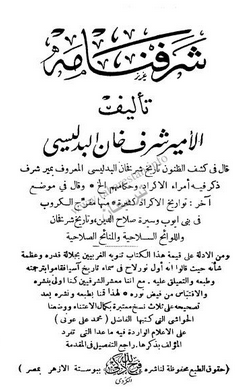
F) Many historians see the consolidation of a broader ethno-cultural consciousness taking further shape across the late medieval and early modern periods. For example, by the 16th century in works like Sharafkhan Bidlisi's Sharafnameh, which maps out distinct Kurdish groups and territories, with modern political nationalism emerging much later in the 19th and 20th centuries.
That is very true, and may be more. The Nestorians were in Mosul and Baghdad Vilayets as well until 1830 when the Vatican officially established the Chaldean Catholic Church patriarchal See in Alqosh and the Nestorians in a very short period of time if not overnight became known as Chaldeans.
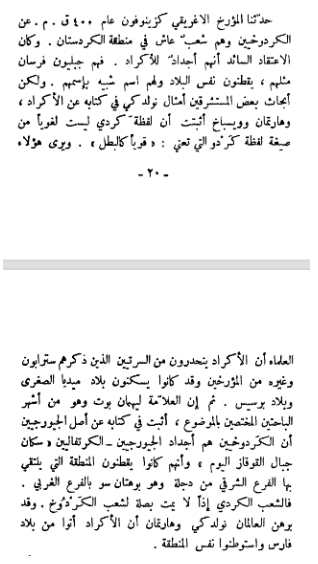
Carduchians mentioned by Xenophon was NEVER intended to mean later Kurds. Just because two words sound a little close in pronunciation does not mean they mean the same. This theory is obselete now by scholars and linguists.
Read the facts from the most expert on Kurdish history, Basile Nikitin in his book, "Les Kurdes." Nikitin is considered the father of Kurdish history.
@Millionair6969@PlatosDisciple Yeah, the Assyrians became extinct in the 17th century and the British re-created them in the 19th century.
Are you real???
@Millionair6969@PlatosDisciple Why do you prove to the readers that you are a moron?
This is the 1939 English translation silly. The original Latin was published in 1612.
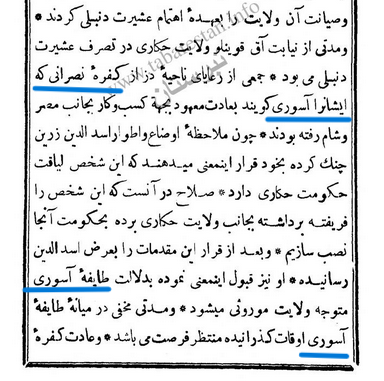
@Millionair6969@PlatosDisciple Yeah, that is why Kurdish most prominent historian, Sharafkhan mentioned Asuri (Asori) or the English term "Assyrians" in his most famous and first Kurdish book "Sharafnama" published in 1597.
The Timeline of the term Kurd:
A) Before the Sassanid Period (3rd – 7th centuries) there is no mention of Kurds or Akrad.
B) Sassanid Period (3rd to 7th centuries) Middle Persian kwrt- (plural kurtan) utilized and applied to all nomads of Iran. The term evolved to Kurd and functioned from around AD 651 primarily as social/economic descriptors for pastoralists, tent-dwellers, or nomadic/transhumant groups rather than a modern ethnic label.
C) In early Islamic-era Arabic and Persian writings (roughly 8th–11th centuries), Kurd (plural akrad) was heavily used as a broad social and political catch-all—often meaning pastoral nomads, mountain dwellers, or even highwaymen/raiders robbers. However, it wasn't strictly divorced from geography or settled/semi-settled groups, nor did "nomad" disappear once the 10th century arrived. Even in later centuries, observers sometimes used Kurd loosely for pastoral/nomadic groups in certain regions (such as parts of the Caspian/Alborz or Anatolian/Iranian borderlands).
D) Between 10th and 12th centuries, medieval writers still blended lifestyle, geography, and tribal identity. Geographers and historians could still associate Akrad with pastoralism or transhumance while also naming specific Kurdish tribes and territories.
E) Between 12th – 14th centuries, Arabic and Persian sources increasingly treat Akrad / Kurds as a recognizable collective group even while noting internal tribal divisions. In fact, even after the 12th century, identity in the medieval Middle East was layered—combining tribe/clan, locality/region, religious affiliation, dynastic loyalty, and linguistic/cultural ties—rather than a single, modern "strict" ethnic identity.
F) Many historians see the consolidation of a broader ethno-cultural consciousness taking further shape across the late medieval and early modern periods. For example, by the 16th century in works like Sharafkhan Bidlisi's Sharafnameh, which maps out distinct Kurdish groups and territories, with modern political nationalism emerging much later in the 19th and 20th centuries.