If you wanna change the world, start off by making your bed. If you make your bed every morning, you have accomplished the first task of the day and it will encourage you to do another task ...
#leadership
https://t.co/rCFKOCwFGE
Interpretability is the most important scientific problem of our lifetime. But it's too slow right now! I wrote some thoughts with @banburismus_ on how we might accelerate it.
(Probably a good time to share that I'll be joining @GoodfireAI post PhD. I'm over the moon about it🌝)
Boltz on Times Square! Proud to see our team be part of the Disruptors 60 Class of 2026 and to see our work bringing AI-based biomolecular design to every scientist recognized. Thank you to our team, our partners and the scientists building with Boltz!
The 1991 version is an obscure tech report with a vague idea, no theory, no experiment to speak of, and certainly no code, that the author never revisited or pushed.
It has one hand-drawn architecture diagram, one formula of the type f(x)=0, and a claim that every other technique is a special case if you instantiate f and x properly.
The repository (under development) contains the code and the article (a new draft). I used the optimizers distributed with PyTorch and implemented those not included.
Feel free to use the code for learning and your own experiments.
https://t.co/LLWbFLOHWC
#deeplearning
🔥Welcome 🔺Simplex Diffusion Models🔻!
Standard discrete diffusion models suffer from "information collapse" because they discard uncertainty at intermediate steps by sampling categorical tokens. (1/5)
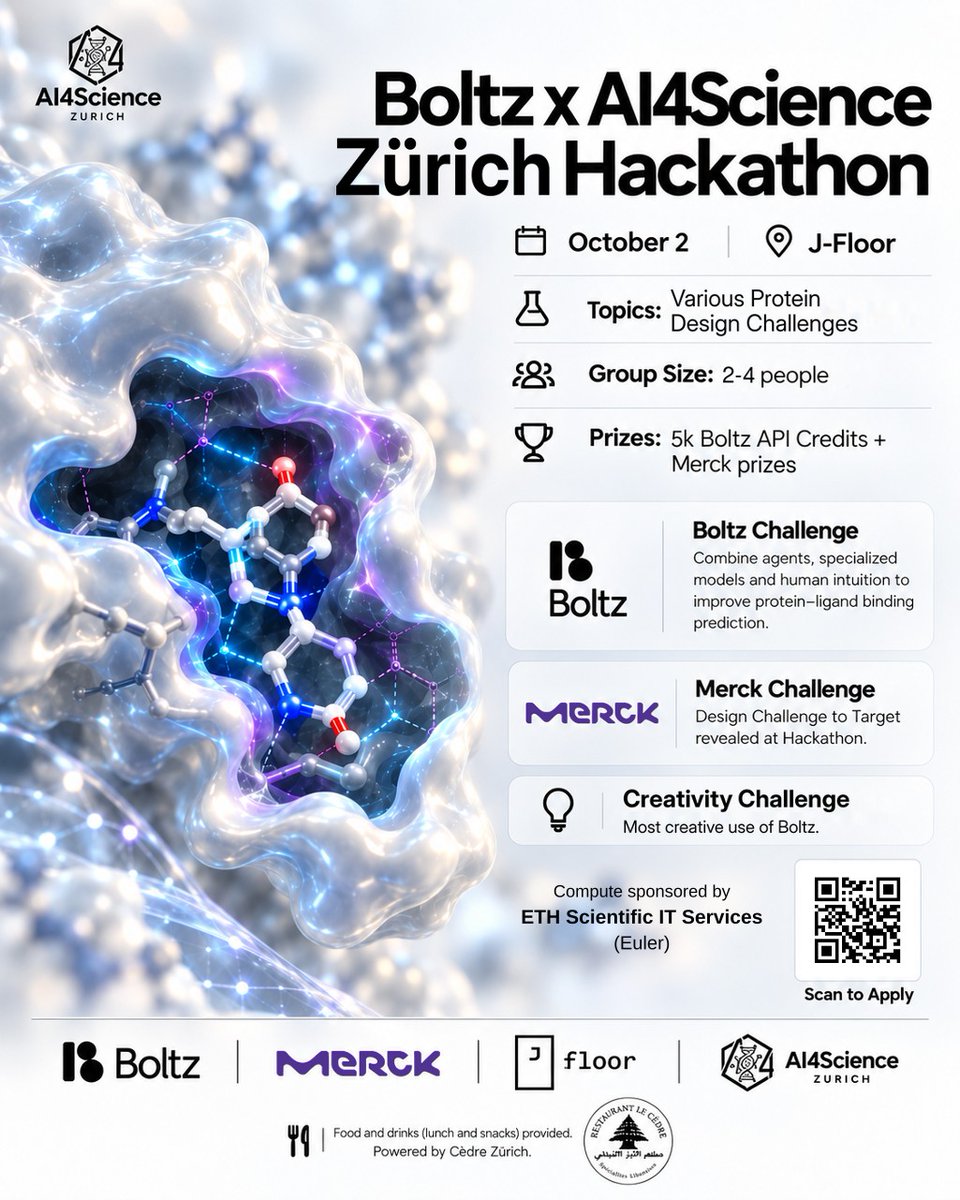
Looking forward to this hackathon on Friday in Zurich co-organized with AI4Science Zurich and @merckgroup! I'll be around helping and brainstorming with teams, I'm excited to hear a lot of cool ideas!
Sign up! https://t.co/6ogWObZSTu
🗓️ Join me on October 7 for one of the inaugural lectures of the Science of Intelligence Institute at @UCBerkeley !
Can we write scientific laws for intelligence? I believe that we can, that the math for it already exists, and that they apply across brains & machines.
https://t.co/NITBxtikkL
New paper from Japan! Our work “Authorship Attribution and Aesthetic Evaluation of AI Poetry: A Case Study with Haiku” is now on arXiv and accepted as a full paper at SCIS&ISIS 2026 🎉
Work done by Livia Oddi with me, @s_scardapane and Toru Sugimoto
https://t.co/CAo39IjQmK
“…. The learning phase - the one in which error, failed attempts, and prolonged incomprehension build intuition - is being delegated increasingly massively to the machine …”
Absolutely spot on! Professor @AlfioQuarteroni hits the mark!
https://t.co/QbzpC3fZyv
**Recirculation**
by @mc_mozer@ShoaibASiddiqui@savvyRL et al.
Very simple test-time intervention where the activation of a late layer is "leaked" into an early layer to steer it towards a more effective answer.
https://t.co/0ShiEXquXn
@s_scardapane Absolutely spot on,I couldn't have said it better! I see people discussing and writing about AI and machine learning, publishing code on GitHub, but when I ask if they've ever solved a Cauchy problem, they say, "No, I've never worked on that." 🤨 #navier_stokes
A curious property of diffusion models: when a sample is mostly noise, the model’s best guess is close to the mean.
So early on samples can be pulled toward the center of the dataset, even when no data exists there, before rebounding toward the data manifold.
🎉The results are in! We are thrilled to announce the winners of the @TAGinDS 2026 Topological Deep Learning Challenge, sponsored by @ARLQ_AI and @newtheoryai 🎉
This was our largest edition yet: 60+ submissions from 50+ participants across 15+ institutions!
🧵👇
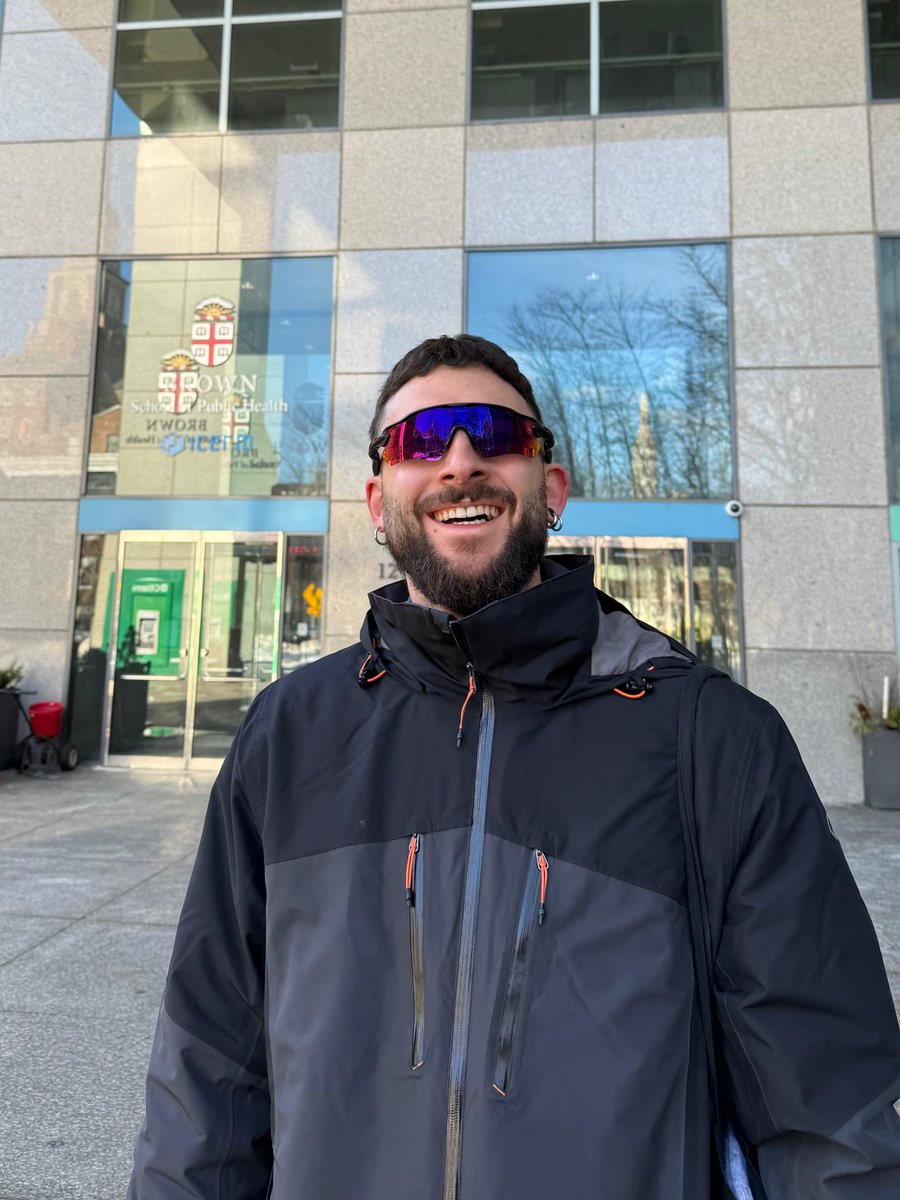
🔴 CAREER UPDATE / I AM HIRING 🔴
After several months of being extremely annoying to everyone who knows me, I have big news: this fall I'm joining Brown University as Assistant Professor of Biostatistics, Data Science, and Computer Science!