T-Mobile CTO in new post on @SpaceX acquiring nationwide low-band spectrum to help turn Starlink into a major U.S. mobile carrier:
"Some are calling it the "last critical piece" needed to compete with the national wireless carriers. I can tell you there's a big difference between owning spectrum and delivering a great mobile experience to millions of customers.
A few things worth keeping in perspective:
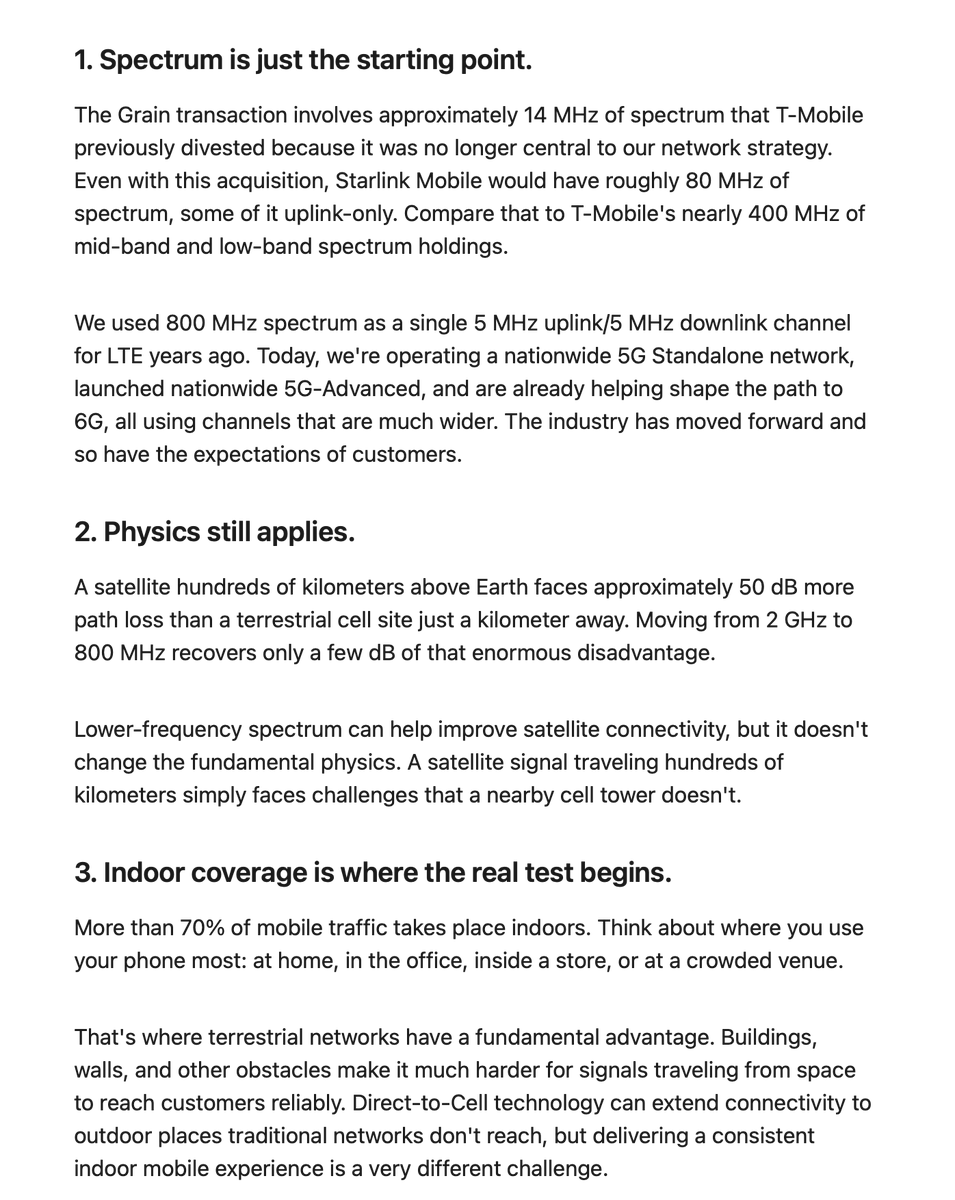
1) Spectrum is just the starting point.
The Grain transaction involves approximately 14 MHz of spectrum that T-Mobile previously divested because it was no longer central to our network strategy. Even with this acquisition, @Starlink Mobile would have roughly 80 MHz of spectrum, some of it uplink-only. Compare that to T-Mobile's nearly 400 MHz of mid-band and low-band spectrum holdings.
We used 800 MHz spectrum as a single 5 MHz uplink/5 MHz downlink channel for LTE years ago. Today, we're operating a nationwide 5G Standalone network, launched nationwide 5G-Advanced, and are already helping shape the path to 6G, all using channels that are much wider. The industry has moved forward and so have the expectations of customers.
2) Physics still applies.
A satellite hundreds of kilometers above Earth faces approximately 50 dB more path loss than a terrestrial cell site just a kilometer away. Moving from 2 GHz to 800 MHz recovers only a few dB of that enormous disadvantage.
Lower-frequency spectrum can help improve satellite connectivity, but it doesn't change the fundamental physics. A satellite signal traveling hundreds of kilometers simply faces challenges that a nearby cell tower doesn't.
3) Indoor coverage is where the real test begins.
More than 70% of mobile traffic takes place indoors. Think about where you use your phone most: at home, in the office, inside a store, or at a crowded venue.
That's where terrestrial networks have a fundamental advantage. Buildings, walls, and other obstacles make it much harder for signals traveling from space to reach customers reliably. Direct-to-Cell technology can extend connectivity to outdoor places traditional networks don't reach, but delivering a consistent indoor mobile experience is a very different challenge.
4) Capacity matters just as much as coverage.
One satellite beam can cover an area served by hundreds of terrestrial cell sectors. Those terrestrial sectors provide the network density needed to support millions of customers streaming video, making calls, working, gaming, and using data simultaneously.
Covering a geographic area is one thing. Delivering the speed, responsiveness, and capacity customers expect from a modern 5G-Advanced network is another.
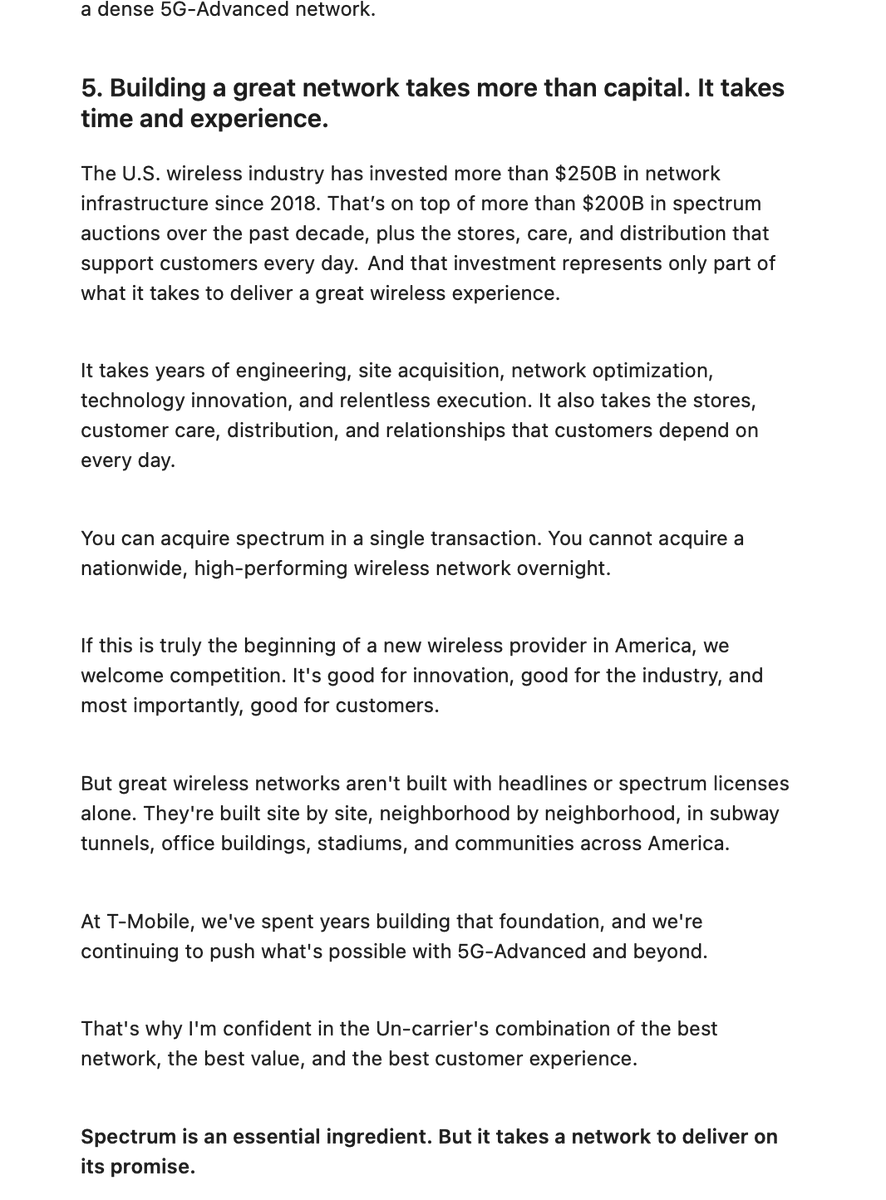
Direct-to-Cell has an important role to play in extending coverage. But it is a complement to terrestrial networks, not a replacement for the capacity of a dense 5G-Advanced network.
5) Building a great network takes more than capital. It takes time and experience.
The U.S. wireless industry has invested more than $250B in network infrastructure since 2018. That’s on top of more than $200B in spectrum auctions over the past decade, plus the stores, care, and distribution that support customers every day. And that investment represents only part of what it takes to deliver a great wireless experience.
You can acquire spectrum in a single transaction. You cannot acquire a nationwide, high-performing wireless network overnight.
If this is truly the beginning of a new wireless provider in America, we welcome competition. It's good for innovation, good for the industry, and most importantly, good for customers.
But great wireless networks aren't built with headlines or spectrum licenses alone. They're built site by site, neighborhood by neighborhood, in subway tunnels, office buildings, stadiums, and communities across America.
Spectrum is an essential ingredient. But it takes a network to deliver on its promise."