Cognitive grounding improves LLM simulation of collective human behavior. The study shows that guiding AI agents with descriptions of how people make decisions in a supply-chain game helps agents reproduce collective human behavior. https://t.co/cv5aqIiB0V
Food co-purchasing networks encode geographic disparities in cardiometabolic health. In 51 million Danish grocery receipts, how foods are combined in baskets, not only which foods are bought, tracks local cardiometabolic prescriptions. https://t.co/xby5dmpkg7
Epidemic control under incomplete observations through mechanistic state reconstruction and multi-agent learning. Inferring infections from incomplete reports before optimising testing and isolation cut infection cost by 88% in Shenzhen simulations. https://t.co/QnSIUMTj81
Percolation under Edge-Reversal: Creation and Destruction of Strong Connectivity in Directed Networks. Randomly reversing edge directions can create or destroy a directed network's giant strongly connected component; exact criteria say which. https://t.co/vFiInfQBwk
Theory-Driven Network Backbones for Bipartite Projections. Preprint: a backboning method that encodes known dynamics through an agent-based model recovers latent links better than structural and statistical filters on synthetic data.
https://t.co/mJ3uVh7Mh1
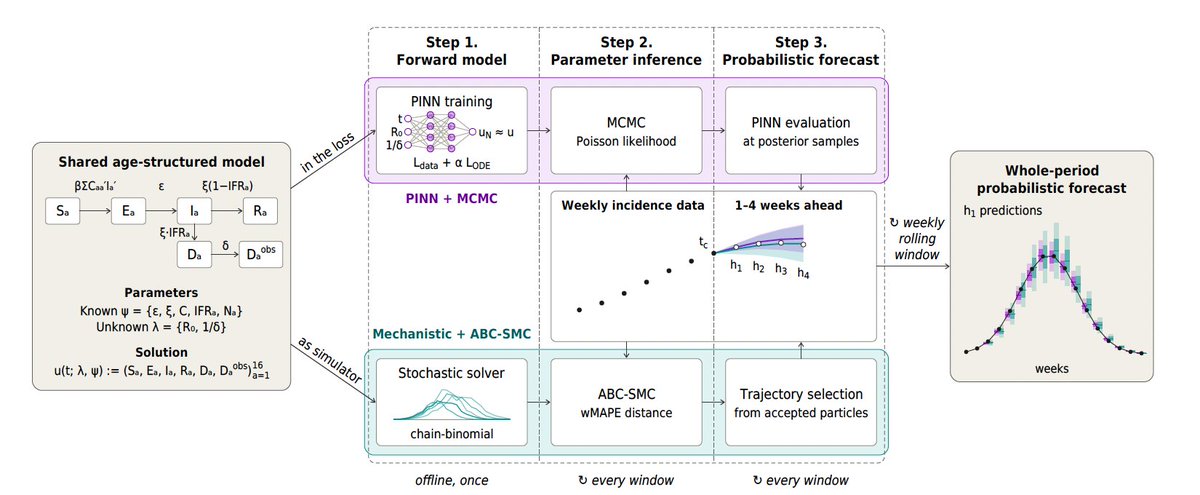
Latest out: A systematic comparison of physics-informed neural networks and mechanistic models for epidemic modeling and forecasting. Great collaboration with Martina Rama, Yuhan Li, @brulepri and @mtizzoni https://t.co/PxxNvKQKHK
This was certainly one of our wildest research projects -- and it's finally published in PNAS (@PNASNews)!
𝗖𝗮𝗻 𝗔𝗜 𝗴𝗲𝗻𝗲𝗿𝗮𝘁𝗲 𝗿𝗲𝘀𝗲𝗮𝗿𝗰𝗵 𝗶𝗱𝗲𝗮𝘀 𝘁𝗵𝗮𝘁 𝘀𝗰𝗶𝗲𝗻𝘁𝗶𝘀𝘁𝘀 𝗮𝗰𝘁𝘂𝗮𝗹𝗹𝘆 𝗳𝗶𝗻𝗱 𝗶𝗻𝘁𝗲𝗿𝗲𝘀𝘁𝗶𝗻𝗴?
https://t.co/zRKKhPvllB
Spearheaded by @GuXuemei , we developed 𝗦𝗰𝗶𝗠𝘂𝘀𝗲, combining LLMs with a knowledge graph of 58 million scientific papers to generate personalized research ideas and suggest unexpected collaborations.
The really unusual part was our evaluation:
We asked 𝟭𝟬𝟬 𝗿𝗲𝘀𝗲𝗮𝗿𝗰𝗵 𝗴𝗿𝗼𝘂𝗽 𝗹𝗲𝗮𝗱𝗲𝗿𝘀 from 50 Max Planck Institutes, in the fields from physics, chemistry, biology, and computer science to the humanities, to evaluate 𝟰,𝟱𝟬𝟬 𝗔𝗜-𝗴𝗲𝗻𝗲𝗿𝗮𝘁𝗲𝗱 𝗿𝗲𝘀𝗲𝗮𝗿𝗰𝗵 𝗶𝗱𝗲𝗮𝘀.
To the best of our knowledge, this is the (by far) largest interdisciplinary human evaluation of AI-generated research ideas involving experienced scientists.
𝗦𝗼𝗺𝗲 𝗳𝗶𝗻𝗱𝗶𝗻𝗴𝘀 𝘁𝗵𝗮𝘁 𝗜 𝗳𝗶𝗻𝗱 𝗽𝗮𝗿𝘁𝗶𝗰𝘂𝗹𝗮𝗿𝗹𝘆 𝗶𝗻𝘁𝗲𝗿𝗲𝘀𝘁𝗶𝗻𝗴:
• 𝗛𝗶𝗴𝗵 𝗶𝗺𝗽𝗮𝗰𝘁 seems to be anti-correlated with 𝗵𝗶𝗴𝗵 𝗶𝗻𝘁𝗲𝗿𝗲𝘀𝘁
• Neural Networks can predict the personalized interest of scientific ideas!
• Even LLMs can zero-shot predict scientific interest of ideas, without access to human evaluation data!
Behind the scenes: more than 1,000 emails, over 100 participating group leaders, and several human researchers generating ideas for our human baseline.
This was only possible because of the large interdisciplinary setting of the @maxplanckpress, and the open-mindedness of their PIs and research group leaders.
For me personally, the most exciting part of this study is that we finally begin to me 𝗲𝗺𝗽𝗶𝗿𝗶𝗰𝗮𝗹𝗹𝘆 𝘀𝘁𝘂𝗱𝘆 𝘀𝗰𝗶𝗲𝗻𝘁𝗶𝗳𝗶𝗰 𝗰𝗿𝗲𝗮𝘁𝗶𝘃𝗶𝘁𝘆 of AIs, and hopefully will improve the creativity of idea-generation in the future significantly.
#AIforScience #ScientificDiscovery
What if we designed materials the way nature builds its networks?
Our @Nature paper introduces Scale-Rich Materials with remarkable properties: tunable stiffness, impact absorption and wave control.
PDF at https://t.co/AHR1woNJCO
#NetworkScience#NetSci#NetworkMaterials
Global return-on-investment of COVID-19 vaccines in the first year of the vaccination programme: A model-based economic evaluation https://t.co/Vv9sNKeV9q