📚 Our Editor-in-Chief @ProfSchrepel shares his May reading suggestions: rugged landscapes & competition policy, populist antitrust’s error costs, the data-center water debate, EU AI-compute sovereignty, blockchain governance & more.
https://t.co/fFth0tchbQ
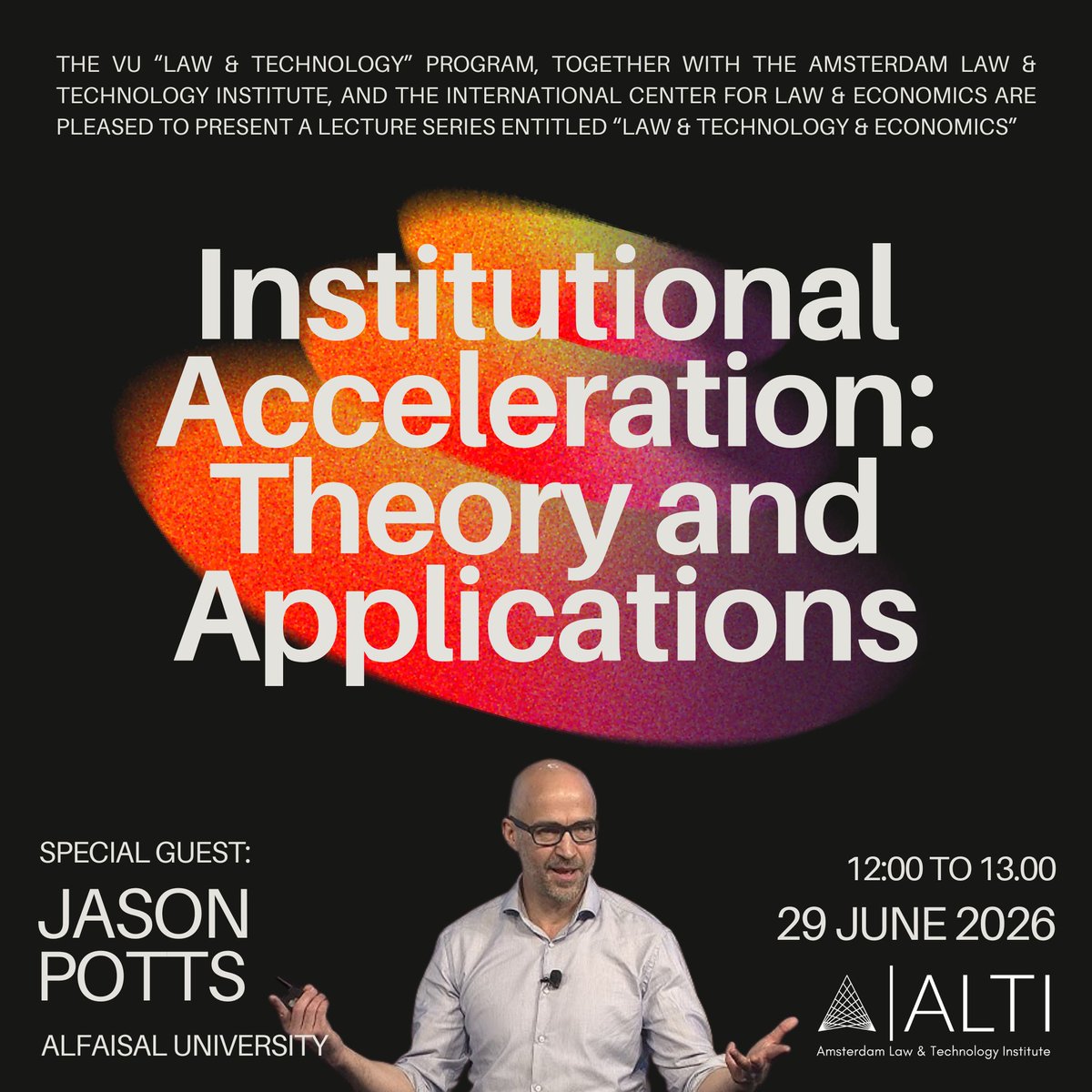
What if the most important innovations of the next decade aren’t in technology, but in institutions themselves?
@profjasonpotts thinks they are. Come and listen to his provocative talk on i/acc.
Live talk + Q&A with @profSchrepel 👇
https://t.co/cRiurUyovl
Firms innovate not along a smooth path but on “rugged technological landscapes”, balancing risky frontier breakthroughs against niche innovation. This has implications for competition policy, as argued by Professors Callander, Lambert, and Matouschek. https://t.co/EZEun4SbUg
Looking for a reliable way to track antitrust case law across jurisdictions?
The Network Law Review runs dedicated series covering the U.S., Europe, and Latin America. No equivalent resource brings this together in one place.
Subscribe ➝ https://t.co/OjOoUjo4Bw (it's free)
Catch up on Latin American antitrust news in the new Chronicles: digital markets regulation, Apple’s iOS settlement, and institutional reform in Argentina and Mexico, written by Carlos Ragazzo, @aboutmattiuzzo, Bruna Cataldo, and Clara Duarte Late https://t.co/dpAuDZzOz6
📚 April 2026 reading suggestions are out.
AI agents meet complexity economics. The waterbed effect collapses. The AI moat wobbles. Europe drifts into American dependence. Hayek’s papers go online. Barabási on networks.
By @ProfSchrepel 👇
https://t.co/pKDOm1dxX4.
Three months of US Antitrust news in the new Antitrust Antidote: refusal to deal, innovation harm in pipeline mergers, and antitrust standing, written by @kwongervin, Jeremy Kauffman, Jeremy Sandford, and Nathan Wilson https://t.co/Q4rXA4jA43
✨New series✨
We introduce "Pott's of Arabia" wherein @profjasonpotts examines institutional market reforms toward innovation and competition in Saudi Arabia. First piece: a shift toward a dynamic competition paradigm. https://t.co/CmNwZT7x2n
New issue of Competition Stories is out, open access, as always.
This one covers: parallel investigations in digital markets, tying doctrine under pressure, Android Auto ruling, the €2.95B Google AdTech fine...
EU competition law moves fast. We track it.
https://t.co/kBFeCthZtO
Catch up on EU competition law with the new Stories by Mario Siragusa & Alice Setari from @ClearyGottlieb, covering parallel investigations by the Commission and NCAs, tensions in abuse doctrines and digital market realities and more! https://t.co/btk6YfcfFF
Here are @ProfSchrepel monthly reading suggestions. Topics include AI's reshaping of research and publishing, the economics of AI talent in universities, using AI to audit EU regulation, economic growth and the rise of large firms, and more... https://t.co/2JOUihxj54
Where else can you read Hovenkamp on monopoly power, Acemoglu on taxing digital ads, case-law analysis, and curated monthly readings designed to keep you up to date without the noise?
Subscribe ➝ https://t.co/ZPPPPbt7h1 (it's free!)
Is antitrust law about fairness? Herbert Hovenkamp’s answer is clear: no, and it never was.
In this new piece, @Sherman1890 dismantles the growing assumption in competition debates that antitrust should correct inequality or redistribute economic power
👉 https://t.co/SaGLwvIgdn.
New on @NetworkLawRev:
Generative AI is increasing academic output.
But when attention is scarce, output does not equal influence. The Matthew effect intensifies. Stratification follows https://t.co/6LwHLyqwgP
Here are Thibault Schrepel’s monthly reading suggestions.
https://t.co/JEtoUS3FHi
Topics include the constitutional limits of the Digital Markets Act, antitrust’s fixation on structural remedies, AI’s productivity impact on firms, generative AI in literature reviews and more!
Looking for a Christmas read and interested in the recent FTC v. Meta ruling and more? The latest Antitrust Antidote by @kwongervin, Jeremy Sandford, and Nathan Wilson highlights unmissable antitrust news from Oct-Dec. Happy reading, happy holidays!✨ https://t.co/ApvQRuHijZ
Can a market really have two monopolists?
@Sherman1890 argues no, and explains why courts’ “direct” measures of market power clash with the historic and economic meaning of monopoly. Market share, dominance, and why >50% still matters. Read it here https://t.co/q5xrbFQZSk