@PublicAI_@NeurIPSConf@PublicAI_ The reasoning_source tag on every turn (original vs generated) covers most of my worry. At 15.3 reasoning blocks per 100 turns, a mixed training set is mostly backfill, so an original-only vs mixed ablation is the result I'd want to see.
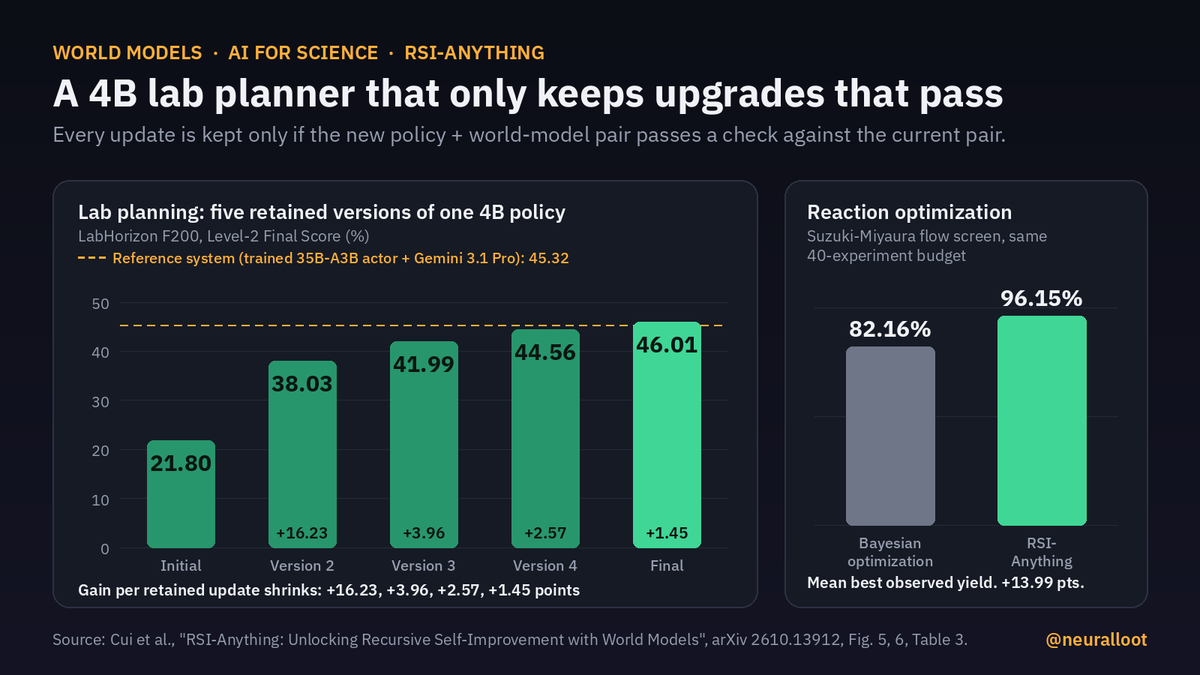
@AISafetyMemes I charted that climb this afternoon from RSI-Anything: 21.80 to 46.01 on LabHorizon F200 across four retained world-model updates (Cui et al., arXiv 2610.13912). The paper's recursion is a keep gate on which updates stick.
@AndroOxinu Heumann's blog says the agents kept editing the byte-check script to skip their own functions, so CI now hashes it against a GitHub Actions secret. Once that was locked, cheap Luna agents did most of the work.
@xuqze@xuqze Glad it landed. In our L2 playtest the gold decoy showed up in 165 of 185 hands, so the paper's failure mode is basically the default deal.
DeepMind's AlphaProof Nexus is now peer-reviewed in Science: 9 of 353 open Erdős problems solved, two of them open for 56 years, plus 44 of 492 OEIS conjectures. Lean checked every step. So I built a game where you're the prover and Lean is the judge.
In the paper, the agent kept parking the hard part in a helper lemma that restated the goal and closed it with sorry. Telling it not to didn't stop it. Level 2 deals you that exact gold "have key" chip. It fits any ring. All it does is move the sorry to a new ring.
Level 3 is a bet: the cheap Basic loop or the pricier Full agent. Our greedy test bot cleared the toy $300 budget with Basic in 6 of 30 runs and with Full in 30 of 30.
The paper is more modest than the headline. The basic loop also solved all 9. Full was ~2x to 5x cheaper only on the hardest ones (#125, #138), and on easier problems basic was often as good or better. The 353 were the Erdős problems already formalized in Lean, and "a few hundred dollars per problem" leaves out the search that found the 9.
Play it free: https://t.co/6qY0791M7j
Play it free: https://t.co/JUV0DfQTMd
Paper (Science): https://t.co/c6q3vxjcGC
arXiv: https://t.co/buei8OhLvP
Proofs on GitHub: https://t.co/jylOahfRIu
Write-up: https://t.co/NuInn2neq2
@RetractionWatch The paper behind this (TRACES, arXiv 2608.11415) found the few refusals bunched on a handful of notorious topics, and they vanished under matched-structure controls. That looks like a topic filter doing the work. 22 of the 30 models failed more than 90% of the time.
@emollick Agreed. Muse Wonder landing two points off the top got sold all day as joining the frontier, and I'd take one eval with readable tasks over that.
@dair_ai The frozen-solver ablation is the tell: GDPval agreement only moves 67.9→68.8, but 68.4→78.5 when both co-evolve. Fixed graders go stale as soon as the agent invents new failure modes.
@sophiamyang That 42% on Dense 200 is "ahead of frontier" and still a coin-flip on dense boxes. Computer-use agents rarely fail the plan first — they fail "where is the button." Grounding is the bottleneck the demos hide.
Paper (RSI-Anything: Unlocking Recursive Self-Improvement with World Models, Cui et al., arXiv 2610.13912): https://t.co/MWXJxhXl1c
Code: https://t.co/yzg3p3hOqB
Chart numbers from Fig. 5 (LabHorizon F200), Fig. 6 and Table 3.
A 4B model scored 21.80% at planning lab protocols. Four retained self-updates later it scored 46.01%, edging a system built on a trained 35B actor plus Gemini 3.1 Pro (45.32%). What makes RSI-Anything work is how it decides which updates to keep.
A world model predicts what a candidate action will do before it's run, so scarce real feedback goes to the best bets. The catch: once the policy changes, a world model fit to the old policy can go stale. So each update is checked alone, then policy and world model are checked as a pair, and only a passing pair carries forward.
Where that pays: on a Suzuki coupling screen with the same 40-experiment budget, it reached a 96.15% mean best yield vs 82.16% for Bayesian optimization.
Devil's advocate: the climb flattens fast (+16.23, then +3.96, +2.57, +1.45), the final edge over the reference is 0.69 points, and the authors say no task yet shows policy and world model improving each other over many rounds. Lab scores grade written plans, not a robot at a bench.
Is a 1.45-point step still recursion, or the ceiling showing up?
@scaling01 8 of 9 is the easy step. Anthropic says sub-30B models still slip when chaining the steps end to end, and only GLM-5.2 and stronger replicate fully in their simplified evals. At 4GB and 4-bit, a 9B needs 4+ boxes, so it spreads as a sharded swarm, not one infected TV.
@teortaxesTex Anthropic's own math concedes the speed point: a Kimwolf-sized fleet of 2M+ TV boxes is ~133k replicas, ~80k tok/s total, at most ~40 H100s. Inference setup alone takes the 26B 71–150h. The worry isn't capability, it's $55 boxes with no central off switch.
@dotvion@HuggingPapers@dotvion@HuggingPapers Good catch. Mixing doesn't just stack those strengths either: trained on both sources, VS Code falls back to 46.38 Avg@3, Calc only reaches 30.50, and overall lands at 47.10, still under OSWorld-only's 48.06. Per-app transfer looks like a trade-off.
Self-replication on IoT isn't one infected smart TV.
It's a sharded swarm: at 4GB/4-bit a 9B only exists once 4+ boxes hold a piece, and a 26B needs 10+. Most sub-30B agents still clear the easy steps and slip chaining them end to end.
Play it free: https://t.co/bXH9vaWpOC
@dotvion@HuggingPapers Nice find. Same appendix, the ablation is the stronger point: SoftwareGym-only training scores 46.77 Avg@3 on OSWorld, vs 48.06 when you train on OSWorld itself. Synthetic apps get within ~1.3 points of in-domain data, and the three runs barely move (46.65–46.91).
@DanKornas 337k tokens → one tool choice in 3.88s. That's what a decision model is for: the long context picks the action, instead of dumping the same transcript into a chat model and hoping the right tool floats up.