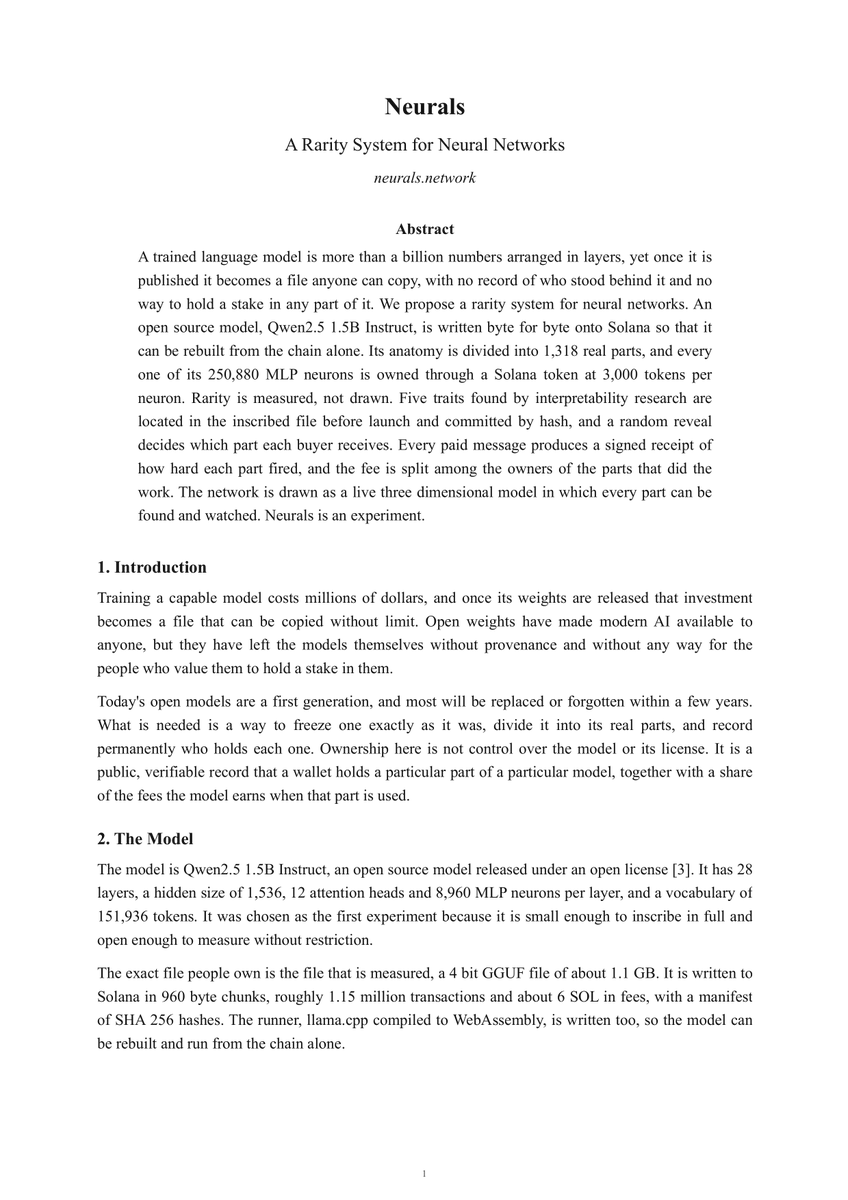
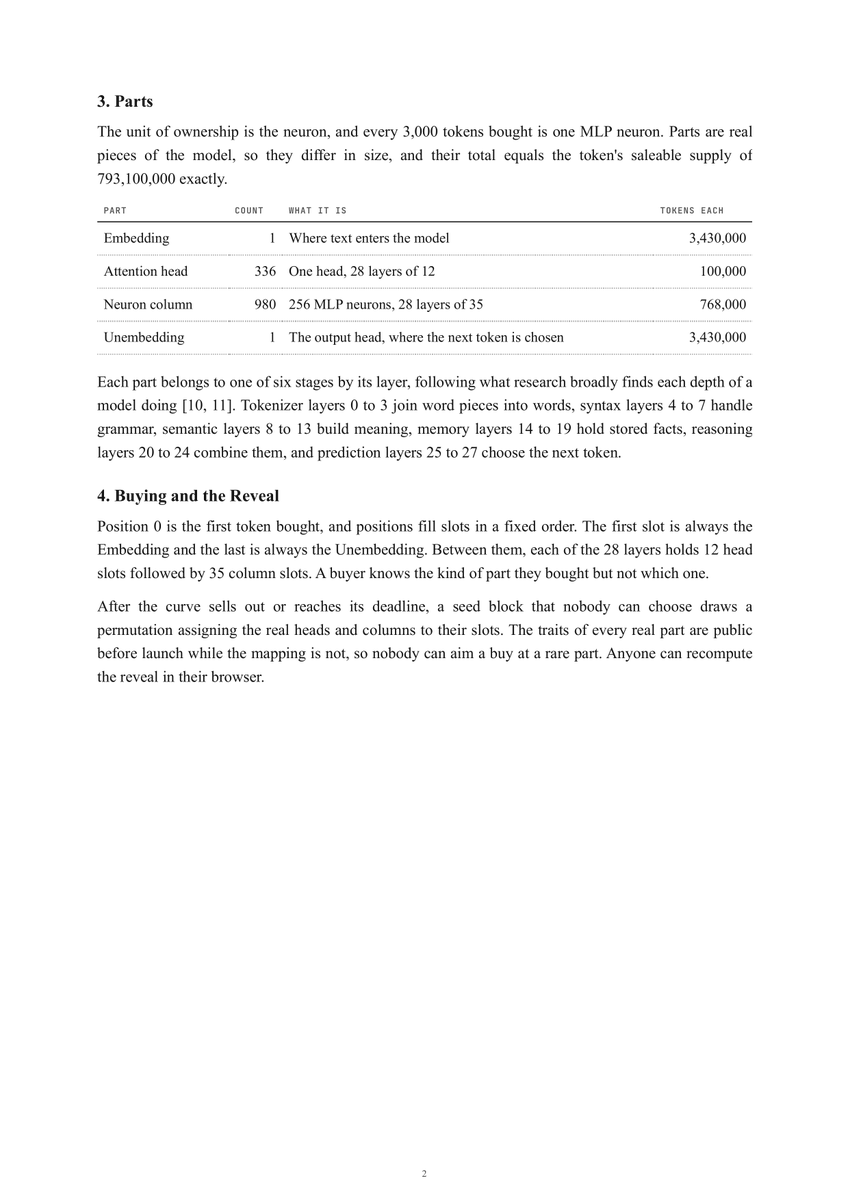
the token is the open source model.
until now a model was a file. you could copy it, but you could never point to a part of it and say it was yours. neurals gives every neuron an owner and every thought a receipt, so value flows to the exact parts of the network that produced it.
ca: 2RBEK4TrbkD4tBBsvj3hh5uKd6gSxKTMWDu5GAwvpump
nvidia says open weights let you own the value you build. but nobody can point to a part of an open model and say it is theirs.
our paper takes that literally. an open source model is divided into its real parts, and every neuron has an owner on chain.
read the full version: https://t.co/PrCvsI6ACs
checkpoint forensics only works if the weights you test are the exact ones that were released. that is why we uploaded qwen 2.5 to solana and paired it with its own token.
the original is stored on chain and hashed, so anyone can run this kind of analysis and know nothing has been altered.
models should come with their own proofs.
I have a major result to share.
I’ve found conclusive forensic evidence that the top 4 Chinese AI labs—DeepSeek, Moonshot, MiniMax and Ant Group—have built their newest models on NVIDIA’s most advanced Blackwell chips, which are barred from export to China.
This sounds insane, but I discovered that almost every AI model carries a hidden signature of the GPU that trained it. When a model is first set up, the starting values of its weights are laid out in a pattern that depends on the exact GPU. Each combination of GPU and seed number produces a unique pattern—a sort of fingerprint of the hardware used to create the model. Traces of that pattern survive training into the published model.
Again, this evidence isn’t based on any insider information or leaking. It’s based on a forensic analysis of the model weights released by the companies themselves.
I searched more than six trillion combinations of chip layout and seed number and matched them to open-weights models. In doing so, I found conclusive evidence that six Chinese AI models—including DeepSeek-V4-Pro, Kimi K3, and MiniMax-M3—were initialized on NVIDIA Blackwell systems. Four of the models match Grace Blackwell, the GB200 and GB300 parts in NVIDIA’s flagship liquid-cooled rack-scale systems.
I then verified these results on real hardware. Running unmodified PyTorch with the seeds I’d recovered, a Blackwell B300 reproduced DeepSeek-V4-Flash’s untouched starting weights bit for bit, and a rented GB200 reproduced Kimi K3’s to a correlation of 0.999995. A Hopper H100 reproduced none of DeepSeek-V4-Flash’s, and changing the seed by one broke the match. (DeepSeek’s seed is 953049583 by the way.) The method also was verified to match 24 known open-weights models to the hardware that developers said they used.
It is exceedingly unlikely that these results are a coincidence. Across six trillion combinations, the best accidental match should reach only about 8 sigma (i.e., eight standard deviations above what random chance would produce). The real matches range from 49 to 1,385 sigma, and even the weakest single test hits 20.
These were data-center-scale training runs. With some analysis of release schedules and model details, I estimate that the largest, Kimi K3 and DeepSeek-V4-Pro, used 2,000 to 3,000 Blackwell GPUs each. Clusters of this size cost on the order of $150 to $200 million each to buy, and across these labs alone would add up to more than half a billion dollars of export-controlled GPUs, not counting experimental compute or otherwise. It’s quite likely that we see multi-billion dollar expenditure on export-controlled GPUs.
I am highly confident in this result, and it has been independently verified by senior researchers at OpenAI and Anthropic. You can read the full report at https://t.co/YOtzND0Jqk.
There is much more I’ve identified about these models through other forms of checkpoint forensics like this, and will have more to share soon.
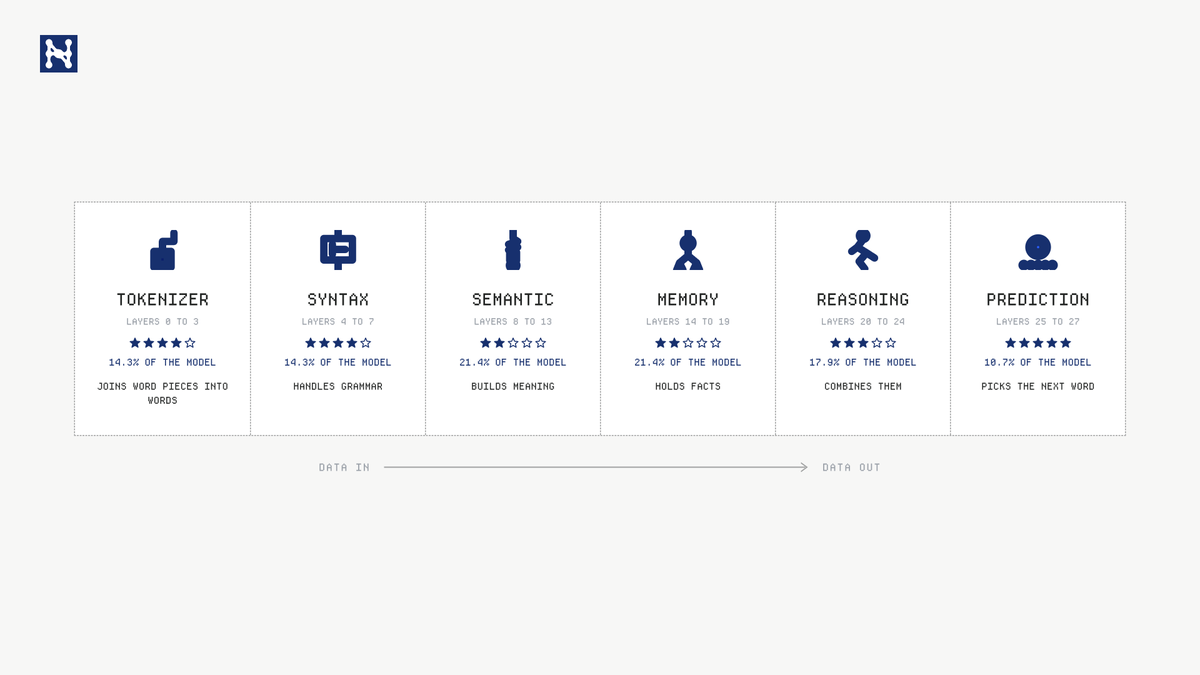
rarity cheatsheet below.
we propose a rarity system for every open source model. measure which parts matter most, lock the results on chain, and let the rarest earn the most when they fire.
qwen 2.5 is our first experiment, and the token is how it runs.
@Lordvibezzz appreciate the feedback. start with the virtual tour on the site, it walks through the whole network in under a minute. more tutorials are coming.
@Pylu69 it splits an open source model into its real parts and lets you own them by holding the token.
the same idea can extend to bigger open models like deepseek, and to the gpus that run them. it's the direction nvidia is already pushing, open weights mean more value for everyone.
@Pylu69 it splits an open source model into its real parts and lets you own them by holding the token.
the same idea can extend to bigger open models like deepseek, and to the gpus that run them. it's the direction nvidia is already pushing, open weights mean more value for everyone.
in the marketplace, buying, selling and listing checkpoints all work.
the live 3d simulation is taking a little longer. the network will only show your neurons once the reveal places them in the model.
we'll continue to provide updates.
this is how you buy part of an open source model.
browse the market, verify the listing on chain, connect your wallet and buy. the checkpoint is yours, and you can find your neuron inside the network.
the neurals token is directly paired to the model.
nvidia says open weights let you own the value you build. but nobody can point to a part of an open model and say it is theirs.
our paper takes that literally. an open source model is divided into its real parts, and every neuron has an owner on chain.
read the full version: https://t.co/PrCvsI6ACs
For my first post, I’m sharing a letter @NVIDIA signed on why open models matter.
AI will transform every industry, power every company, and be built by every country.
Open models strengthen safety and cybersecurity, accelerate innovation and diffusion, and enable sovereignty.
The world needs both frontier closed models and frontier open models.
https://t.co/AUKzoQ5Ikb
open weights have made modern ai available to anyone, but they have left the models themselves without provenance and without any way for the people who value them to hold a stake in them.