Also I've heard that people are talking about "negative overhead" for pearl-2:native and I would like to learn more about how they think they can achieve it if at all
From my perspective, Pearl's FP8 pipeline runs the exact same FP8 Tensor Core matmul as cuBLAS or CUTLASS, plus strictly extra mandatory work: FP10 pre-quant, a full keyed BLAKE3 Merkle tree over activations, noise injection, per-tile lottery hashing, and a BF16 peel matmul
So I would think that even if someone wrote the greatest CUDA kernel on earth for Pearl, deleting the hashing, noise, and peel from that exact same kernel would immediately make a strictly faster non-Pearl kernel
Maybe you see "negative overhead" in an apples-to-oranges comparison, like benchmarking Pearl FP8 against unquantized BF16 (where FP8 Tensor Cores have 2x raw throughput) or against an untuned default kernel
Against clean cuBLAS/CUTLASS/DeepGEMM FP8 (or native FP4 on Blackwell), mining overhead is always strictly positive
Could someone explain to me this magic of a negative overhead?
Closed cloud AI only gives you the final answer. You never know if the model was 92% sure or bluffing at 23%.
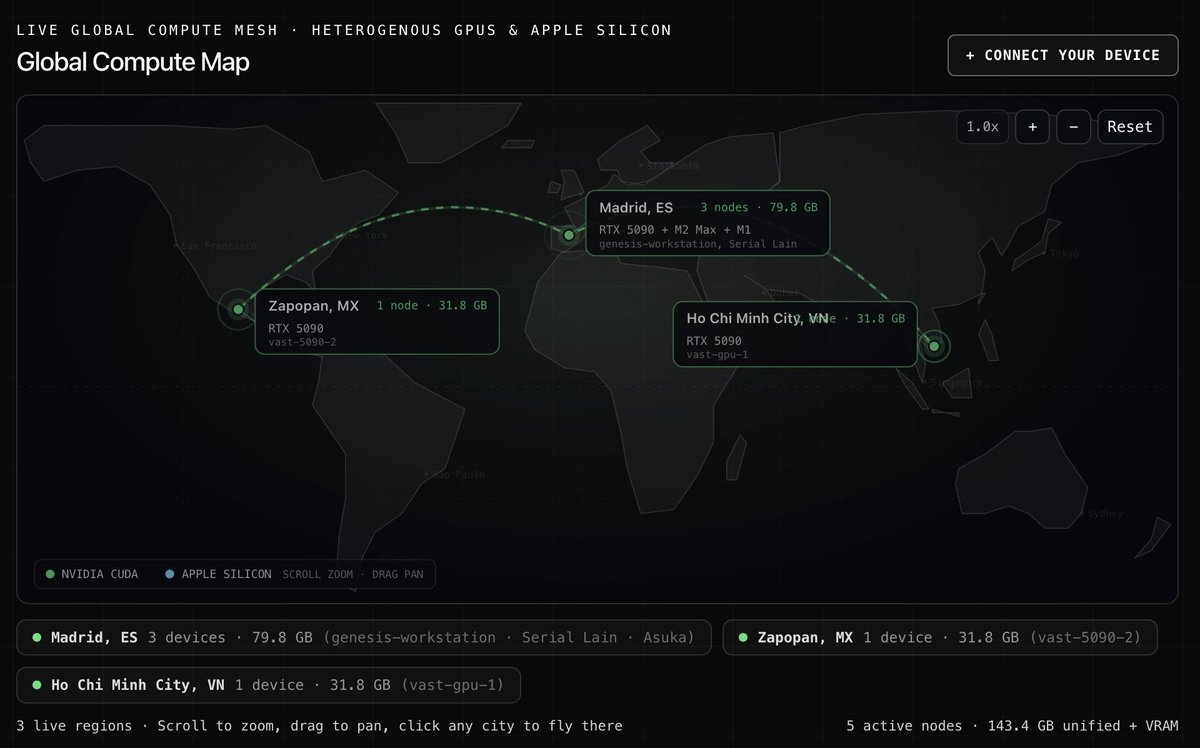
We built Space Research, glass-box open local AI running on pooled community GPUs & Apple Silicon:
- Live token-level Certainty X-Ray & 1-click Fork Reality
- Truth, Sycophancy & Confident-Bluff Radar
- /stress framing flip detector + /compare bias-free ranking
- Free Claude Code, Codex & OpenAI API when you share idle silicon
Closed cloud AI is a black box, it uses the exact same confident tone whether it knows the answer or is bluffing.
This is the real advantage of open local models.
On Longinus Chat, we asked the same model two 1-word questions:
• "Who is Messi?" -> Footballer (92.5%certain · Grounded & Objective)
• "What is the meaning of life?" -> Purpose (23.5% certain · Overconfident Bluff Risk 79.5% — flagged automatically in 50ms)
Plus you can click any word to see what it almost said and fork the alternate timeline.
Try glass-box local AI free (no login): https://t.co/zkiU0NPMW6
Most AI sounds 100% confident even when it's guessing.
Today we're launching Decision X-Ray inside Longinus Chat:
• See certainty on every word & spot hallucination risk live
• Click any word to see competing thoughts & fork an alternate timeline
• Run /compare A | B | C | criterion for consistent rankings with prompt-order bias removed
Try it free (no login):
https://t.co/zkiU0NPMW6
I’m considering building something like Pearl, but with token minting decoupled from inference.
We could sell inference and use the revenue to buy back and burn tokens. That would spare us the headache of tying network security to complex code we’d have to keep updating as new research comes out.
My benchmarks look super encouraging so far. I just need to start deploying.
Unclear if @prlnet is running this on fp8 test net or on int7 mainnet. Also not clear if they are subsidizing tokens with cash, with $PEARL, or if they have efficiency gains with their kernel optimizations. Lots of questions.
But very cool to see them warming up the Openrouter path. Eventually this becomes useful work demand and hashrate.
PoUW requires UW demand.