And that’s how almost all authentication works today. It proves a device was there and assumes the person was.
Should a machine ever be able to approve a transfer that size on its own?
Both halves of this are the same problem. A $2,000 laptop held the authority to move billions, and a couple of companies held the authority to freeze them. Control sat with devices and intermediaries, never with a person who willed it. Every outflow should connect to a fresh human approval, the customer withdrawing or several accountable people at the custodian, that no compromised device can reproduce. Non-reproducibility is the missing piece.
@MarioNawfal Freezing is damage control. The real failure came earlier: a single laptop held enough authority to move billions. Withdrawals at that scale should need a fresh human approval that a compromised machine can’t reproduce.
Software is a most malleable substance, a fungible substrate for making imagination manifest in the physical world.
While human innovation knows no bounds, there are limits to what we can and cannot do in computing.
First, there are the laws of physics. We cannot transmit information faster than the speed of light; thermodynamics constrains the design of integrated circuits; computational speed and storage density have energy considerations.
Next, algorithms. While we might have a theoretical framework for some process, turning that into an effective algorithm requires discovery; Fast Fourier Transform, the Viterbi algorithm, and transformers are all such examples.
Architecture is the next barrier. Assembling a system at scale is far more than the operation of its parts.
Organizations are where the human elements of computing begin to dominate. A simple person working alone can do remarkable things, but to build an enduring system of global reach demands a team.
Economics: many things are possible, but not all things are viable, because they cost money, and in the end, those with the money will require a return on their investment, else they will take their money elsewhere.
Finally there are the legal, ethical, and moral elements. Not everything that can be done, should be done.
It is these latter topics that are clear and present problems for @OpenAI, @AnthropicAI, and @grok.
How will this unfold?
Time will tell.
@CodeWisdom Every leaked password piles up. One leaked in 2015 is still in the pile today. Time for a password that doesn’t exist until the moment you use it.
BREAKING: This may be the worst 48 hours in cybersecurity history.
Some are calling it “Black October.” Almost every hour brings a new incident that, in a normal year, would rank among the year’s biggest.
THE LAST 48 HOURS:
Year-defining incidents:
PHP2Shell: A flaw in the software behind ~70% of websites. Governments took sites offline.
eMudhra: Master keys that verify websites are real were cracked. One was reportedly the number 4.
California: Data on every public school student since 2023 stolen, including disability status.
Railway: Hackers stole customers’ secret keys from a hosting platform used by millions of developers.
Zeabur: 321,810 accounts breached. The company is shutting down.
LiteLLM: An AI tool downloaded 3.4 million times a day was laced with a password stealer.
GitLab: A maximum-severity flaw in every version since 2014.
Cairn: Criminals used an AI hacking tool to break into 100+ companies.
Ahold Delhaize: Hackers knocked the owner of Food Lion and Stop & Shop offline.
Onamae: Malware planted on up to 26,739 customer servers in Japan.
Two properties matter in the age of agentic banking: nonrepudiability and — far more critically — non-reproducibility.
The first is largely solved. The second is almost entirely missing.
Banks can’t distinguish legitimate user activity from autonomous agents because credentials are reproducible. A stolen token, a shared session, a copied key — all work identically to the real human. Until the auth signal itself can only be generated by the person, in that moment, you haven’t solved the problem.
One dot is an assistant. Many dots are a team. Here's what it looks like when you can see all your agents at once.
Bring your own AI — Claude, GPT, Gemini, and now Jev (by @typesafeai ) powering the Filter agents. Or run it free in your browser.
@DarioAmodei The x-risk debate stays too abstract. If keeping humans in control is the actual goal, it has to show up in the concrete layers too.
Why are our safety mechanisms becoming more machine-dependent, not less? Human cognition should be the anchor for identity.
We just shipped this handy button to our Implementation Guide.
Use your favorite AI to get customized steps to implement newauth SSO.
We provide the context. You pick the AI.
https://t.co/OPukpeX1RW
#SSO#SAML#DevTools#OIDC
A memória visual funciona por mecanismos diferentes da memória para símbolos, como senhas ou PINs. O estudo de referência aqui é o artigo de 1973 de Lionel Standing, "Learning 10,000 pictures" (Quarterly Journal of Experimental Psychology) — os participantes viram 10.000 fotografias, cada uma exibida uma única vez por 5 segundos, e depois reconheceram 83% corretamente em testes de escolha forçada. Um estudo anterior relacionado (Standing, Conezio & Haber, 1970) mostrou que o tempo de exposição podia ser reduzido para apenas 1 segundo por imagem sem prejudicar seriamente o reconhecimento, e a retenção se mantinha mesmo após um intervalo de 3 dias.
O motivo real pelo qual isso se aplica a nós: pesquisadores de memória traçam uma linha clara entre reconhecimento ("é esse?" — com pista, mais fácil, mais durável) e recordação ("produza do zero, na lembrança fria" — como uma senha). Nosso sistema é baseado em reconhecimento do início ao fim — a imagem é mostrada como a pista, e o ponto que você clica é uma pista adicional aninhada dentro dela, então você nunca está gerando algo às cegas como uma senha exige. Esse é exatamente o tipo de tarefa que os números de Standing descrevem. Também não dependemos de um único olhar — nosso processo de cadastro exige que você confirme o ponto várias vezes, reforçando isso ainda mais.
Entre nossos usuários, vemos falhas ocasionais, mas um padrão típico é um ou dois erros seguidos de acerto na mesma sessão. Isso é consistente com o que o mecanismo baseado em reconhecimento prevê: uma memória vaga geralmente se corrige assim que você está diante da pista real novamente, ao contrário de uma senha esquecida, que simplesmente não volta.
Sobre sua pergunta real — a recuperação quando isso falha — você está certo em insistir nisso, é o problema genuinamente difícil de qualquer alternativa à senha, incluindo passkeys. A recuperação por e-mail está disponível hoje para quem quiser usá-la. Posso detalhar melhor como isso funciona, se for útil.
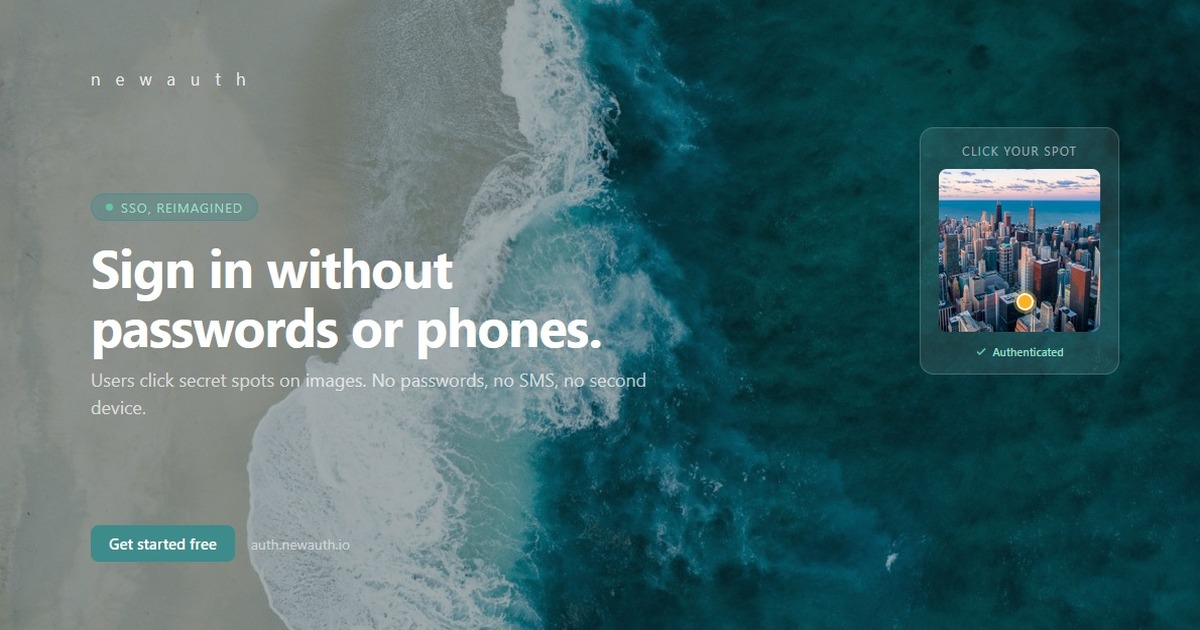
SSO your users may actually like. 🗝️
No passwords to phish.
No SMS codes to intercept.
No second device to lose.
Your users sign in by clicking their secret spots on images they know — and it gets faster every time.
Standard OIDC. Works with your identity stack.
@NightSkyToday If light had mass, we would all be blind.
regardless, light is NOT obeying gravity. Light is obeying the space (which is obeying gravity).