Happy New Month, family. 🍂
This October, may closed doors open, may your effort match your reward and may good news find you and your household. You will not labour in vain.
Three months left. Enough time to turn the year around.
October will be kind to us. Amen 🙏
The “good thing” about election riggers is that they are not generally smart people, either they are stark illiterates or people that barely made it through school. If and when Nigerians are ready this nonsense of writing election results will stop!
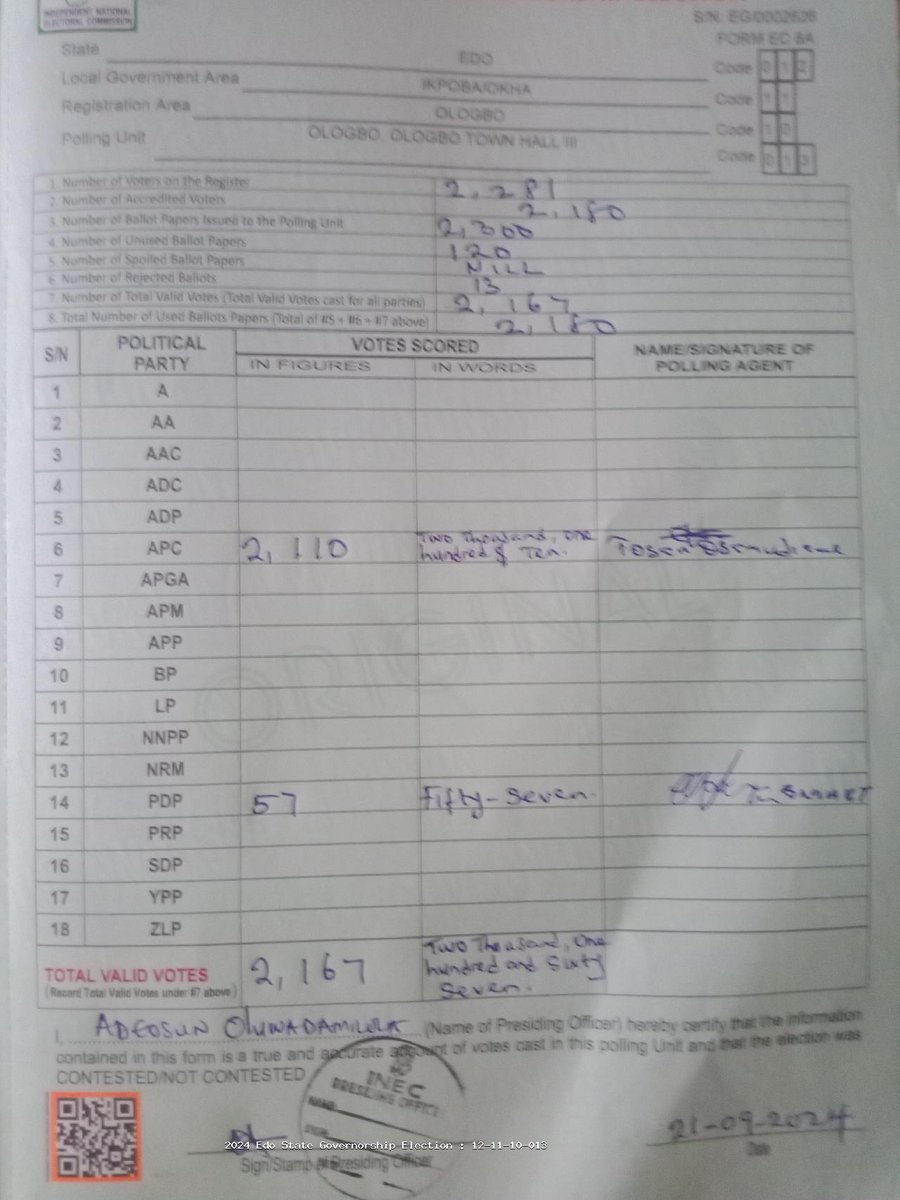
So I came across this polling unit result while looking through the 2024 Edo governorship election, and the numbers stopped me:
2,180 accredited voters. 2,167 valid votes. Uploaded to IReV at 5:47:07 p.m. on election day.
Here’s a short course in arithmetic, free of charge to whoever filled out this result sheet.
Lesson 1: The clock is an honest witness.
You declared 2,180 accredited voters and 2,167 valid votes at a single polling unit.
Yiaga Africa’s observation of BVAS accreditation found that it typically took 1–2 minutes per voter. Let’s use the midpoint: 1.5 minutes.
2,180 voters × 1.5 minutes = 3,270 minutes.
That is 54 hours and 30 minutes of accreditation with one BVAS machine.
Now, I’ll be generous. Let’s pretend this polling unit somehow had two BVAS machines running continuously.
That brings it down to 27 hours and 15 minutes.
Lesson 2: Parallel processing will not save you.
Someone will say: “But accreditation and voting happened simultaneously!”
Correct. But irrelevant. :)
Let’s assume the polling unit had four voting booths and could comfortably process four voters per minute.
The problem is that two BVAS machines, at 1.5 minutes per accreditation, can feed the voting process at only about 1.33 voters per minute.
The bottleneck is the BVAS, not the voting booths.
Classic tandem queue. Operations Research 101
Then comes sorting and counting.
At just 10 seconds per ballot, counting 2,167 ballots takes approximately 6 hours and 1 minute.
So:
Accreditation: 27h 15m. Counting: 6h 1m. Total: 33h 16m
Even assuming the polling unit opened promptly at 8:30 a.m. on Saturday, you should not have finished until roughly 5:46 p.m. on Sunday.
No breaks and no sleep.
Lesson 3: There’s something called timestamp
The IReV timestamp says this result was uploaded at 5:47:07 p.m on election day.
That is just 9 hours and 17 minutes after 8:30 a.m.
So, under these assumptions, you performed more than 33 hours of sequential work in 9 hours and 17 minutes.
To make that timeline work, you would need roughly 17 BVAS machines running continuously and perfectly, followed by six straight hours of ballot counting.
And btw, I checked the statewide data.
The median was 111 accredited voters per polling unit.
This polling unit claimed 2,180.
That is almost 20 times the statewide median.
Closing note to Adeosun Oluwadamilola :)
Next time, pick a number with the fear of God, and one that a clock can defend.
#Mundx
Psychology says when people face constant stress and uncertainty, their bodies learn to live in survival mode. They stay alert, tense and exhausted. Always waiting for the next thing to go wrong. Even in moments of calm, their minds don't relax. It's not because they're overreacting, it's because their nervous system has forgotten what safety feels like.
@davido the people have done their part by voting it is time to help protect those votes they came out massively to cast. Their modus operandi is very predictable. They are desperately desperate!!!
🚨 EXCL: Vinicius Junior rejects Real Madrid’s new contract proposal. No breakthrough in talks despite fresh negotiations, with player & representatives not accepting current terms. #AFC now expected to intensify pursuits to push to finalise deal. @TheAthleticsFC