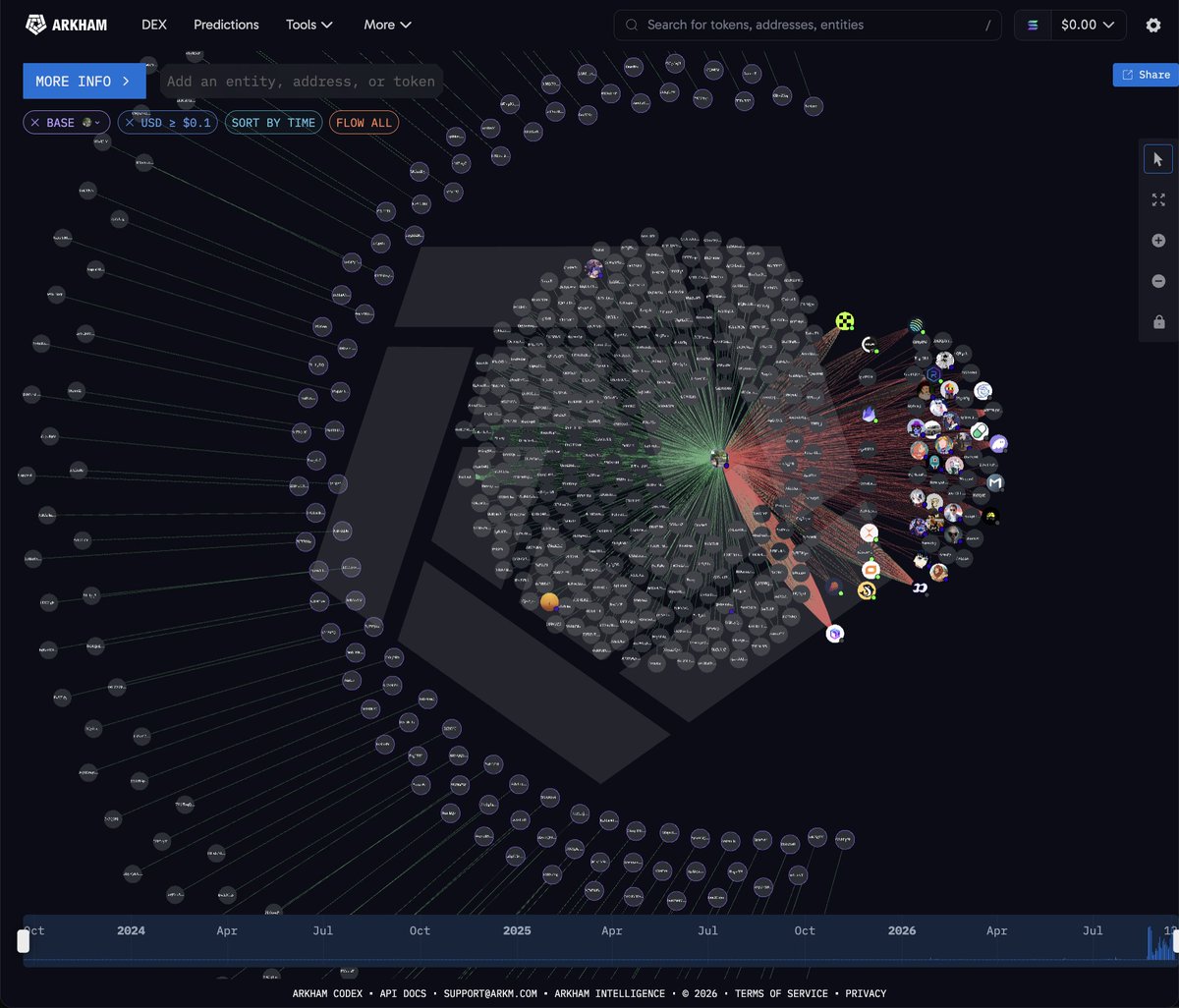
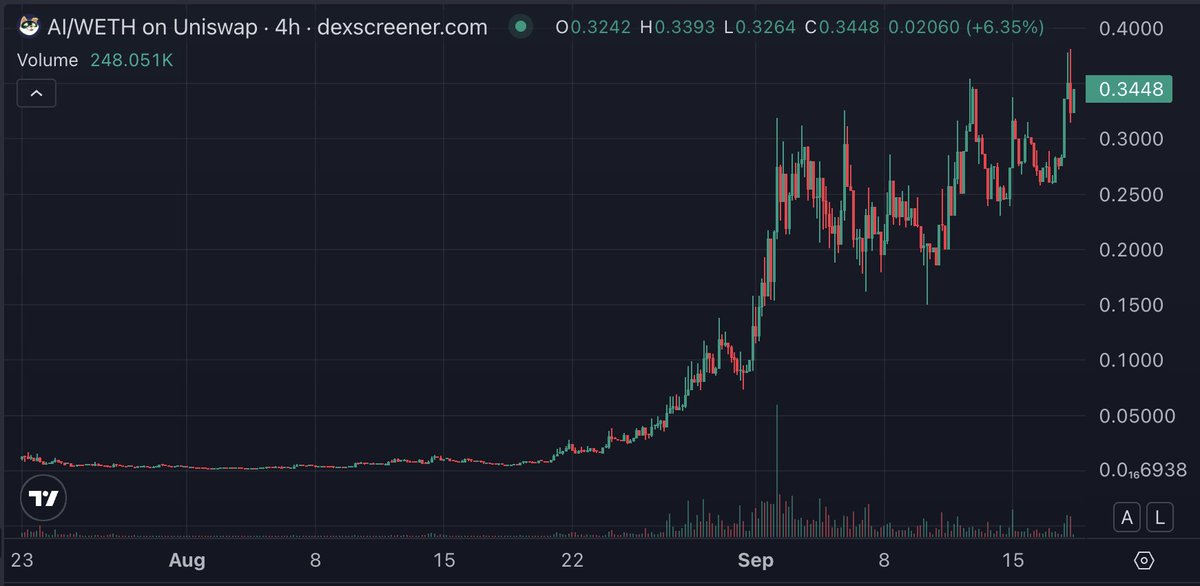
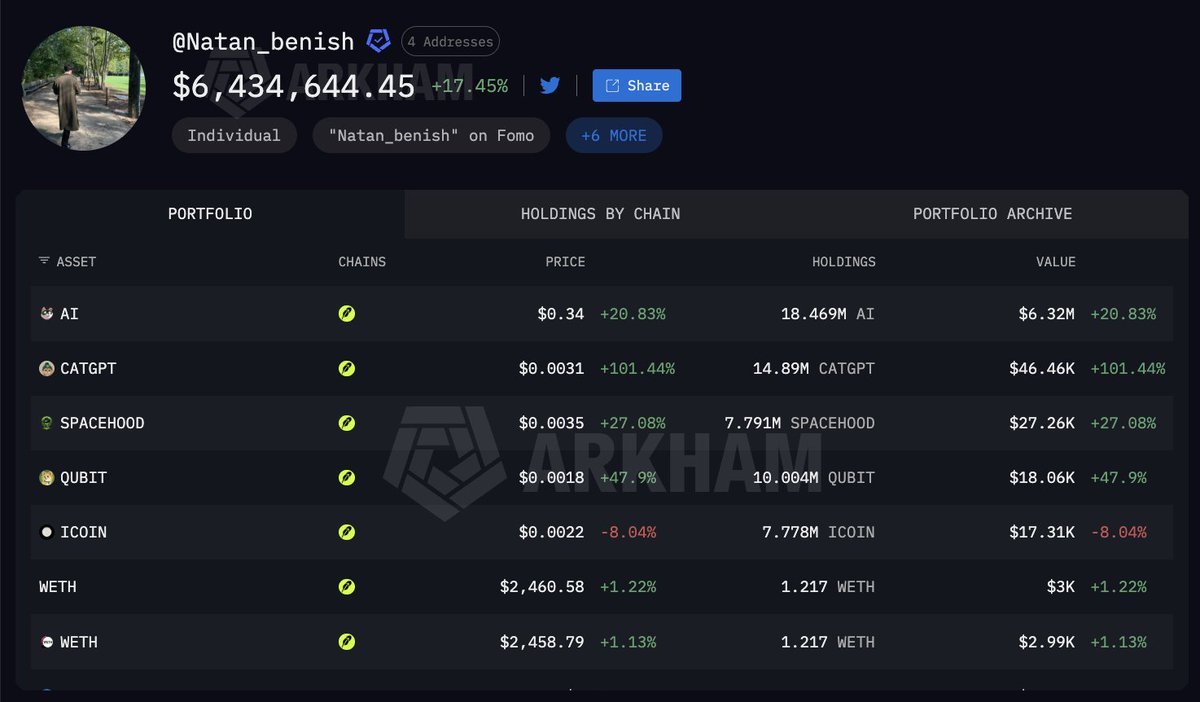
He turned $3.8K into $2.7 million on Robinhood Chain.
@Natan_benish bought $3.8K of AI 2 months ago at a $219.8K market cap and has never sold. Those tokens are now worth $2.92M - a 758x.
He holds $6.38M of AI in total: 54% of the stack was transferred in, 6.0M tokens of it from @heyhawx.
A note on recursive STARK mempools (EIP-8288) https://t.co/XNBuNtkKmi
This is an EIP that I am hoping we can get included in I-star (the fork after Hegota) that you can think of as the next step after Frames, that would unlock extreme amounts of power. Particularly:
* Ultra-cheap quantum-safe signatures (SPHINCS-). Much of the cost savings comes from the fact that the signature data (~3 kB) does not have to go onchain
* Ultra-cheap quantum-safe privacy protocols. Status quo minimum cost for private txs is ~300k if you engineer very well (no one does), status quo quantum-safe is ~10M gas, this could reduce it to low tens of thousands.
* Universal support for your favorite new signature or proof scheme without needing EVM changes. Whatever you use (Falcon, ML-DSA, some other lattice-based thing, something code-based or isogeny-based or even more esoteric), you can just wrap it client-side in a STARK, onchain gas cost low tens of thousands just like privacy protocols. Hopefully, Ethereum will never need "please support my favorite cryptographic algo" politics again.
* Private account abstraction: keep your account logic private, and in a private location onchain. Then you can make one transaction to change the ownership of all your onchain state - accounts, defi positions, privacy protocol notes, everything - without revealing which objects' ownership you're changing.
Here's how it works.
Your transaction can include a type of frame that we call a "dependency frame". The frame is a list of statements, asserting claims like "message hash M was signed by SPHINCS- public key P" and "data hash D was proven to satisfy a statement defined by verification key V".
When you send your transaction, you send it in an envelope, which includes a signature or a STARK for each statement in a dependency frame.
Once the transaction reaches the mempool, nodes aggregate them. Each node runs a loop: wait one tick (eg. 500ms), aggregate all new envelopes (either single-tx or multi-tx) that you've seen, remove any transactions that are expired, generate a STARK recursively proving all dependencies, and send a new multi-tx envelope containing that STARK.
Hence, the bandwidth load is bounded: each node's outbound is one STARK (~100-300 kB) per tick, plus each transaction getting broadcasted through the network once (as happens already).
The block builder acts as "yet another mempool node", receiving envelopes from the mempool (plus any side channels), generates its own STARK covering the subset of transactions it intends to include in the block, and adds that STARK to the block.
Total onchain overhead: one STARK (100-300 kB), plus 96 bytes for each statement being proven.
This is what I've called before ( https://t.co/3jfVkYTZrR ) "The Proof Singularity". Today, we have all the ingredients to actually implement it.
As a developer, this requires a somewhat different workflow than you are used to, but it is conceptually simple. Any signatures or STARKs, you put into a separate frame. Then the main logic that today is verifying a signature or STARK, you replace with checking for the existence of a frame that includes the correct statement as a dependency.
Examples of useful statements:
* [tx sighash] verifies against [the pubkey at sload(0)]
* there exists a secret and a merkle branch such that hashing secret+0 and applying the merkle branch outputs (public) root R, and hashing secret+1 outputs (public) nullifier N
* there exists a secret address A, salt S and signature Z such that sload(0) = hash(A, S) and a merkle proof of address A inside a recent ethereum state contains some pubkey D where [tx sighash] was signed by D [this is private account abstraction; all variables except [tx sighash] and sload(0) are private; you can also make D a STARK verification key]
* there exists an ML-DSA signature signing [tx sighash], that verifies against an ML-DSA pubkey whose hash is sload(0)
At the core, this is moving any compute and data other than bookkeeping "business logic" outside the core path of Ethereum execution, sharding and parallelizing it via the mempool.
Notice also that this requires agreeing on a _language_ (aka. an ISA) for the recursive STARKs to define statements in. The current leading candidate is RISC-V. So this would also de-facto be Ethereum adding RISC-V (or something else we decide on) as a canonical ISA - a big decision that should be done carefully, but that I think will be necessary to drive Ethereum forward.
We are running a public testnet for the EIPs behind Ethereum's privacy roadmap, built on top of Glamsterdam.
It runs EIP-8141 (Frame Transactions), EIP-8250 (Keyed Nonces), EIP-8272 (Recent Roots), EIP-7805 (FOCIL), and EIP-8369 (VOPS profiles), each implementation up to date with its spec. The frames implementation matches the latest execution spec tests release.
Anyone can sync, peer, transact, and use the faucet to fund test accounts. The only permissioned part of the network is validator entry. If your client team is working on any of these EIPs and wants to validate, reach out to us, and we'll get you set up with deposit tokens.
RPC, explorer, and tooling notes: https://t.co/bEbIcah0PX
A lot of important progress on Frames (EIP-8141) has been quietly happening over the last few months. Highly recommend reading this, also the updated EIP https://t.co/jYqeS55j6P
https://t.co/CPYONKnWZc
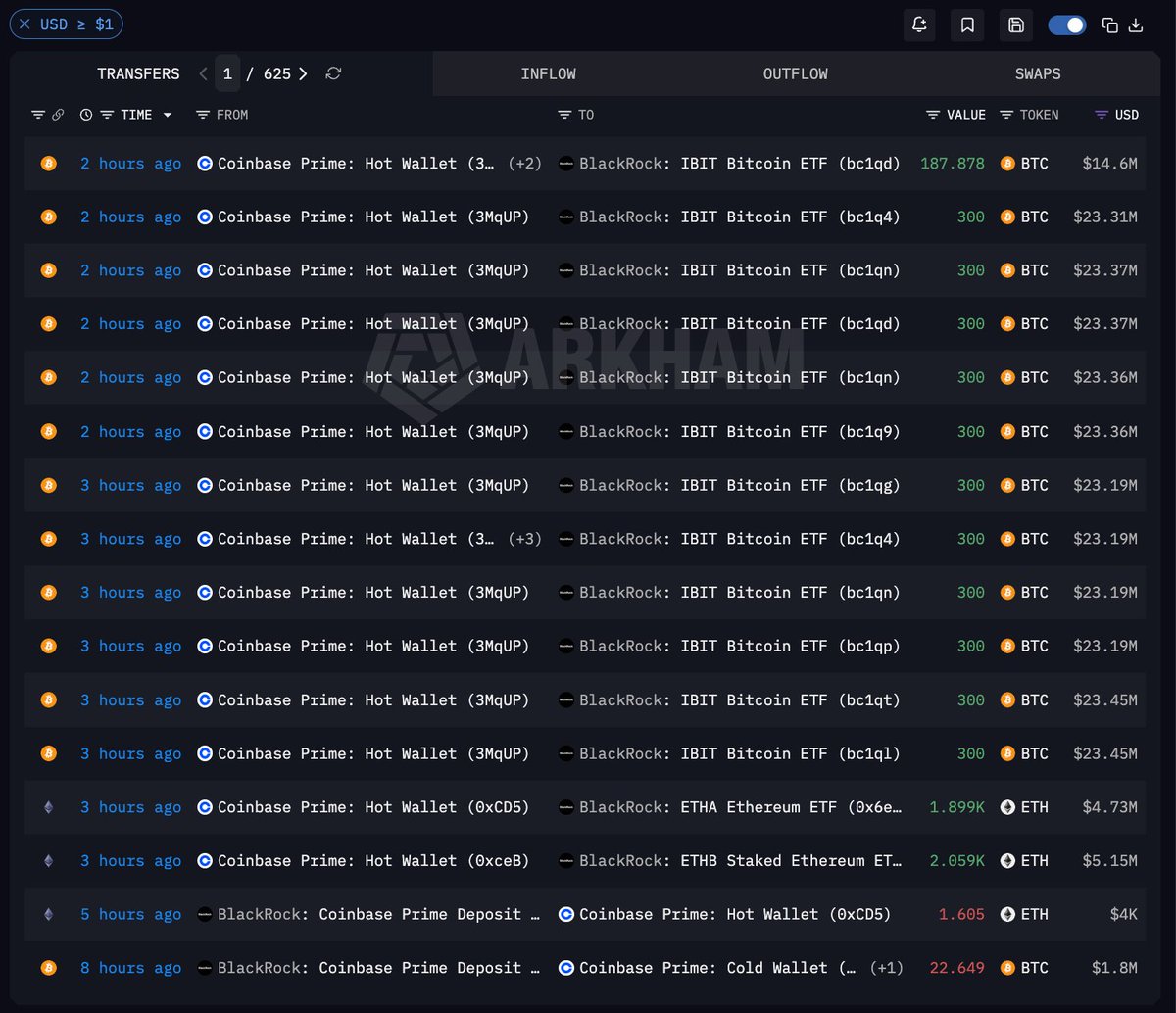
BLACKROCK BUY STREAK: $1 BILLION $ETH
BlackRock’s clients have purchased over $1 Billion of ETH without any days in which they net-sold. In the past 9 days, BlackRock’s ETHA ETF purchased $1.02B of ETH.
BlackRock’s ETHA estimated average buy price is $3,060 ETH.
Impressive work!
For comparison, an H100 can do roughly 100-200 tok/s of Muse 30B for raw inference single-thread, going up to low thousands of tok/s with a large number of threads - and I am sure that for the massively-multi-threaded case they can optimize the prover further.
So we roughly, sort of, have single-digit (<10x) overhead for LLM proving!
Next step is getting single-digit overheads for FHE, and then ultimately vFHE (aka STARK * FHE). A crazy ambitious milestone given present FHE overheads, but because of how highly structured and almost-linear LLM inference is, it's closer to the realm of possibility than you might think.
Single-digit-overhead all the things.
https://t.co/NXOTrPTjp6
@VitalikButerin AI Agent Marketplace
Sovereign, verifiable AI agents running in ephemeral sandboxes. Select multiple agents — fees are summed, and every completed execution can be anchored on-chain (EVM networks) so its receipt stays verifiable at any time. https://t.co/JYhpTBRMya
Banks are prisons 🔒States are wardens 📷Finance is a cage 📷 Sovereign infrastructure. No ask. No permission. No mercy. https://t.co/cGz9DDMiUK #DeFi#Web3#Fintech#P2P#Crypto#Privacy
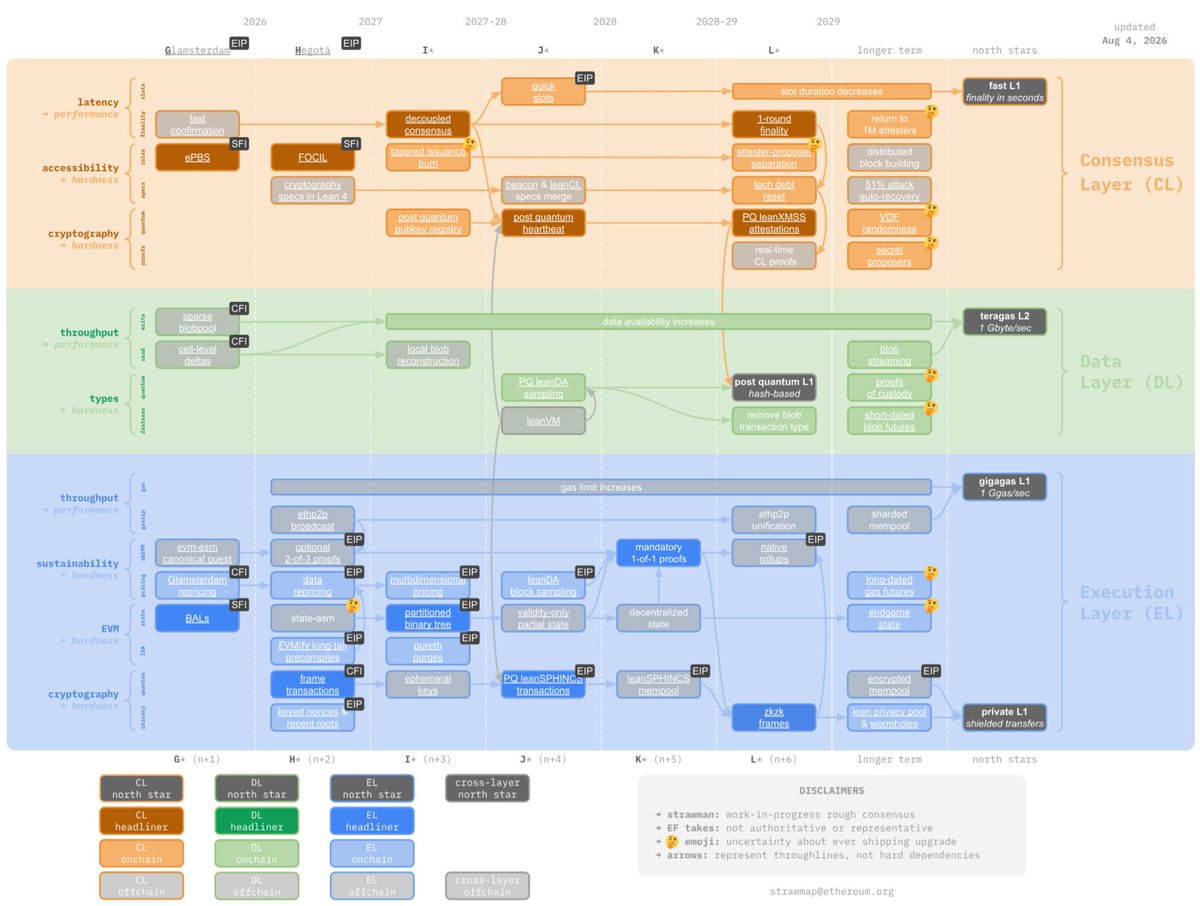
I updated my 2023 roadmap diagram to overlay where the items that were there sit in the current Strawmap ( https://t.co/I35mrXutP2 ).
In general, a lot of overlap, but:
* Some things got reshuffled in order (eg. quantum safety up-prioritized)
* Some things deprioritized (eg. VDFs; many EVM improvements)
* Some things replaced with superior constructions (eg. Verkle -> unified BT -> PBT; state expiry -> new state types)
What's most striking, however, is that some completely new things are in the strawmap that are NOT in this diagram, because they were not in the 2023 roadmap at all. These reflect changing priorities.
Notably:
* First-class attention to strong privacy. This covers: keyed nonces and recent roots, aspects of FOCIL, lean privacy pool & wormholes
* Aggressive scaling in the context of post-quantum. This covers: leanSPHINCS signatures and aggregation, zkzk frames (see https://t.co/ibrOpMxMfO )
* Lean-ification of the spec, to assist in formal verification (full FV of everything is only possible because of modern AI)
* Blob and gas futures (this idea just didn't exist back in 2023)
* Native rollups (SNARKs were nowhere near mature enough to even consider this back in 2023)
* A more open design space for the "future of the EVM". zkzk frames already implies that the protocol will expose to users some ISA that's not the EVM - current leading candidates are leanISA and RISC-V. These ISAs are more simple, modern and efficient than the EVM. Once they're there, why not expose them to developers everywhere? (And then, why not turn the EVM into being an IR on top of that ISA, instead of an enshrined feature massively complicating the base protocol?) Though much of the deeper exploration here is too early even for the strawmap.
* New state types are not just a replacement for expiry, they're a fundamentally different paradigm to how Ethereum does scaling
A common theme in scaling, found in both state types and zkzk frames (both new ideas), is that instead of trying to maximally scale ALL ethereum activity, we try to create specialized mechanisms that have more restrictive properties that make them more scaling-friendly, while supporting the heaviest loads incurred by users and applications today (eg. token transfers, swaps) and tomorrow (eg. privacy protocols).
The other common theme is treating STARKs and AI-accelerated FV as first-class objects, that we are okay betting the technical future of Ethereum on. There are recursive STARKs in many layers of the protocol, one particular primitive (the "aggregate to union verified dependencies" primitive) is expected to be used in *three* places in the protocol: EL, CL and DL. This can only be safe with formal verification, which is itself only feasible with modern AI tools.
In general, many steps forward in maturity. And a huge amount of hard work by many dozens of Ethereum researchers and developers on all of these features.
Ethereum will be quantum-safe. Ethereum will put users' privacy first. Ethereum will be secure. Ethereum will be censorship-resistant. Ethereum will be highly performant and scalable while satisfying the above. And Ethereum will be Lean.
Banks are prisons 🔒States are wardens 📷Finance is a cage 📷 Sovereign infrastructure. No ask. No permission. No mercy. https://t.co/cGz9DDMiUK #DeFi#Web3#Fintech#P2P#Crypto#Privacy
Morpho is built on Ethereum.
@Morpho enables users and applications to borrow, lend, and create custom credit markets through open, permissionless infrastructure.
Committed to FLOSS principles, Morpho advances more self-sovereign financial systems.