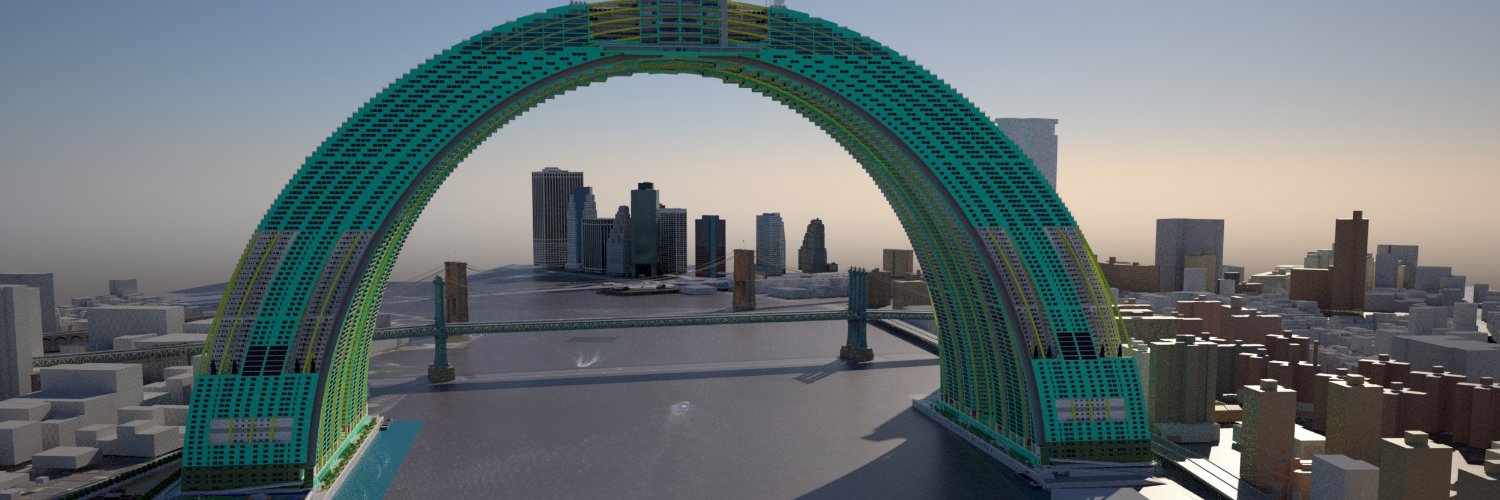
CEO/Founder: RiverArch Ventures LLC; Managing Editor: Opednews; Director: Public Banking Institute; VP: Common Ground USA; Author: America is Not Broke!
New article/interview headlined in The Broadsheet explaining the virtues of the RiverArch for all New Yorkers: https://t.co/TLJGN6tONy Partners present & sought. Full presentation upon request.
Americans would like these things explained:
1. How will the strait of Hormuz be re-opened? It was open before and now it's mostly closed. Detours & alternate transports won't work if Iran can just bomb those too. Why can't the speedboats and missiles be as neutralized as the regular army, navy, and air force? Why don't we have modern drone/anti-drone technology? Why is Ukraine leading the world in the most effective war-fighting weapons now?
2. Why are we not accelerating alternate energy sources now, since oil has been a national security threat for decades & having "enough" here (even though we can't refine it) isn't saving America from high gas prices?
3. How can the threat of Islam be finally defeated? Getting the gulf states to sign the Abraham accords is a good first step but it's stalled with the war and is a cause of it, according to Iran and the late Sinwar who masterminded the attack on @Israel 10/7/23. No one wants to live with the Palestinians, especially the Arab states. What is to be done? Iran must have regime change or nothing will change in the death-cult pay-for-slay jihadist culture. Israel is on the front line, but it's not enough.
Yeah, I've seen this shocking series before & even had it bookmarked already. Some of the charts are a few years out of date now but the trends are the same if not worse. There's too much there to attribute a single cause to WTF happened in 1971, but obviously a series of critical changes altered society not just here but all over the world, though the charts mostly deal with America.
Were the main causes:
1. The end of the international gold standard? (we came off the domestic gold standard under FDR to allow him to spend the U.S. out of the Great Depression, though it wasn't until WWII that that really took hold for decades after). I'm not a fan of gold-backed currency. And even before 1971, financiers were starting to figure out ways to get around that limitation through leveraging & derivatives. Gold should also trade freely, not be bound by artificial price levels set by government.
2. The breakdown of the 1-earner (typically, men) family when women entered the workforce in serious numbers? Men's income declined while women's went up, but this was not a wash: it introduced the need to outsource childcare & at the same time, increased mobility meant there were fewer extended family members to help shoulder the burden. Making the State a co-parent had its own share of problems, not the least of which that there was no provision to pay for it, so people starting having fewer children, even getting married later too.
3. The rise of the petrodollar? OPEC had us over a barrel since the 1970s embargo, which is now breaking down, but inflation is accelerating too, so something else will have to come along. I prefer using the Output Gap - a measure of potential output vs. actual Output, by GDP. Many economists calculated this. So does the non-partisan CBO. It was $1.3t at the bottom of the 2008-09 crisis, and Obama's chief economic advisor said $1.3t was the amount needed to stimulate the economy out of the Great Recession. Congress dithered & only authorized about half that amount, plus some unnecessary tax breaks from Republicans, and the recovery took years longer than it should have. Advisor Christine Romer was right.
4. The rise of the Great Society programs from LBJ, including Medicare, but also a vast multi-governmental bureaucracy and private administrator explosion? It certainly seems to have vastly inflated the cost of education & healthcare, also incarceration, though crime too (but see #2).
5. The cost of the Vietnam war? Nixon had to pay for the then most expensive war in American history somehow, and devaluing the dollar by removing the gold standard internationally was one way to pay America's many international creditors, as well as OPEC.
Some things are better now, some worse. But we can't go back, even if we can learn from the past. The world is a mess, that's for sure.
@VictorFaculty32@CBSNews No need. Seniors no longer need to save for retirement & they spend almost all of SS already. As long as the payout is not raised beyond what they need to live on, they won't save it. That is the line.
@heterodoxan@JDStokes79@ThrillaRilla369 As I've said repeatedly, improvements should not be taxed under a Georgist Land Value Tax. Only the Land - location in urban areas - should be taxed, not the home nor improvements to it. That will spur improvements while discouraging hoarding & speculation on Land.
@VictorFaculty32@CBSNews No, as I said, it can only be up to the point where it starts to get saved, not spent. Saving will cause asset inflation. Do you want to take away SS and see how deep the deflationary depression will be?
@Gh4nder@BuffaloByGodDan@ThrillaRilla369 I actually think it's the opposite. Maybe that's because I'm a director at 2 NGOs and have been writing about economics & politics for 2 decades with >1m views & a quarter of that in video views. Maybe no one really has much control though too; that's possible. 🤔
@Gh4nder@BuffaloByGodDan@ThrillaRilla369 Um, isn't that what we are doing already? The solution lies in the ballot box, not in granting still more power to the MIC to tax our productive output and monopolize the rent upon the Land as well as throttle growth and innovation elsewhere.
@YourAnonNews No one should be surprised about this, nor that the only way to defeat it is for @TheDemocrats to gain control of at least one chamber of Congress. Dems have their problems too, but they are committed to saving Social Security & Medicare.
No, like I said, and the studies confirm, it only works up to the point where retirees start saving instead of spending. SS could be increased a little bit, but not to the point where seniors start saving, which would create asset inflation. That's the line.
Think of the reverse. Suppose SS went away. How much would the economy contract, i.e. go into a depression, then?
Well, I agree that in almost all cases it is the government through its services that increases the value for an entire city, or even a neighborhood. A single property owner doesn't have much effect, as you say. But some people here just hate the government, so for them I use an example of a single neighbor's improvements and assume they will extrapolate that to many neighbors, but perhaps that's the wrong assumption?
In any case, yes, it's unfair for you to reap the improvements made by others - whether government or your collective neighborhood activities - without paying for the increased value of Land.
But there is an alternative: deferment, which lets you not pay the tax, but requires the next buyer to pay it along with what they pay you for the house and land, which will be lower because of the extra tax burden? Fair?
@MichaelAArouet Debt to whom? It's a very different thing when China owes money internally to itself, like Japan too. China understands monetary sovereignty. The U.S. mostly doesn't.
@KobeissiLetter What hypocrisy! @Israel suffers far more than this every day & yet he tells @netanyahu not to respond to Iran, which is an existential crisis to Israel in a way America can never understand.