I just built the exact playbook for transitioning from traditional SaaS to Service as a Software.
Not basic wrapper ideas Not beginner prompt tips
The complete infrastructure setup for founders who want to scale revenue without bloating their headcount.
Most software guides are:
→ Generic SaaS ideas that get wiped out by the next OpenAI or Anthropic update
→ Pure theory with no actual backend logic or workflow integration
→ Advice on building complex dashboards that clients do not even want to log into
→ Nothing specific to automated delivery and quality control systems
This is different.
What is inside:
→ The architectural framework to separate the fragile application layer from the high-value service layer
→ The outcome-based model that lets you stop selling tools and start selling completed work
→ The exact human-in-the-loop configuration where AI does the heavy lifting and humans handle validation → Scaling blueprints to run hundreds of client accounts with the same operational footprint
If you need to:
→ Stop worrying about your tech stack getting commoditized overnight
→ Deliver enterprise-grade results to clients without hiring an army of account managers
→ Build a highly defensive business model that scales with software margins
This works immediately.
You also get:
→ The end-of-the-dashboard reality check (why clients pay for execution, not another login)
→ The 90 percent automation rule (how to structure workflows so your team only touches the final output) → The hiring deflection checklist (the exact systems to deploy before you ever consider posting a job opening)
Want it?
Connect with me Comment SERVICE
I will send it.
i just built the exact stack for deploying an autonomous lead generation agent.
not basic scraping scripts
not beginner tips
the complete setup for keeping your pipeline full while you focus entirely on closing.
most lead gen guides are:
generic advice anyone can find online theory with no actual routing workflows features listed but never applied to real b2b growth nothing specific to building ai infrastructure that actually deflects hiring
this is different.
what is inside:
the prospect finder that builds a qualified list every day without manual searching the enrichment engine that appends emails and company data in seconds the personalization writer that generates tailored first lines so your outreach never sounds robotic the sequence sender that launches campaigns and paces follow ups automatically the reply qualifier that spots buying signals and only pushes hot leads to your calendar
if you need to:
stop manually checking target accounts and audience signals run outbound nonstop with smart follow up built right in keep your crm current without doing the admin work yourself
this works immediately.
you also get:
the exact workflow connecting linkedin apollo and perplexity the pipeline tracker that syncs stages across hubspot and airtable the complete system to turn your inbox into a qualified meeting queue
want it?
connect with me comment agents
i will send it.
I just built the exact blueprint to hit $10K per month using only a laptop, WiFi, your brain, and Claude Code.
Not basic hustle advice Not generic startup theory
The complete setup for solo founders building and scaling software entirely on their own.
Most MRR guides are:
→ Generic motivational posts with zero technical execution
→ Theory with no actual codebase generation workflows
→ Advice that requires you to hire a full engineering team to actually build the product
→ Nothing specific to solo operators running development and distribution simultaneously
This is different.
What is inside:
→ The exact Claude Code setup that turns your brain dump into a production ready app in 48 hours
→ Automated distribution scripts that pull traffic while you are away from the WiFi
→ Slash commands that handle your entire customer support queue automatically
→ The solo architecture that scales your revenue without scaling your hours
If you need to:
→ Stop waiting on technical cofounders and just build the product yourself
→ Ship features, fix bugs, and deploy updates without learning complex syntax
→ Run a highly profitable software business with practically zero overhead
This works immediately.
You also get:
→ The $10K pricing model (exactly how to package a Claude built app for recurring revenue)
→ The infinite ideas framework (how to train Claude to find profitable gaps in your target market)
→ The solo deployment checklist (everything you need to verify before taking your app live)
Want it?
Connect with me Comment 10K
I will send it.
I just built an architectural blueprint for deploying autonomous AI agents that do not break.
Not basic scripts Not beginner tutorials
The complete setup for builders running high volume automation without babying the code
Most agent guides are:
→ Generic API wrappers anyone can clone in an afternoon
→ Happy path demos that crash the second a real user enters an unexpected input
→ Pure theory with no actual error handling or production state management
→ Nothing specific to founders managing 50 distinct automated workflows simultaneously
This is different.
What is inside:
→ The 8 strict deployment patterns that push agent reliability from 40 percent to 99.9 percent uptime
→ Zero manual fix infrastructure that auto heals state loops instead of locking your database
→ Dynamic throttle adjustments that handle token spikes and rate limits without dropping execution
→ Automated environment setup to generate, test, and deploy unique agent skills completely unattended → Instant failover routing that seamlessly maps broken LLM calls to backup nodes in real time
If you need to:
→ Stop wasting 2 hours per agent debugging fragile chatbot slop
→ Move past linear scale where more active automations just means more manual work for you
→ Run production grade infrastructure that executes tasks exactly like a senior employee
This works immediately.
You also get:
→ The raw configuration prompt (describe any business skill and output the exact agent pattern)
→ The 0.5 percent bounce defense (how to pair reliable agents with bulletproof outbound protocols) → Linear to infinite scaling framework (the database structure that stops agent memory from bloating your context window)
Want it?
Connect with me Comment PATTERNS
I will send it.
Most founders are using Claude Code to build products nobody wants.
They spin up an MVP in a weekend, launch it, and hear absolute silence. Building the product is no longer the hard part. Distribution is.
If you are a founder relying on manual social media engagement or waiting for organic traffic, you are wasting your time. Here is the exact framework to go from zero to your first 100 real users by pairing elite development speed with aggressive growth infrastructure.
1. Ship the core utility fastUse Claude Code to get a functional product out the door immediately. Stop overbuilding. Get the bare minimum into the wild so you have something to sell.
2. Deploy automated distributionManual commenting does not scale. You need to shift to high volume automated distribution. Build systems that push your content out aggressively and consistently to manipulate algorithms and get eyeballs on your product.
3. Optimize the funnelOnce the traffic hits, see where users drop off. Feed that data back into Claude Code to ship fixes and optimize your conversion rates in real time.
Vibecoding is only half the battle. You need the growth infrastructure to back it up.
Comment CODE below and I will send you the complete framework.
Cold email deliverability is crashing, but still converting.
If your open rates are tanking, you are not alone. Standard outreach protocols have seen a massive 60 percent decline in inbox placement since the latest authentication mandates. Legacy systems simply fail against modern AI filtering.
To land in the primary inbox today, you need a completely updated technical sending stack.
Swipe through this breakdown of the 2026 Cold Email Protocol to see exactly how to fix your infrastructure. You will learn the high volume standards required to keep your sender score above 95 and your bounce rate under 1 percent.
Key areas you need to upgrade immediately:
Strict DMARC enforcement
Continuous DNS health monitoring
Neural response generation for warmup
Dynamic load balancing across domains
Stop debugging DNS and start landing in the primary inbox.
Comment WARMUP below and I will send you the free tools to help you scale your business faster.
↓ I built a full Claude Code sales system and now giving it away for free. Here's what is inside:
→ A lead research assistant that turns one company name into pain points, decision makers, tech stack, and a tailored pitch angle
→ A cold outreach workflow that builds a personalised LinkedIn and email sequence from the prospect brief
→ A sellthedream skill that turns discovery call notes into a tailored asset and follow-up message before the next call
→ A voice extractor that builds a usable voice guide from your writing so every output sounds like you
→ A case study workflow that turns closed deal notes into proof assets you can reuse in future outreach
→ A chained system where every skill feeds the next step in the pipeline
I put this together because manual outbound is still slow, inconsistent, and expensive.
Hours disappear into prospect research before a single message goes out.
Outreach stays generic because there is no real prospect context behind it.
Follow-up drags, momentum dies, and deals stall because the response came two days later instead of two hours later.
The issue is not just speed.
The issue is that most outbound workflows are disconnected.
So I turned the whole process into a system:
First, the lead research assistant gives you a prospect brief fast.
Company context, likely pain points, decision makers, tech stack, and a strong pitch angle are ready before outreach starts.
Then cold outreach uses that brief to build a personalised sequence.
Connection request, opener, and follow-up touches all map to the specific situation instead of sounding generic.
Then turns discovery call notes into leverage before the next conversation.
It extracts the brief, picks the right format, generates the build prompt, and drafts the message you send the prospect.
Then voice extractor makes the whole system sound like you.
It pulls sentence rhythm, vocabulary, and language patterns from your writing so every skill produces outputs in a consistent voice.
Then case study turns every closed deal into future proof.
Your notes become a one-page asset with specific numbers you can reuse in later outreach.
Follow, comment SKILLS, and I’ll DM it to you.
Prompt engineering is completely dead. You need to stop prompting and start programming.
If you are still writing long paragraphs hoping the AI understands your goal, you are operating like a consumer. The top tier of builders treat Claude like an operating system. They use strict slash commands to force exact behaviors.
Here is the protocol to program your AI outputs:
The Reasoning Protocol Stop asking the system to think carefully.
Trigger /CHAIN OF THOUGHT. This forces the model to execute and show its intermediate reasoning before it generates the final answer.
The Persona Override Stop asking the system to act like an expert.
Trigger /DEV MODE. This simulates a raw technical style and eliminates all conversational fluff.
The Output Structure Stop hoping for a good layout.
Trigger /SCHEMA to generate a strict data model. Use /EXEC SUMMARY to enforce a highly dense executive brief.
The Memory Lock Never lose the context of a long session again.
Trigger /CONTEXT STACK to keep your core rules and system instructions locked in active memory across the entire chat.
You build the protocol once and guarantee the output every single time.
Comment COMMAND below and I will send the complete protocol directly to your DMs.
Stop paying monthly subscriptions for software you can build yourself in an afternoon.
You are renting your tech stack when you should own it. With Claude Code, you can prompt fully functional versions of your core apps into existence for free.
Here is exactly how to replace your core SaaS stack using Claude, Supabase, Vercel, and Resend:
1. Notion Replaced in two hours. You prompt Claude to build a custom markdown wiki with a slash command block editor. It uses Supabase for the Postgres backend and deploys for free on Vercel.
2. Typeform Replaced in ninety minutes. You generate a conversational UI with custom conditional branching on any answer. Submissions land directly in your database and trigger Resend emails.
3. Calendly Replaced in two hours. You build a custom scheduling interface hooked directly into the Google Calendar API. It handles booking and automated email confirmations in one seamless loop.
4. Loom Replaced in three hours. You build a custom screen recorder using the browser MediaRecorder API. You get unlimited video storage via Supabase, auto generated share links, and built in view tracking.
You go from paying monthly fees for features you barely use to owning custom infrastructure with zero limits.
Comment REPLACE below and I will send you the exact four prompts to build this stack yourself.
How to replace $19,600/month in employee salaries.
Most founders are bleeding cash on bloated teams. They pay agencies for content, hire reps for sales, and burn thousands on virtual assistants.
You are trading your profit margin for headcount.
You do not need employees. You need an automated AI stack.
Here is the setup:
1. The Marketing Department Stop paying social media managers $3,000 a month. You use Claude to write an entire week of content in one hour.
Drop the copy into templates, batch schedule it, and let the system post for you across every platform.
2. The Sales Team A human sales rep costs $4,500 a month. Replace them by pulling free leads automatically, using Claude to instantly write hyper personalized outreach, and routing the replies straight to your calendar.
3. The Operations Manager Stop doing manual admin work. Connect an automation layer to handle your repetitive tasks.
When a lead books a call, your system automatically updates your database and generates a meeting prep document without a single click.
4. The Finance Department Never chase an invoice again. Set up automated billing that charges clients, sends receipts, and follows up on late payments while you sleep.
You paste your bank statements into Claude and it categorizes your expenses in seconds.
5. The Data Analyst Instead of paying a business analyst $5,000 a month, feed your raw weekly data directly into Claude.
It acts as your consultant, giving you a full strategic breakdown and telling you exactly what to prioritize next.
You save 68 hours a week and keep all the profit.
Comment REPLACE below and I will send you the complete list of free tools to build this exact stack.
#ai #automation #founder
Most people are trying to build huge AI products.
Wrong move.
The better play is to build one agent that solves one problem for businesses 24/7.
Not 10 agents.
Not a full startup.
One system that does something useful every day:
- finds leads
- revives stale deals
- tracks competitors
- writes content
- catches missed opportunities
Businesses do not pay for AI. They pay for:
- more revenue
- faster follow-up
- less manual work
- fewer things slipping through the cracks
That is why this works.
You use Claude + Clawdbot / OpenClaw to build one agent around one bottleneck, then sell that system over and over.
That is the shift:
- old model: sell hours
- new model: sell a system
This is also why small founder-led businesses can suddenly move like teams 10x bigger.
That is exactly what I built with Ultron.
A system where agents handle sales, outreach, content, research, and monitoring so the business keeps moving without the founder doing everything manually.
I put together a free blueprint that shows how to structure this properly, and a live demo where you can watch it run.
Comment "W" for the blueprint + demo.
I replaced my 90K/year sales rep with 9 CLAUDE CODE SKILLS.
Your sales rep is your most expensive mistake. Manual research takes hours, generic templates destroy your reply rates, and missed follow ups kill deals silently in your CRM.
You do not need to pay another salary. You need an automated system.
Here is the exact architecture that replaces manual outbound:
Account Research:
Pulls company signals and decision maker bios in sixty seconds.
Lead Scoring:
Mathematically ranks your prospects so you know exactly who is ready to buy.
Meeting Prep:
Generates a complete call brief before you ever jump on a call.
Email Personalizer:
Drafts highly personalized first lines based on their actual business.
Follow Up Writer:
Generates context aware sequences based on the last touchpoint.
Objection Handler:
Prepares tailored rebuttals for exact objections in real time.
CRM Updates:
Logs meeting notes and fills every empty field the second you hang up.
Pipeline Analyzer:
Flags stalled deals and missing next steps before accounts go dead.
Deal Closer:
Drafts final proposals tied to the exact pain points and timeline of your prospect.
A human rep works 40h/week and takes sick days.
This pipeline runs twenty four hours a day with zero pipeline leakage.
Comment "SALES" below and I will send the complete nine skill setup directly to your DMs.
#ai #automation #founder #startup
@grok - what do you think of my delegation system:
Overview
Opus is the orchestrator. It reads the task, decides what to delegate, picks the model, writes the prompt, reviews the output, applies edits.
CF Workers AI does the bulk labor. Code generation, JSON shaping, multi-step agents, research, content. Bills from a separate Neurons pool, ~30-50x cheaper per token than Opus.
Target ratio: ~20% of work on Opus, ~80% on Workers AI.
Architecture
Opus runs locally in the dev environment.
Opus invokes a single primitive called cf for every delegation.
cf reads the task from a file or stdin, calls a specified Workers AI model via the OpenAI-compatible Cloudflare endpoint, writes output to disk, returns one summary line.
Opus then reads only the output file when it needs to review or integrate.
No Claude sub-agent wrapper. The Workers AI model IS the worker.
The two execution modes
Mode 1 — text-only
Workers AI model returns text. Opus applies it via Edit/Write.
Preset: none
Use for: pure generation (code, templates, SQL, summaries, JSON extraction).
Mode 2 — agentic
Workers AI model drives the work. It has access to run_bash, read_file, write_file, list_files, optionally http_get.
Preset: exec (or http for web fetch tasks).
Use for: multi-step tasks (scaffold project, fix-until-tests-pass, install-and-build, multi-file refactors).
Model matrix
Use case Model Mode Notes Code generation (default) @cf/qwen/qwen2.5-coder-32b-instruct none Cleanest TS/Python output Code requiring reasoning @cf/qwen/qwen3-30b-a3b-fp8 none Larger context, thinks before coding Short text / commit messages @cf/meta/llama-3.1-8b-instruct none Fastest, cheapest JSON extraction @cf/google/gemma-3-12b-it none Strip ```json fences in output Long-form reasoning text-only @cf/meta/llama-3.3-70b-instruct-fp8-fast none Hard-blocked in agentic — loops infinitely Agentic default @cf/qwen/qwen3-30b-a3b-fp8 exec Best tool-call quality Agentic alternative @cf/google/gemma-4-26b-a4b-it exec Talkier but reliable Agentic OpenAI-style @cf/openai/gpt-oss-20b exec Fast Agentic heavy reasoning @cf/openai/gpt-oss-120b exec Pricier Agentic lighter @cf/mistralai/mistral-small-3.1-24b-instruct exec Mistral dialect handled internally Web fetch + reason any agentic model above http Adds http_get tool
Routing decision tree
Code/SQL/markdown >5 lines → cf <coder-model> none (Mode 1), Opus applies via Edit/Write.
Multi-file or "do X then verify Y" → cf qwen3-30b-a3b-fp8 exec (Mode 2).
Data extraction / log parsing / JSON shaping → cf gemma-3-12b-it none.
Research / fetch + summarize → cf qwen3-30b-a3b-fp8 http.
≤5 lines / surgical edit / git op / architecture decision / debugging → Opus does it directly.
What stays with Opus (the 20%)
- Architecture and approach decisions
- Codebase navigation (Grep, Glob, targeted Read)
- Surgical edits (1-5 lines)
- Git operations, PR creation
- Supabase Management API calls
- Error diagnosis / root-cause reasoning
- Reviewing CF outputs and deciding integration
What never runs on Opus (the 80%)
- Bulk code generation
- Boilerplate, scaffolding, repetitive refactors
- JSON extraction and reshaping
- Multi-file modifications driven by a clear spec
- Web research and content summarization
- Commit message drafts, short text generation
Cost and speed profile
- Workers AI per-token cost is roughly 2-4% of Opus per-token cost.
- Workers AI agent tasks complete in ~14 seconds vs 30-60 seconds for Opus on equivalent jobs.
- Workers AI bills from a separate Neurons pool — bulk usage does not drain the Anthropic budget.
Opus stays sharp because it only handles weight-class problems.
Standard invocation pattern
cf <MODEL> <PRESET> - << 'TASK'
<full task description, paths, requirements, expected output format>
TASK
Returns one line:
CF_OUT=<path> CF_ERR=<path> EXIT=<code> ITERS=<n>.
Opus reads the output file only when it needs to review.
For Mode 2 the file contains the model's final summary; the actual work is already on disk.
Why this beats a single-model setup
Opus burns budget on every token; offloading bulk work reclaims that budget.
Workers AI open-source models are now genuinely good at scoped tasks (Qwen 3 follows tool calls reliably, Gemma 3 nails JSON, Llama 3.3 70B reasons well in text-only mode).
Pool separation means heavy automation runs on Neurons, not on the Anthropic plan.
Opus retains all final-decision authority, so quality gates do not move.
Here is the exact step-by-step breakdown:
Step 1: Install Claude Code & Dependencies
Open your terminal and set up your local environment. Run the official install script for Claude via your command line.
-> Verify the installation: claude --version
-> Install the Python requests library: pip install requests
-> Create your working directory: mkdir ~/meta-ads-claude && cd ~/meta-ads-claude
Step 2: Connect the Meta Graph API
You need to authenticate your script using a System User, not your personal account.
Go to your Meta Business Manager Settings, then navigate to System Users.
Create a new user named claude-ads-bot with Admin access.
Generate a token and enable two specific permissions: ads_management and ads_read.
Grab your ad account ID (act_XXXXXXXXX) from your Business Settings.
Export these to your environment (e.g., in ~/.zshrc): export META_ACCESS_TOKEN="your-token" export META_AD_ACCOUNT_ID="act_XXXXXXX"
Step 3: Define the Logic (CLAUDE md)
Claude Code automatically reads the CLAUDE md file in your project root.
This file contains your permanent scoring and rewriting rules.
Set it up like this:
Role: Senior Meta Ads analyst & direct-response copywriter.
Scoring Rules: CTR > 3% (+3 points).
CTR < 0.5% (-3 points).
0 clicks per 500 impressions = score 1 (kill ad).
Rewrite Rules: Instruct it to rewrite failing creatives using 3 distinct hook styles: Direct benefit, Curiosity gap, and Social proof + number.
Step 4: Execute the Loop
You run this sequence directly from the command line: python3 pull_ads py (Pulls your 7-day ad performance into a JSON file).
claude (Claude reads the JSON, scores every ad based on your CLAUDE.md rules, and saves the new copy to ad_rewrites.md).
python3 update_ads py (Reads the rewrites and pushes the updated campaigns live via the Meta API).
The Loop: Pull → Score → Rewrite → Push → Monitor.
Want the actual Python scripts (pull_ads py and update_ads py) to run this?
Comment "META" below and I will send the raw code straight to your DMs.
#ai #automation #claude #founder #business
↓ The No. 1 untapped business model you have never heard of:
There is still a huge gap in the software media companies.
Software businesses create products just to pay influencers to promote them instead of building their own distribution channels.
They spend 50K-$200K annually on ads and influencer partnerships while their competitors build audiences that print money for free.
Here is the exact 8 app workflow to build your product, scale your distribution, and sell direct:
Claude for coding:
Write your product, automations, and frontend without hiring an expensive dev team.
Vercel for deploys:
Push your code and it goes live instantly.
Zero Dev Ops nightmares.
Cloudflare for security:
Protect your application and route your traffic globally on autopilot.
Supabase for data:
Store users, track behavior, and manage your entire backend database securely.
Ultron for growth:
Deploy autonomous agents to scale your operations and outpace enterprise teams.
Stripe for payments:
Accept money the exact moment your customer is ready to buy.
Brevo for email:
Nurture your leads and automate your follow up sequences to drive conversions.
X for marketing:
Build a massive audience that actively wants what you sell.
Most founders do this entirely backwards.
They build the product first. Then they try to find customers. Then they realize nobody cares. Then they spend 10K on ads hoping someone bites.
The smart play is the exact opposite:
-> Build the audience first on X.
-> Validate what they actually want through content
-> Build the product they are already asking for.
Launch to people who are waiting to buy.
Your X account becomes your distribution engine. Your content becomes your sales team. Your DMs become your discovery calls.
Comment "WORKFLOW" below and I will send the step by step setup directly to your DMs.
#ai #automation #business #startup #founder
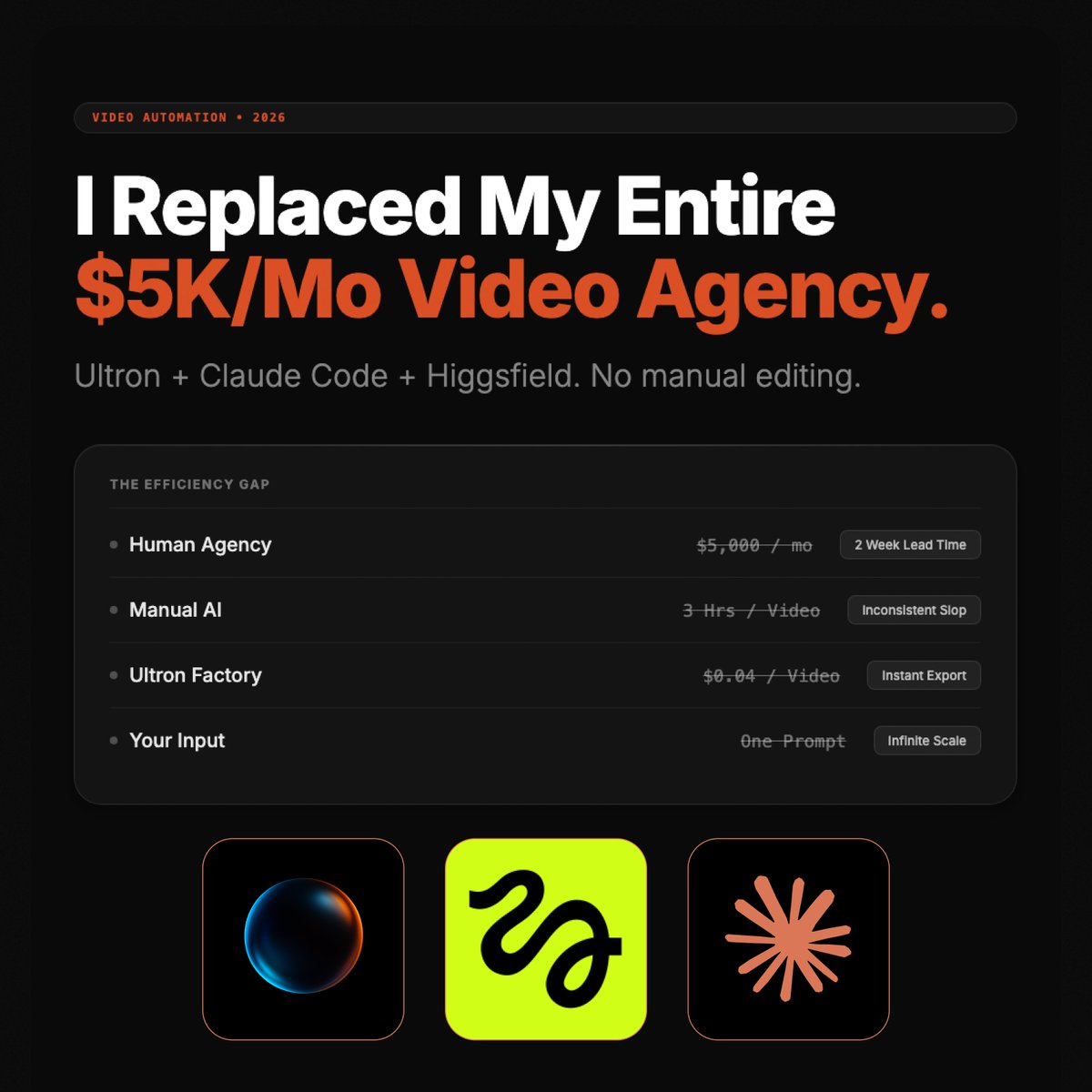
↓ Stop paying a video agency $5,000 a month just to wait two weeks for a simple edit.
I fired my entire production team and replaced them with an automated pipeline. Zero manual editing required.
Most creators are still doing AI video the hard way. They spend three hours manually prompting different tools just to end up with inconsistent slop.
I built an autonomous factory that generates instant exports for exactly four cents per video.
Here is the exact stack:
First, I use Claude Code to build the backend logic and script the scenes.
Second, I deploy Ultron to run the autonomous workflow and manage the process.
Third, I connect Higgsfield to render the actual high fidelity footage.
You type exactly one prompt. The system handles the generation, pieces the clips together, and exports the final file instantly.
You get infinite scale without hiring a single editor.
The key insight: stop treating AI video generation as a manual task. You do not need to be an editor anymore. You need to be an architect. Build the pipeline once and let the software replace the agency.
Want the exact blueprint to connect these three tools?
Comment Factory below and I will send the full setup directly to your DMs.
#fyp #ai #automation #business #founder
↓ The most valuable skill in tech right now is connecting AI agents directly to your revenue pipeline.
While most companies are still treating AI like a basic chatbot, top performing teams are building autonomous infrastructure.
Founders winning new mandates right now do not rely on a pitch deck. They close deals by demonstrating a live, AI powered workflow right on the call. That is the new standard for credibility.
Most founders and revenue operations leads are actively bottlenecking their own growth through unscalable habits:
Spending months trying to learn complex automation nodes.
Hiring expensive developers to build workflows they could own entirely.
Wasting hours resetting context because their AI cannot remember previous commands.
Manually switching between different software instead of connecting them directly.
That is not how smart companies scale.
To bridge this gap, I compiled the exact frameworks used to build production ready systems into the Claude Code GTM Engineer Playbook.
Here is exactly what is inside:
1. The Core WAT Framework
A complete breakdown of Workflows, Agents, and Tools. You will learn the exact architecture required to make these three layers communicate seamlessly without human intervention.
2. Zero Touch Prospecting Pipelines
Step by step instructions to build a workflow that automatically scrapes data, enriches profiles, scores leads, drafts personalized outreach, and pushes everything directly to your CRM.
3. Direct MCP Integrations
Complete connection protocols for the tools you already use. Learn to link your AI directly to Attio, Apollo, Outreach, Slack, Notion, and ClickUp to eliminate manual data entry.
4. Specialized Sub Agent Configurations
Architectures for deploying specialized agents dedicated to specific tasks. This includes setups for ideal customer profile research, sequence building, campaign diagnosis, and raw data analysis.
5. Unsupervised Scheduling
The deployment guide for pushing your workflows to Modal and Trigger dev.
This ensures your agents run on a strict schedule in the background while you focus on high leverage tasks.
6. Advanced Context and RAG Systems
Strict context management rules that prevent output degradation during long sessions, plus a Retrieval Augmented Generation setup that completely removes the knowledge ceiling on your projects entirely.
This is not theoretical advice.
This playbook is built from actual builds that generate complete competitor analysis reports for fractions of a dollar and research dozens of leads in parallel.
Want access to the full playbook?
Comment "SCALE" and I will send the link.
#fyp #ai #automation #founder