Every brain surgery workflow has the same inefficiency: you stop operating to image, then you image to operate again.
BrainBot eliminates that.
A fully robotic system that works inside the MRI scanner, real-time guidance, submillimeter precision, zero radiation, no patient repositioning.
The OR and the scanner are becoming one room.
Every brain surgery workflow has the same inefficiency: you stop operating to image, then you image to operate again.
BrainBot eliminates that.
A fully robotic system that works inside the MRI scanner, real-time guidance, submillimeter precision, zero radiation, no patient repositioning.
The OR and the scanner are becoming one room.
Medicine abandoned physics for biology and chemistry.
Diagnosis became imaging.
Treatment became statistics. The body became a collection of symptoms.
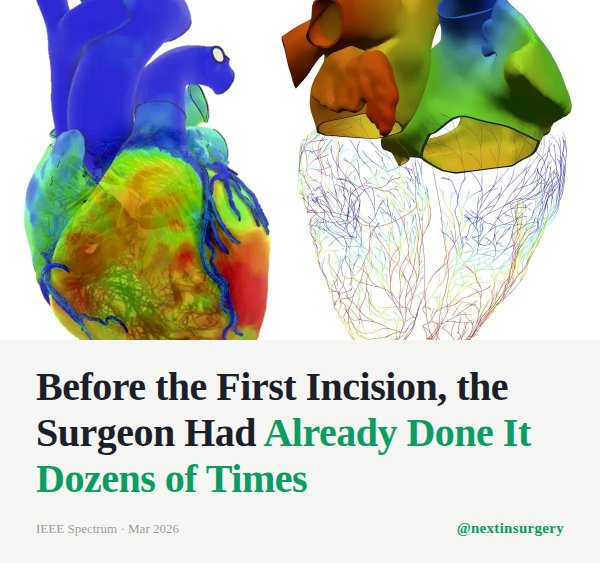
Virtual twins are bringing physics back, simulating how a specific heart beats, bends, and bleeds before a surgeon touches it.
The physician was always meant to be an engineer of the body.
Google AI reviewed 125,000 mammograms with the NHS and Imperial College London.
It caught 25% of the breast cancers that conventional screening missed.
The tool works. The harder problem is getting the system to trust it.
ETH Zurich researchers 3D-printed an ear from human cartilage cells that retained its shape and elasticity in animal models after six weeks.
For the 4 in 10,000 children born with microtia, the current standard is still rib cartilage, a painful, scarring, and often stiffer alternative to a natural ear.
This is what replacing it could look like.
One of the quiet trade-offs of robotic surgery is the loss of tactile feedback.
You gain 3D vision, precision, and reduced fatigue during eight-hour procedures.
You lose the ability to feel what you are operating on.
The PALPABLE project is working on a fibre-optic probe that translates tissue contact into a visual stiffness map.
A prototype is expected to be tested by surgeons this year.
In 2001, a surgeon in New York removed a gallbladder from a patient in Strasbourg, 6,000 km away.
The idea stalled for two decades.
On June 14, 2025, Dr. Vipul Patel performed a robotic prostatectomy from Florida on a patient in Angola, nearly 7,000 miles away.
The longest-distance telesurgery ever completed.
The spine is one of the most challenging anatomical areas to operate on.
The corridors are narrow, the structures are delicate, and there is very little room for mistakes.
Researchers recently published a robotic system called MicroSpine in Science Robotics that autonomously navigates these spaces for anterior lumbar nerve decompression.
It reaches where traditional surgical tools cannot.
NVIDIA has just removed two of surgical robotics' oldest constraints: no labeled data and no safe place to test.
The result: surgeons training on synthetic cases, hospitals simulating entire OR wings, medtech building on shared models instead of starting from zero.
The infrastructure before the leap.
AI is literally changing how surgeons see breast cancer, not metaphorically.
SimBioSys converts routine MRI scans into interactive 3D models of tumors. Surgeons walk into the OR with a full spatial map of the tumor, not a grayscale image.
Ultrasound has always required clinicians to mentally reconstruct a 3D anatomy from a series of 2D slices.
That skill takes years to develop.
MIT researchers built an AR system that does it automatically, projecting a live 3D view directly over the patient.
Novices performed nearly as well as experts.
Japan expects to lose half its surgeons by 2043.
Tokyo startup Direava is training AI on real surgical footage to guide the next generation step by step through the OR.
85% to 90% accuracy in a live trial with medical students.