Holy shit... Alibaba just dropped a 30B parameter AI agent that beats GPT-4o and DeepSeek-V3 at deep research using only 3.3B active parameters.
It's called Tongyi DeepResearch and it's completely open-source.
While everyone's scaling to 600B+ parameters, Alibaba proved you can build SOTA reasoning agents by being smarter about training, not bigger.
Here's what makes this insane:
The breakthrough isn't size it's the training paradigm.
Most AI labs do standard post-training (SFT + RL).
Alibaba added "agentic mid-training" a bridge phase that teaches the model how to think like an agent before it even learns specific tasks.
Think of it like this:
Pre-training = learning language
Agentic mid-training = learning how agents behave
Post-training = mastering specific agent tasks
This solves the alignment conflict where models try to learn agentic capabilities and user preferences simultaneously.
The data engine is fully synthetic.
Zero human annotation. Everything from PhD-level research questions to multi-hop reasoning chains is generated by AI.
They built a knowledge graph system that samples entities, injects uncertainty, and scales difficulty automatically.
20% of training samples exceed 32K tokens with 10+ tool invocations. That's superhuman complexity.
The results speak for themselves:
32.9% on Humanity's Last Exam (vs 26.6% OpenAI DeepResearch)
43.4% on BrowseComp (vs 30.0% DeepSeek-V3.1)
75.0% on xbench-DeepSearch (vs 70.0% GLM-4.5)
90.6% on FRAMES (highest score)
With Heavy Mode (parallel agents + synthesis), it hits 38.3% on HLE and 58.3% on BrowseComp.
What's wild: They trained this on 2 H100s for 2 days at <$500 cost for specific tasks.
Most AI companies burn millions scaling to 600B+ parameters.
Alibaba proved parameter efficiency + smart training >>> brute force scale.
The bigger story?
Agentic models are the future. Models that autonomously search, reason, code, and synthesize information across 128K context windows.
Tongyi DeepResearch just showed the entire industry they're overcomplicating it.
Full paper: arxiv. org/abs/2510.24701
GitHub: github. com/Alibaba-NLP/DeepResearch
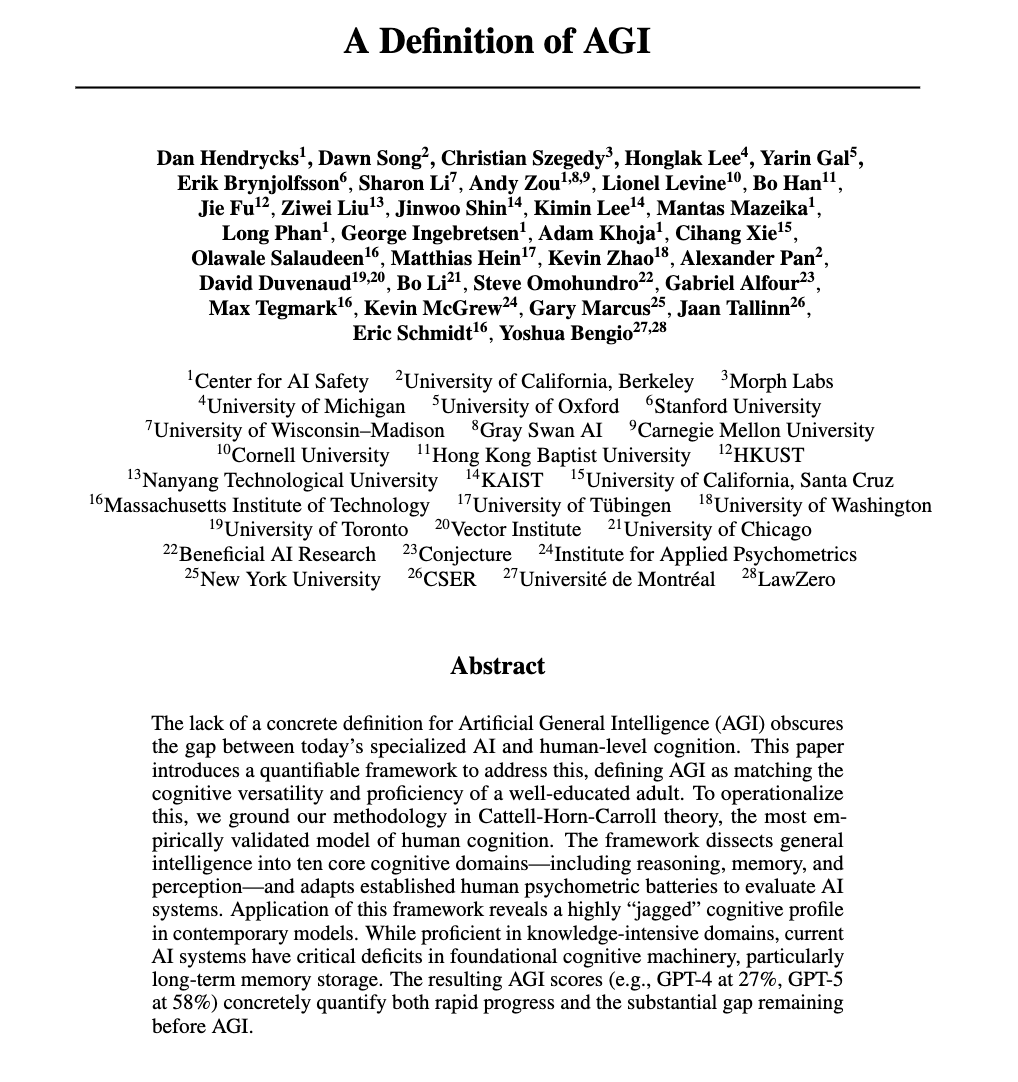
I finally understand what AGI actually means… and it’s all thanks to a new paper from some of the biggest names in AI Yoshua Bengio, Dawn Song, Max Tegmark, Eric Schmidt, and others.
For years, everyone’s been throwing the term AGI around like it’s some mystical milestone. But this paper finally pins it down with a definition that actually makes sense.
They describe Artificial General Intelligence as an 'AI that can match the cognitive versatility and proficiency of a well-educated adult.'
No marketing spin. No vague “human-level” claims. Just a clear benchmark based on how human intelligence actually works.
The researchers built their framework around something called the Cattell–Horn–Carroll model, which psychologists use to measure human cognitive ability. It breaks intelligence down into ten areas things like reasoning, memory, math, language, perception, and speed.
Then they did something bold: they tested real AI models against those same standards.
And here’s what they found:
- GPT-4 scored 27% toward AGI.
- GPT-5 jumped to 58%.
In other words, the latest model performs at more than half the cognitive range of an average human adult.
But it’s not there yet.
The biggest weakness? Long-term memory both GPT-4 and GPT-5 scored 0% in the ability to store and recall new information over time.
So yes, we’re making real progress.
But we’re still missing something fundamental the ability to remember and learn continuously.
What’s incredible about this paper is that it finally gives us a way to track that progress.
For the first time ever, AGI has a number.
And right now, we’re sitting at 58%.
99% of "future investors" never buy their first property.
Not because they can't find deals. Because they don't have a system.
I analyzed what separates those who actually close from those stuck in "research mode" for years.
Here's the brutal truth (and the exact path that works):
Most people don't fail because of bad deals.
They fail because they chase every property instead of defining their buy box. They trust gut feelings instead of numbers. They prepare for perfection instead of building systems.
The 1% who actually do it follow one path: Think → Buy → Own → Receive.
1. THINK stage kills 70% of beginners.
They never write down their "why." So when the first offer gets rejected, they quit.
The ones who make it? One clear sentence:
"I'm buying two cash-flowing doors to cover my mortgage in 24 months."
Clarity beats motivation every time.
2. BUY stage kills another 20%.
They wait for the "perfect" deal instead of perfecting their criteria.
Millionaire investors start with a formula:
Price range: 3x annual income
Cash flow: $200+/door
Location: 15 min from growth job centers
They stop guessing. They measure.
3. OWN stage is where amateurs burn out.
They manage with emotion. They underinsure. They over-upgrade.
Smart owners build rules before problems:
Rent > 1% rule (if not, pass)
6 months of reserves
Two contractors, never one
Systems replace stress.
4. RECEIVE stage is where wealth compounds.
But most never get here. They sell too early or refinance wrong.
Those who "receive" don't chase flips. They chase cash flow velocity how fast each dollar comes back to work.
They play a 10-year game in a 1-year market.
5. You don't need genius. You need stamina.
The ones who win aren't the best at spreadsheets they're the best at sticking to boring, repeatable rules while everyone else gets distracted by trends.
Save this 3-line checklist:
Define your why in one sentence
Write your buy box and stop chasing outside it
Build 6 months reserves before scaling
Do that for 90 days. You'll already be ahead of 99% of "future investors."
Anyone can do it. Not everyone will.
You get to decide which side of that sentence you live on.
Bruh… it’s over for 90% of video studios. 💀
Google’s Veo 3.1 can now generate films with character consistency, emotional flow, and dynamic camera movement.
Examples + how to try:
🚨 BREAKING: Veo 3.1 just got its first real production tool.
@invideoOfficial launched full integration today and it changes everything.
You can now go from 5-second clips → complete cinematic videos with perfect continuity.
Here's what just became possible 👇
🚨Google’s NotebookLM got an upgrade so crazy it feels like cheating.
NotebookLM now learns from your docs, builds summaries, and answers questions like it knows your brain.
Here’s everything you need to know🧵👇
Veo is getting a major upgrade. 🚀
We’re rolling out Veo 3.1, our updated video generation model, alongside improved creative controls for filmmakers, storytellers, and developers - many of them with audio. 🧵
Alibaba just released a new lineup of next-gen Qwen3 AI models - an update that takes multimodal performance to another level.
They’re incredibly fast. They’re extremely capable.
And they’re doing things I didn’t think were possible yet.
Here are 5 that blew my mind 👇
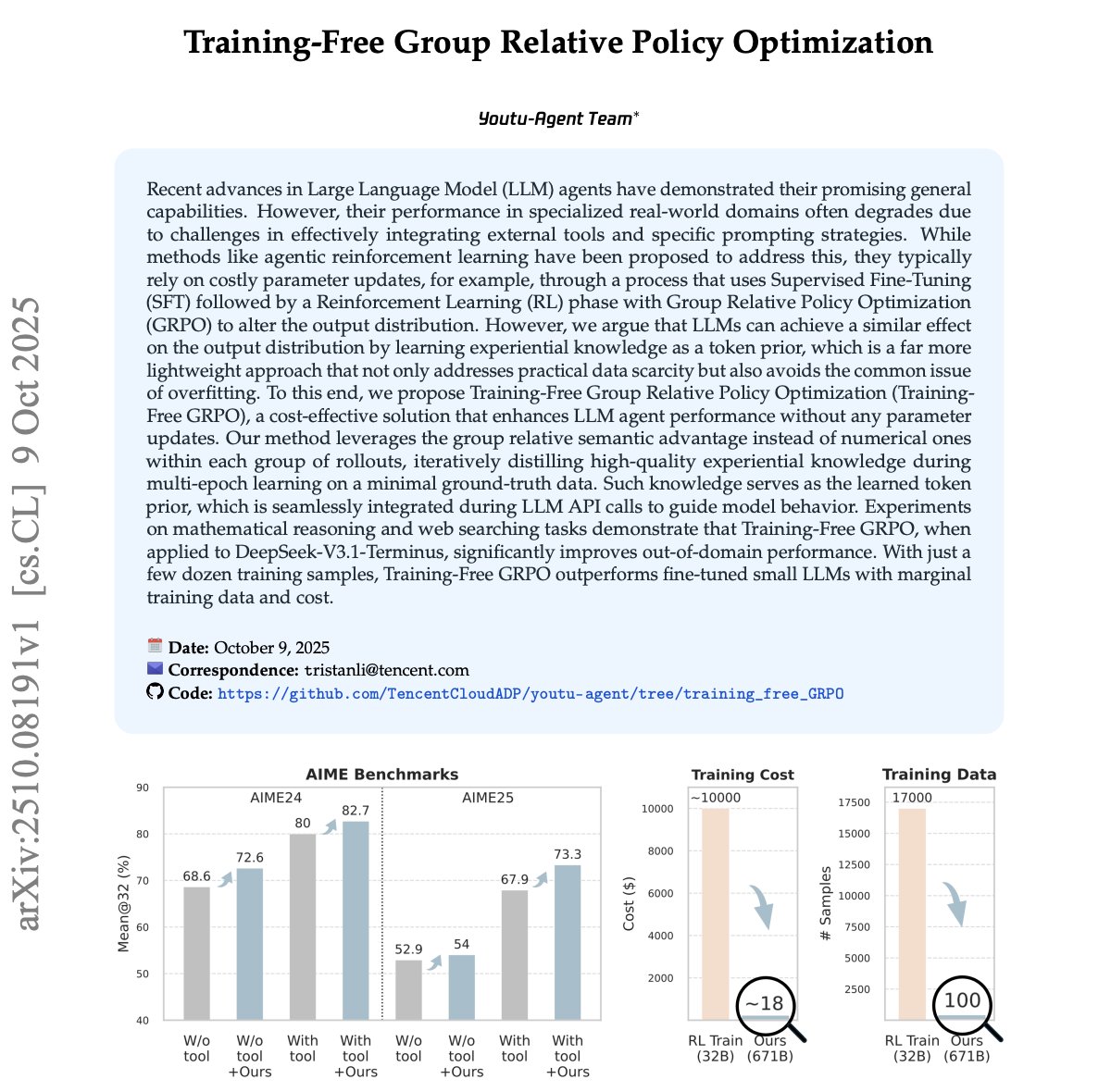
Holy shit... Tencent researchers just killed fine-tuning AND reinforcement learning in one shot 😳
They call it Training-Free GRPO (Group Relative Policy Optimization).
Instead of updating weights, the model literally learns from 'its own experiences' like an evolving memory that refines how it thinks without ever touching parameters.
Here’s what’s wild:
- No fine-tuning. No gradients.
- Uses only 100 examples.
- Outperforms $10,000+ RL setups.
- Total cost? $18.
It introspects its own rollouts, extracts what worked, and stores that as “semantic advantage” a natural language form of reinforcement.
LLMs are basically teaching themselves 'how' to think, not just 'what' to output.
This could make traditional RL and fine-tuning obsolete.
We’re entering the “training-free” era of AI optimization.
🚨 This paper might be the bridge between logic and intelligence.
It’s called Tensor Logic, and it turns logical reasoning into pure tensor algebra no symbols, no heuristics, just math.
Here’s the wild part:
Logical propositions become vectors. Inference rules become tensor contractions. Truth values propagate as continuous operations meaning deduction and neural computation now speak the same language.
This isn’t symbolic AI or deep learning. It’s both.
Tensor Logic proves that Boolean reasoning, probabilistic inference, and even predicate logic can all be embedded inside a single differentiable framework.
Every major AI model today struggles with consistency and reasoning because logic is discrete and gradients are continuous. Tensor Logic erases that boundary.
In experiments, the system performs logical inference as matrix math, allowing neural nets to reason with symbolic precision — and symbolic systems to learn like neural nets.
If this scales, we might finally get models that don’t just predict truths — they can prove them.
The fusion of logic and learning just got real.
Paper: “Tensor Logic: A Unified Framework for Differentiable Reasoning”
🚨 Google might’ve just reinvented how AI thinks
They built something called TUMIX, and it’s basically AI teamwork on steroids.
Instead of one mega model doing everything, Google made a squad of mini AIs that debate, challenge, and refine each other’s answers in real time.
One codes. Another searches. Another reasons.
They argue → share → vote → and reach consensus.
The result? Gemini-2.5 + TUMIX crushes every reasoning benchmark by +17.4% at half the inference cost.
No retraining. No extra data. Just coordination.
Here’s the twist:
A diverse team of 15 small agents outperformed 15 copies of the “best” single model.
Then Gemini started designing its own new teammates and got even better.
The system literally evolved smarter versions of itself.
Forget trillion-parameter monsters. The future of AI is small minds that think together.
Read the full paper: arxiv. org/abs/2510.01279
This is truly wild 👇
A new system called Paper2Video can read a scientific paper and automatically create a full presentation video slides, narration, subtitles, even a talking head of the author.
It’s called PaperTalker, and it beat human-made videos in comprehension tests.
Hours of academic video editing… gone.
AI now explains your research better than you do.
Here’s how it works (and why this changes everything):