Crypto's largest-ever ETH Slashing Cover is here
@ether_fi has selected Nexus Mutual to protect its validators against up to 15,000 ETH in slashing penalties
@ether_fi runs one of the largest validator sets on Ethereum, so slashing isn't a theoretical tail risk
This cover was structured to hold up in even the most extreme scenarios, and it represents more than all historical #ETH slashing losses combined
Protection built for institutional scale
"We've always believed the safest protocols will ultimately win. That's why we've invested heavily in audits, operational security, staking architecture, and now the largest insurance program in the industry. We are excited to partner with Nexus Mutual to make this a reality," said @MikeSilagadze, Founder & CEO of @ether_fi
"We've known the https://t.co/c0M0IMKoKi team since before it was https://t.co/c0M0IMKoKi, and they've been focused on risk from day one. Covering their stakers for up to 15,000 ETH in slashing penalties is a historic step, and we're proud they chose Nexus Mutual to take it with them," said @HughKarp
See the full announcement below!
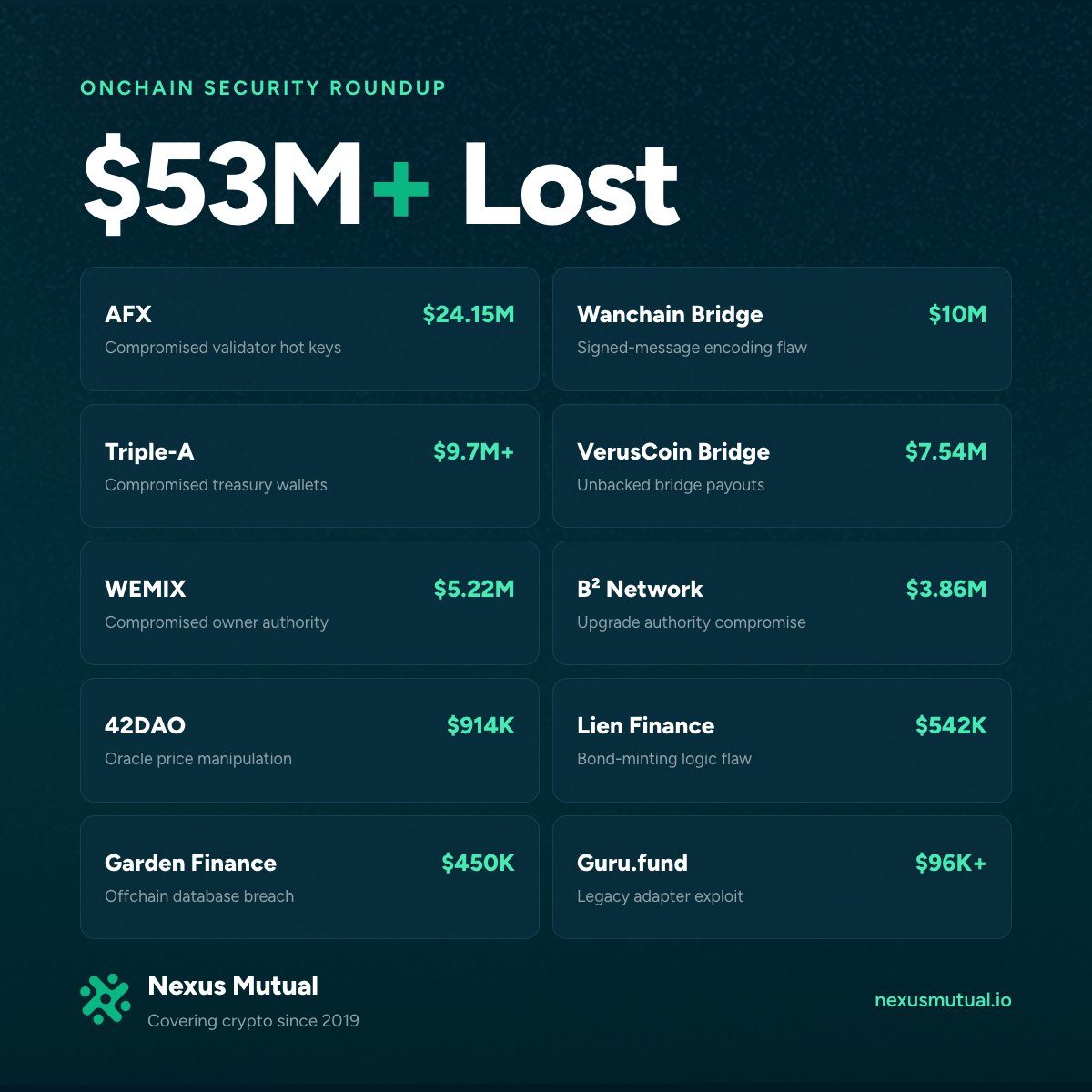
Last week had over $53 million in onchain losses, with 10 major incidents spanning key management, signer/validator control, upgrade authority, and more
AFX (Anti-Fragile Exchange): $24.15M USDC. AFX is a Layer 1 chain running a perpetuals exchange with an onchain orderbook. Compromised validator hot keys reportedly met the quorum with enough signatures to clear the threshold. AFX suspended the bridge and said trading infrastructure and mainnet were untouched; a 70% white-hat offer went unanswered.
Triple-A: estimated $9.7M to $11.8M. Triple-A is a Singapore payments processor that lets merchants accept crypto and get paid in fiat. Attackers took control of operational and treasury wallets across at least four chains. Triple-A says client funds weren't touched, and the Singapore Police Force is involved.
VerusCoin Ethereum Bridge: $7.54M. VerusCoin is a blockchain that lets people launch their own interoperable chains. This is the bridge’s second loss in two months, after the attacker abused submitImports to trigger Ethereum-side payouts unbacked on the Verus source chain. @blockaid_ calls it the same entry point and bug class as the $11.58M May loss.
Wanchain Cardano-BNB Bridge / NIGHT: $9M to $13M (depending on NIGHT's price, 515.2M taken in nine minutes). Wanchain operates cross-chain bridges. NIGHT is the token of Midnight, a privacy sidechain on Cardano. BlockSec's early read blames non-injective signed-message encoding in the Cardano-side TreasuryCheck validator, which let an approval for ~3,110 NIGHT on BNB Chain be reused to pull 203M. Wanchain took the bridge offline and acknowledged unauthorised withdrawals, the Midnight Foundation called it contained, and exchanges added precautions.
B² Network B2 staking: $3.86M (~$3.01M to $3.11M realised after ~$850K of slippage). B² Network is a Bitcoin Layer 2 and a staking service on BNB Chain. The draining address had held the staking contract's upgrade authority since 2025 and only lost it after the transfer, so this was likely a compromised or insider key rather than a seizure, though B² hasn't disclosed which. B² suspended staking, promised full compensation, and offered the hacker a white-hat bounty.
WEMIX: $5.22M (only ~$724K realised as the token collapsed from $1 to ~$0.0008). The attacker compromised owner authority on a WEMIX$-related contract (WEMIX is the blockchain arm of Korean game publisher Wemade), and minted 5.2M tokens outside DIOS, the stabiliser that only mints against incoming USDC, so the new supply had no reserve behind it. WEMIX suspended bridges, paused the WEMIX$ Module and PNIX DEX, withdrew foundation liquidity, requested exchange and issuer freezes, and has a contract-wide audit underway.
42DAO / Balance Protocol: $914K (plus ~$3.5M of nominal BLC erased as the token fell from $0.9954 to ~$0.0014). 42DAO is a MakerDAO fork on BNB Chain, critically missing the original’s Oracle Security Module. The attacker manipulated the BTCB feed through the Spotter/VAT liquidation path, which lacked TWAP, bounds, floor, drawdown and delay controls.
Lien Finance: $542K USDC. An attacker exploited this options protocol via a logic exploit that allowed for price manipulation in their OTC pools. SlowMist blames exchangeEquivalentBonds in BondMakerCollateralizedEth, which lacked multiset integrity checks and minted BondTokens without consuming collateral, while Defimon and ExVul trace the drain through GeneralizedDotc OTC pools. These are the original Lien BondMaker contracts, and the bug class matches the September 2020 whitehat rescue of ~$10M.
Garden Finance: $450K USDT across Ethereum, Base, Arbitrum and BNB Chain. Garden Finance is a Bitcoin bridge where solvers compete to fill cross-chain swaps. The bridge suffered an exploit after an offchain database breach let the solver release funds for unfunded swaps, its second such compromise in nine months after a ~$11M loss. Garden took the app offline, said nobody lost funds, and is investigating with zeroShadow, Quantstamp and Blockaid.
Guru-fund Lotus deployments: $96K to $101K (~$61.5K realised after slippage). The fund management protocol suffered a loss after an attacker exploited a legacy, never-verified P2P adapter that was left enabled in the protocol registry and could grant arbitrary token allowances through the delegatecall function during normal deposits. The Guru-fund team paused the protocol and announced the protocol will be winding down in the wake of this hack.
With the variety of attack vectors and pace of exploits, it’s clear that attackers are constantly looking for any way in.
Whether you’re a protocol, investor, or fund looking for protection against these risks and more, get in touch with our team today.
You’re Covered with Nexus Mutual
By popular allocator request, two new Covered Vaults are now live.
@maplefinance Syrup USDC and USDT, now with integrated protection against covered technical and economic onchain risks ⤵️
Real-world assets have grown 10x over the last few years to a market cap of nearly $30 billion
This makes tokenized stocks, treasuries and commodities a fixture in DeFi rather than a fad
However, it all rests on getting a real-world price onchain accurately, and some recent losses in the space have shown that can be a risky proposition
Whether it’s due to oracle failure, manipulation, misconfiguration, or a smart contract exploit, every link in the pricing chain is a potential flaw
What are the real risks behind RWAs, and how can you manage it?
Check out our blog to find out!
https://t.co/WxlmfuO3qK
Risk adjusted yield is the way to go 🤝
If you know the @avantprotocol team, you know they don't mess around when it comes to security
Explore the new Depeg Cover options below!
Another layer in the stack.
@NexusMutual depeg cover is now available for:
🔹 savUSD @ 2.1%
🔹 savETH @ 2.23%
🔹 savBTC @ 2.23%
Available now for holders who want an extra layer of protection.
Depeg Cover is now available for @frankencoinzchf users.
Users can now add protection against defined depeg events through OpenCover.
Built by OpenCover, underwritten by @NexusMutual ⤵️
The Onchain Security Roundup tracked 6 major incidents last week, with over $28.3M in reported losses
As smart contract security improves, attackers are going after the underlying economic assumptions (oracles, liquidity depth, mark prices) rather than the contracts themselves
Ostium: 23.75M USDC drained from its LP vault after offchain price-feed infrastructure was compromised. @blockaid_ reported that a registered PriceUpKeep forwarder and future-dated authorized oracle reports were used to create artificial trading profits to extract funds from the OLP vault. Trading remains paused, with investigation and LP recovery details pending
Allbridge Core: $1.65M lost from a flash-loan-assisted manipulation of Allbridge's StableSwap-style automated market maker, where the attacker exploited the same-asset swap accounting divergence. The protocol paused and asked LPs in affected pools to withdraw while the investigation continues
Cascade CLS Vault: $1.3M lost after thin-liquidity markets and manipulated mark prices triggered liquidations against the CLS vault. Trading and withdrawals remain paused
BarnBridge SMART Yield cUSDC: $776K drained from a dormant protocol after a governance takeover allowed the attacker to use legacy USDC approvals
DeFiTuna: $570K lost from a Solana lending-pool issue involving a highly illiquid TUNA/USDC pool, Jupiter routing, and a rounding/solvency-check flaw. DeFiTuna said the vector was identified and mitigated, with investigation and recovery ongoing
Lumi Finance / Sodium Smart Accounts: approximately $270K drained after a design flaw in smart-account validation logic allowed an attacker to gain unintended token approvals
These are the exact sorts of risk that Nexus Mutual can cover: oracle failures, oracle manipulation, governance takeovers, and smart contract exploits
Whether you’re a protocol, investor, or fund looking for protection against the changing risks in DeFi, Nexus Mutual is there to help
Introducing: Frankencoin depeg cover.
Frankencoin is the first non-USD stablecoin you can cover against a depeg.
For 0.99% p.a.
Live and available now.
Provided by @NexusMutual through @OpenCover
Our new insurance policy would cover all slashing events in the history of Ethereum slashing
No safer place to stake than EtherFi
Stake now:
https://t.co/lsw3Mcln1s
Ethereum is for shipping.
Here are some of the things the Ethereum ecosystem launched, upgraded, and announced over the past month.
0/ @RobinhoodApp launched Robinhood Chain (@RobinhoodCrypto) on mainnet, an Ethereum Layer 2 built on the @arbitrum stack, enabling 24/7 trading of tokenized stocks and ETFs for users in over 120 countries through Robinhood Wallet. The network surpassed $1B in DEX volume in just over a week.
1/ @aztecnetwork achieved Stage 2 rollup decentralization under @l2beat's framework, removing governance control over its core protocol and taking another step toward trust-minimized infrastructure.
2/ @VitalikButerin shared updates to Ethereum's evolving technical roadmap, outlining the next phase of Lean Ethereum and the protocol's long-term direction.
3/ @ethlabs_org launched as a non-profit R&D lab for Ethereum and ETH. Their mission is to make Ethereum the settlement layer of the global economy.
4/ @ethereuminsti launched as an independent non-profit dedicated to accelerating the institutional adoption of Ethereum, its L2s, applications and overall ecosystem.
5/ @aave introduced Stable Vaults, fixed-rate stablecoin yield vaults designed for seamless integration into consumer applications.
6/ @zama launched the First DeFi Yield Venue for Confidential USDC (cUSDC) in partnership with @Morpho and @SteakhouseFi, bringing private stablecoin lending to Ethereum.
7/ @swissknifexyz launched a new Privacy Protocol Tracker, making it easier to compare fees, wait times, supported chains, and other metrics across Ethereum privacy protocols.
8/ Global tickets for @EFDevcon 8 went live, alongside speaker applications for this year’s conference in Mumbai, India.
9/ @Optimism and @toss__official signed an agreement to explore bringing the Korean Won onchain, expanding blockchain-based financial infrastructure for one of South Korea's largest fintech platforms.
10/ @OctantApp completed Epoch 12, its first full quadratic funding round using a zero-knowledge vote coprocessor and new voting application, distributing 88.1 WETH to Ethereum public goods projects.
11/ @0xprivacypools launched the trusted setup ceremony for Privacy Pools V2 ahead of its next protocol deployment.
12/ Gwei Name Service launched an ownerless, immutable Ethereum naming system built without administrative ownership.
13/ @ammalgam launched on Ethereum mainnet, introducing oracle-free lending without impermanent loss.
14/ @lodestar_eth added support for Fast Confirmations, allowing Ethereum node operators to confirm transactions in a single slot using validator attestations.
15/ @PrivacyBoost introduced preconfirmations for private transfers, allowing transfers to be treated as usable in around one second before final settlement.
16/ The @ethereumfndn published Ethereum Basics for Governments and Institutions, a new primer introducing Ethereum as a credibly neutral digital public utility for policymakers and enterprise leaders.
17/ @OndoFinance launched @OndoPerps, enabling tokenized stocks to be used as collateral for perpetual futures across equities, commodities, and indices.
18/ @base introduced Base Privacy, giving enterprises infrastructure to trade, pay, and settle onchain with built-in confidentiality and compliance features.
19/ @BGDA_UK launched BAGEY, a natively tokenized UK regulated fund on Ethereum where the blockchain serves as the legal register of record.
20/ @sparkfinance launched the Stablecoin FX Layer on @Uniswap v4, introducing shared liquidity infrastructure that lets stablecoins access a common liquidity layer.
21/ @Trueo_ launched user-created prediction markets, allowing anyone to create a market by asking a question and letting participants trade on the outcome through a fully onchain prediction market.
22/ @kpk_io integrated @OpenCover Covered Vaults, allowing depositors to add opt-in onchain insurance to curated vaults, with coverage underwritten by @NexusMutual.
23/ @PropellerSwap launched Turbine on Ethereum mainnet, enabling large trades to settle with lower slippage by sourcing liquidity across onchain, offchain, and peer-to-peer markets.
24/ Hosted by @web3privacy, the Neocypherpunk Summit brought together around 1,000 builders and researchers in Berlin to advance privacy, open-source infrastructure, and human rights.
25/ @eth_systems launched as a company building modular privacy infrastructure for institutional Ethereum.
We at @NexusMutual are proud to protect @ether_fi and their users against slashing penalties with the industry's largest ETH slashing cover
etherfi takes security seriously, and it's always a pleasure working with their team 🤝
Crypto's largest-ever ETH Slashing Cover is here
@ether_fi has selected Nexus Mutual to protect its validators against up to 15,000 ETH in slashing penalties
@ether_fi runs one of the largest validator sets on Ethereum, so slashing isn't a theoretical tail risk
This cover was structured to hold up in even the most extreme scenarios, and it represents more than all historical #ETH slashing losses combined
Protection built for institutional scale
"We've always believed the safest protocols will ultimately win. That's why we've invested heavily in audits, operational security, staking architecture, and now the largest insurance program in the industry. We are excited to partner with Nexus Mutual to make this a reality," said @MikeSilagadze, Founder & CEO of @ether_fi
"We've known the https://t.co/c0M0IMKoKi team since before it was https://t.co/c0M0IMKoKi, and they've been focused on risk from day one. Covering their stakers for up to 15,000 ETH in slashing penalties is a historic step, and we're proud they chose Nexus Mutual to take it with them," said @HughKarp
See the full announcement below!
We’ve partnered with @NexusMutual to provide the largest ETH slashing cover in crypto history
Up to 15,000 ETH in validator slashing penalties
We run one of the largest validator sets on Ethereum
With $7+ billion in onchain risk covered since 2019, there was no better partner than Nexus Mutual