0 stories from AP on Henry Nowak
0 stories from PBS on Henry Nowak
0 stories from NYT on Henry Nowak
0 stories from NPR on Henry Nowak
0 stories from WSJ on Henry Nowak
0 stories from CNN on Henry Nowak
0 stories from MSNBC on Henry Nowak
The good news? People are catching on.
The surveillance, the tracking, the data‑harvesting, folks are getting tired of being treated like products.
If there’s one thing that can unite people, it's the shared desire to not be tracked 24/7.
United Against Flock!
A trans Indian migrant who arrived in the UK a few years ago and is not a citizen or permanent resident was elected to the Scottish parliament as a member of the woke Green Party. Scotland allows non-citizens to become elected to office.
“Q Mannivannan” is set to earn over $100k USD despite not having the right to work full time on his temporary visa.
🚨NON-DOMICILE CDL DRIVER CAUGHT HAULING HIDDEN HAZMAT LOAD THRU ARKANSAS - AND ARKANSAS HIGHWAY POLICE ENFORCEMENT OFFICERS FAIL TO CHECK HIS IMMIGRATION STATUS
A non-domiciled CDL driver, licensed in California—unable to speak English and appearing to speak Mandarin (unconfirmed)—was caught hauling tanks of nitrous oxide ("puff gas" in colorful, kid-targeted canisters like Galaxy Gas, which is blowing up on TikTok). There was zero declaration on the bill of lading, no hazmat placards on the truck, and the driver had no HazMat endorsement on his non-domiciled CDL - making him completely unqualified to haul it.
If they're hiding undeclared hazardous materials this boldly, what else could they be hauling? Yet law enforcement fails to even check his immigration status or call ICE.
Why is Arkansas leadership refusing to fully vet these out-of-state non-domicile CDL holders when they're now widely known to be illegal aliens and endangering the safety of Arkansans? It's important to understand that this same leadership also blocked legislative efforts in HB1569 to prevent this activity.
Demand real enforcement NOW!
1. Revoke and Ban All Non-Domicile CDLs!
2. Check The Immigration Status of Every Driver in Possession of Non-Domicile CDLs!
3. Check The Immigration Status of Every Truck Driver from CA, TX, and FL!
#BanNonDomicileCDL #HazMatCrisis #RoadSafety #ArkansasFirst #AmericaFirst @ARHighwayPolice
Bahrain says an Iranian strike damaged a desalination plant, marking a new phase of the conflict targeting water infrastructure.
Gulf countries rely heavily on desalination.
Qatar nearly 100%, Kuwait and Bahrain ~90%, Oman 86%, Saudi Arabia 70%.
The strike came after U.S./Israeli airstrikes targeted Iran's desalination plant on Qeshm Island.
Now, if we could only petition the federal government to do the same. Sadly weasel John Thune is blocking the voice of the people. Somebody must have some serious dossier on this guy, that he would block the will of a super majority of Republicans and a healthy majority of Democrats. It may be the only thing both Democrats and Republicans have agreed on in years, yet the leaders of both parties, Schumer, and Thune, are blocking it with all their might. The deal stinks to high heaven.
Yesterday, I explained how seven insurance firms in London shut down one-fifth of the world's oil supply.
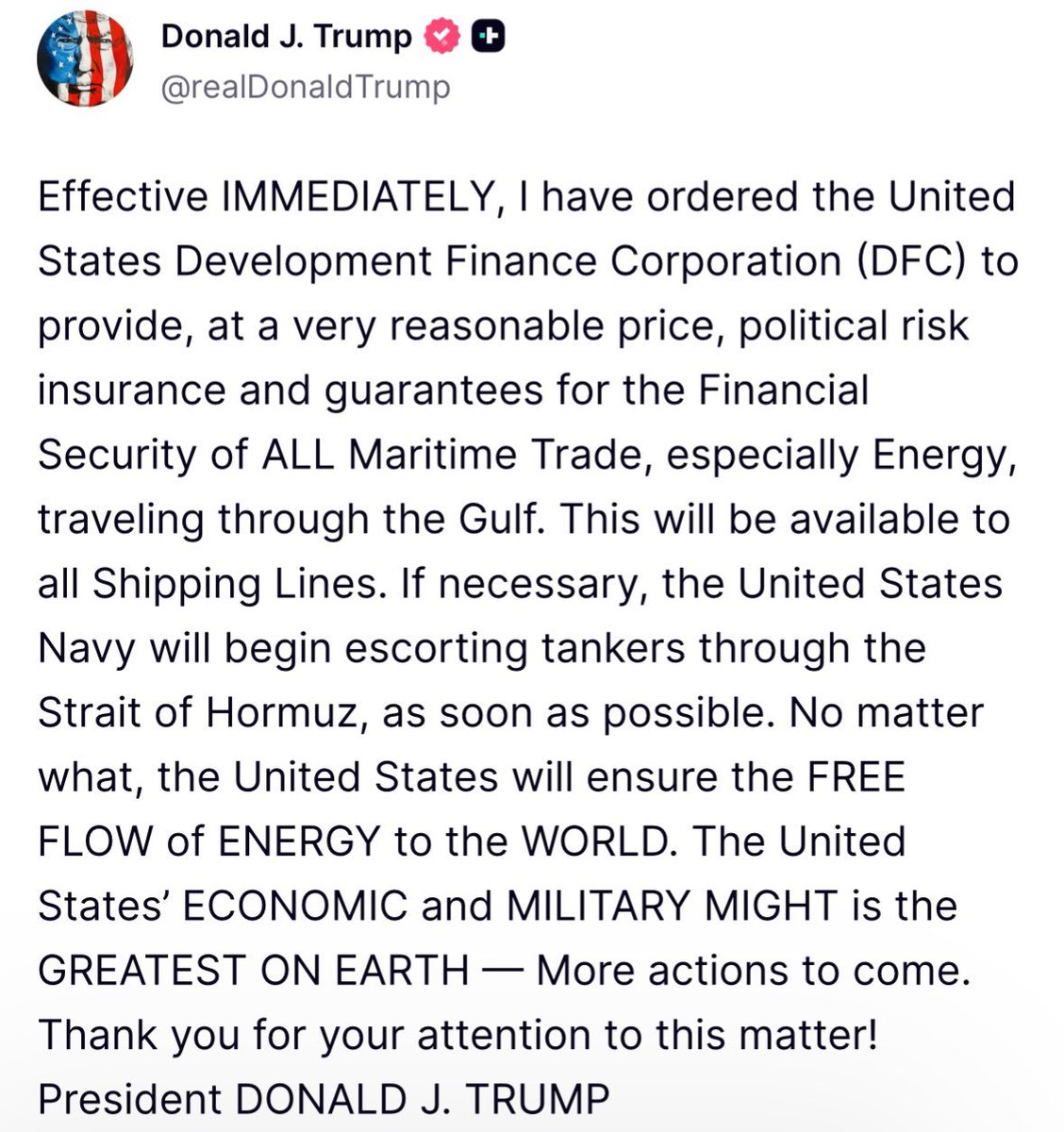
Today, Trump may have just made the most aggressive sovereign insurance play in modern history.
Here's what happened and why it matters:
Trump ordered the U.S. Development Finance Corporation to immediately offer political risk insurance and guarantees to all maritime trade through the Gulf. Especially energy. Backed by Navy escorts if needed.
Read that through the lens of what I described yesterday.
The Strait didn't close because of missiles. It closed because the insurance market collapsed. P&I clubs pulled coverage, reinsurers withdrew, and the entire commercial shipping architecture froze.
This move doesn't address the military problem. It addresses the actuarial one.
The DFC is stepping into the void that Lloyd's and the London reinsurance market created when they pulled out. The U.S. government is effectively saying: we will underwrite what the private market won't.
No sovereign has attempted to replace the global marine war risk market in real time during an active conflict. Here's why the structural implications are significant:
1. It challenges Lloyd's dominance.
For centuries, London has been the center of gravity for marine insurance. Lloyd's and its reinsurers controlled pricing, terms, and risk appetite for global shipping.
That concentration is exactly what made the actuarial blockade possible. A handful of firms in one city froze global oil flows.
The DFC offering competitive political risk coverage to all shipping lines is a direct challenge to that architecture. If American-backed insurance proves cheaper and more reliable during crises, shippers may not return to London when the dust settles.
2. It breaks the actuarial blockade.
I said yesterday that China has massive leverage over Iran but zero leverage over Lloyd's. The same was true of every oil-producing and oil-consuming nation watching their economies choke.
This goes around the insurance market entirely. If the DFC covers the voyage and the Navy escorts the tanker, the ships sail. Oil flows. The spreadsheet blockade breaks.
3. It redirects billions in premium revenue.
War risk premiums in the Gulf are currently running at extreme multiples — 3× to 5× pre-conflict rates. Those premiums were flowing to London reinsurers who then pulled coverage anyway.
Now those premiums flow to Washington. At rates the DFC can set below the panicked London market, while still generating substantial returns. The same shippers get cheaper coverage. The revenue just changes continents.
4. It creates a chokepoint within the chokepoint.
The Strait of Hormuz is already the world's most critical energy bottleneck. If the U.S. is both insurer and naval escort, America controls access at two levels: physical security and financial coverage.
No other nation can replicate that. You need the world's dominant navy and a sovereign balance sheet large enough to backstop the risk. Only one country has both.
5. It reassures every stakeholder simultaneously.
Gulf producers were watching exports freeze. Asian and European consumers were watching energy prices spike. Both feared the Iran campaign would wreck their economies.
One announcement addressed all of them: your oil will move, your ships will be covered, and the rates will be reasonable.
Yesterday I described a system with no TARP, no Fed equivalent, no backstop at global scale.
This may be the first attempt to build one in real time, during the crisis itself.
The actuarial blockade just met a sovereign counterparty.