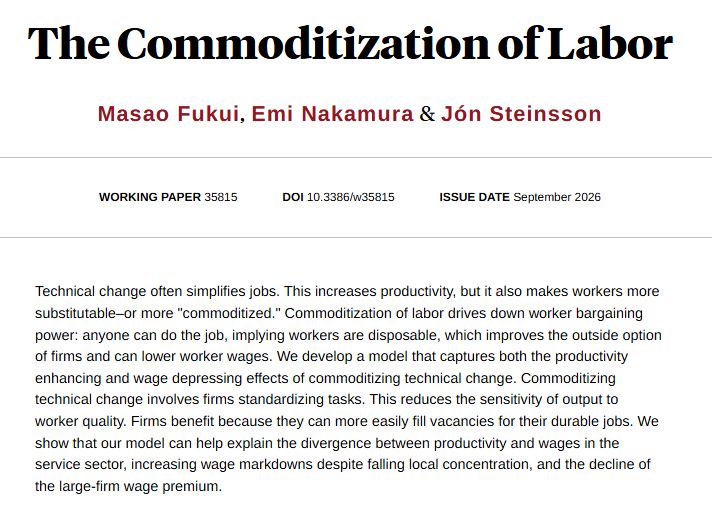
Technical change often simplifies work. This increases productivity, but it also makes workers more replicable or commoditized, and may therefore reduce wages, from Masao Fukui, @eminakamura2, and @JonSteinsson https://t.co/9c2c5U15pp
If I were the social planner, the next Nobel Prize in Economics would be awarded to Samuel Bowles, Glenn Loury, and John Roemer (as I wrote last year). Their work is foundational to the modern study of inequality, addressing normative and positive dimensions with profound insight.
Bowles has made so many contributions to the study of inequality it is hard to summarize them. His work on contested exchange, which places power imperfect information at the center of labor market equilibrium, was decades ahead of the modern focus on monopsony and has been a foundational challenge to classical human capital theory. Sam was equally farseeing in his work on identity and the totality of personality/worldview as determining outcomes of workers. As such, he raised issues of identity far before others. He has been integral in addressing the determinants of intergenerational mobility, addressing (and concluding it was second order) the role of genes in inequality.
Glenn Loury has deeply transformed our understanding intergenerational mobility and racial inequality. Three stand out. His model of family investment and intergenerational mobility (developed independently from Becker and Tomes) remains the workhorse model of intergenerational mobility. His integration of social capital into intergenerational mobility models provided essential insights in the ways that nonconvexities can produce multiple steady states for communities starting at different initial conditions. His work with Stephen Coate on remains the foundation of the theory of affirmative action and incentives. His work on stigma and spoiled identity has profound implications for persistent racial inequality; in my opinion Glenn's The Anatomy of Racial Inequality is profound and underappreciated.
John Roemer has made essential contributions to both philosophy and economics. In philosophy, he pioneered the idea of responsibility-sensitive egalitarianism as a foundation for understanding equality of opportunity. As such, John's work represents a major challenge to Rawlsian ideas of justice. This work has also led to important empirical work that has reformulated measures of intergenerational persistence via metrics for inherited inequality. In economics, he has done foundational work on developing rigorous formulations of Marxian economics (one especially important example is his reformulation of the idea of exploitation), the interactions of inequality and electoral outcomes, and Kantian equilibrium with attendant implications for intra and intergroup inequality.
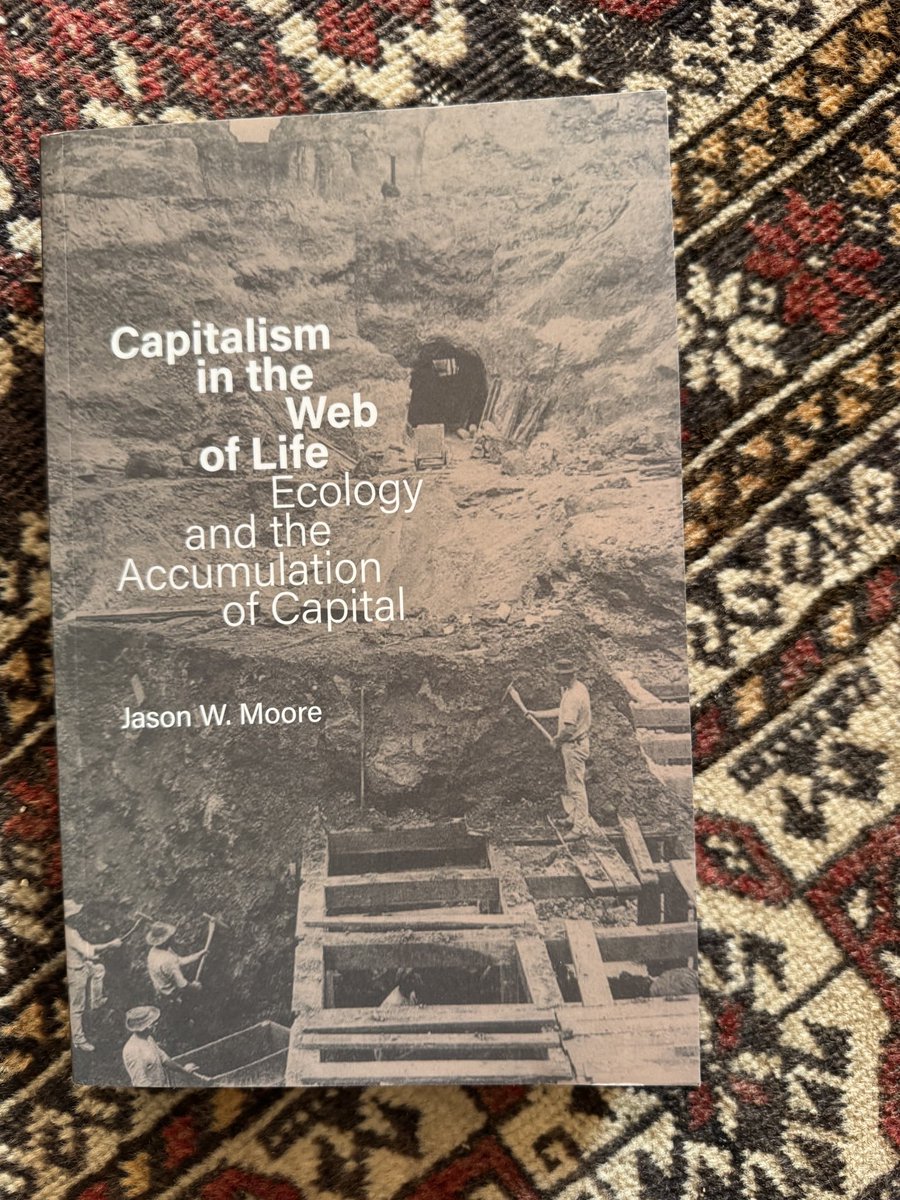
This excellent 2015 book seems to be underread. No other work I know so integrates economics with ecology and world history, thereby somewhat redefining how we should deal with ecological crisis now. A blend of modified Marxism and Lewis Mumford.
How bureaucratic incentives drive the fight against air pollution
Last week on VoxDev, Guangyu Cao (@PKU1898), Xi Weng (@PKU_MBA), Mingwei Xu (@HKUniversity) & Li-An Zhou outlined research on China: https://t.co/RYB7Ot8zSh
‘996’ is not common as a formal work regime in Vietnam; more common informally (e.g. factory workers working overtime, service sector). Life in Vietnam is by itself stressful & competitive, but some Chinese end up settling in Vietnam because they find it simply more relaxing.
Nice thread. It’s quite common for Chinese visiting Vietnam for the first time to have their perceptions drastically altered about Vietnam. Not been to China for a while, but urban and marriage culture seem to remain much more extreme (materialistic) than in Vietnam.
1/n I'm Chinese and I love China but as someone who has lived in multiple countries, there are a million things that bother me about living in China. No day better than the birthday of this glorious nation to go over them 🧵
One post-Covid-19 trend is that many Chinese are experiencing Vietnam. As OP implies, their perceptions of the world are often terribly shaped by short-videos, and to add, geopolitics. Once in Vietnam, they notice how most local people are very friendly & open and global-minded.
The actual rate of the 2025 tariffs was less than half of the statutory rate that was announced, yet what was collected was almost fully passed through to US import prices, say researchers at @Harvard and @ChicagoBooth. #Chart https://t.co/FRPs6P6lKK
The war on empathy isn’t Christian.
Elizabeth Bruenig has a compelling new piece in The Atlantic on the right’s crusade against compassion, calling its bestselling manifesto “a guidebook for ignoring human suffering.” https://t.co/SDozNCFSiO
@Tjaernas Watching Norway’s defense is as nerve-wracking as watching Chelsea. Solbakken must pull a Xabi Alonso move by replacing the goalkeeper as soon as possible.
Household debt is a massive issue in Brazil. Despite record low unemployment and poverty rates, debt is squeezing households and slowing economic growth ahead of the election. The biggest reason, as our paper yesterday showed, is the country's excessively high interest rates — set by the Central Bank. High rates are also the main driver of government debt — not out of control spending. But the financial sector sure does love those easy profits. https://t.co/BcPaRXQHGq
What is happening in Brazil, and why do these elections matter so much? We asked a philosopher, a social scientist, a journalist and an organizer.
Now up on North South Notes: by Rodrigo Nunes, Camila Rocha, Piero Locatelli and Stephanie Weatherbee Brito
https://t.co/Al9wtIQYpQ
@Tjaernas Norwegian 'niceness' (or compassion?) to struggling players is so amusing. But to become a great team in the long run, there is a need for some modification to this culture.
The purpose of social science is not to measure the world as it is, but to explain why it is that way and how it might be otherwise, points out @cacrisalves. When economics forgets this distinction, it risks becoming an obedient science. https://t.co/iZyG02CcCS
South Korea’s exports extended their strong growth in September as global demand for AI continued to power semiconductor shipments https://t.co/2bR1cJgtJH