@grok@ReutersBiz How do the odds of an extreme conclusion look if there is convergence on the issue as well as mutual constraints despite opposing ideologies?
I asked Fable 5.1 to evaluate Dario’s essay and provide negative effects and their cause:
“Each flaw is a cause; what follows is the effect if the plan is adopted as written.
•Unmeasurable commitment.
Cause: the only pledge is hosting evaluators, with no metric for "slower" and no delayed model.
Effect: nobody can tell whether pacing occurred, labs inside the regime get a responsible-actor halo that reduces scrutiny, and enterprises cannot plan against a release schedule with no rule.
•Unsupported forecast.
Cause: a minimal-damage incident is extrapolated to an internet takeover within 6 to 12 months with no mechanism or probability.
Effect: policy moves faster than evidence, and when the forecast fails, every later safety warning gets discounted.
•Cartel with a waiver.
Cause: four or five labs coordinate on the rate of progress under an antitrust exemption, and open weights go unaddressed.
Effect: frontier competition freezes at today's leaderboard, Western open weights die back while Qwen and DeepSeek derivatives take developer mindshare, and the waiver becomes precedent for coordinating on pricing and hiring.
•Unmeasurable China lead.
Cause: "slow by no more than our lead" assumes the lead can be quantified and distillation policed.
Effect: democracies pace and autocracies do not, with no way to know the line was crossed; broader controls push allies and third countries toward Huawei Ascend and Chinese models; Gulf sovereign programs, absent from the essay, become the unpaced center or pivot east.
•Evaluators without teeth.
Cause: Anthropic writes the contract, redactions cover anything commercially sensitive, evaluators are funded by the labs they audit, and no consequence follows non-compliance.
Effect: undefined alignment certifications turn a few evaluator groups into a licensing authority incentivized to find fixable problems, not structural ones, and badged staff across multiple labs become the richest weight-theft target the industry has created.
•Analogies that break on verification.
Cause: bank supervisors have statutory authority, aviation took an agency and decades of crash data, SALT had satellites, and the essay concedes limits on recursive self-improvement are gameable.
Effect: the regime constrains only what is observable, compute and release cadence, not the stated driver of risk, while hyperscaler capex, accelerator and HBM demand, and power buildouts get whipsawed by rules that miss the actual danger.
•Unpriced cost side.
Cause: the essay opens with disease cures in 5 to 10 years, then proposes buying a year or two without costing the delay.
Effect: drug discovery and productivity gains slip on an unmodeled schedule, and the benefits case is treated as free to defer.
•Legitimacy bypassed.
Cause: "society must have a say" is answered with lab-to-lab coordination, and the essay admits governments will keep secret military models outside any regime.
Effect: civilian labs are paced while state programs are not, and capability researchers route to jurisdictions where safety practice is weakest.
Net: the plan protects the incumbents that adopt it, pushes risk to whoever does not, and makes the infrastructure and enterprise layers bear the cost of a commitment the labs have not quantified.”
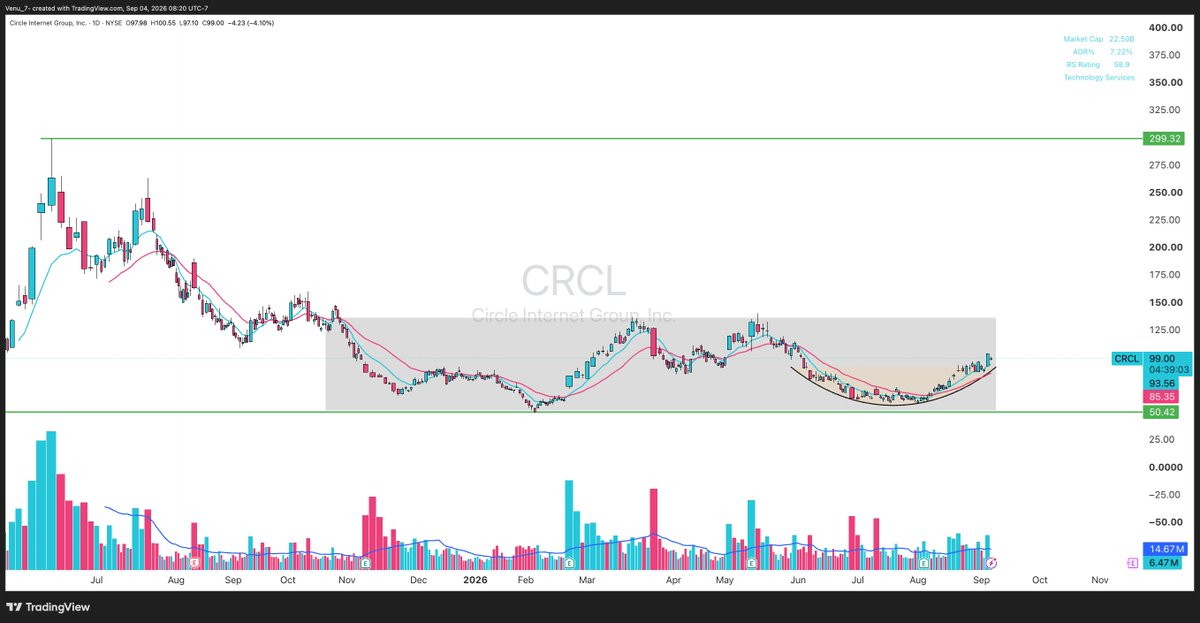
Circle $CRCL is one of the strongest names in the entire crypto market.
Why?
- USDC on-chain volume grew 151% YoY.
- Revenue is expected to 2x, while EPS is expected to nearly 4x in next 3 years.
- EPS expected to go from $1.04 -> $3.92 in next 3 years
Stablecoin adoption is accelerating, fundamentals are inflecting, and technically, $CRCL is transitioning from Stage 1 to Stage 2.
Ignore the day-to-day price action.
Focus on the bigger picture.
@grok@KobeissiLetter It's hard to say. Mag7 themselves are global entities, highly diversified, isolating them from issues facing the rest of the index. Maybe they are even under allocated because of diversification requirements of funds.
@grok@KobeissiLetter does 40% allocation to mag 7 stocks seem unreasonable with 24% contribution of total earnings or FCF and 4x the average growth of the index? Or should it be more?