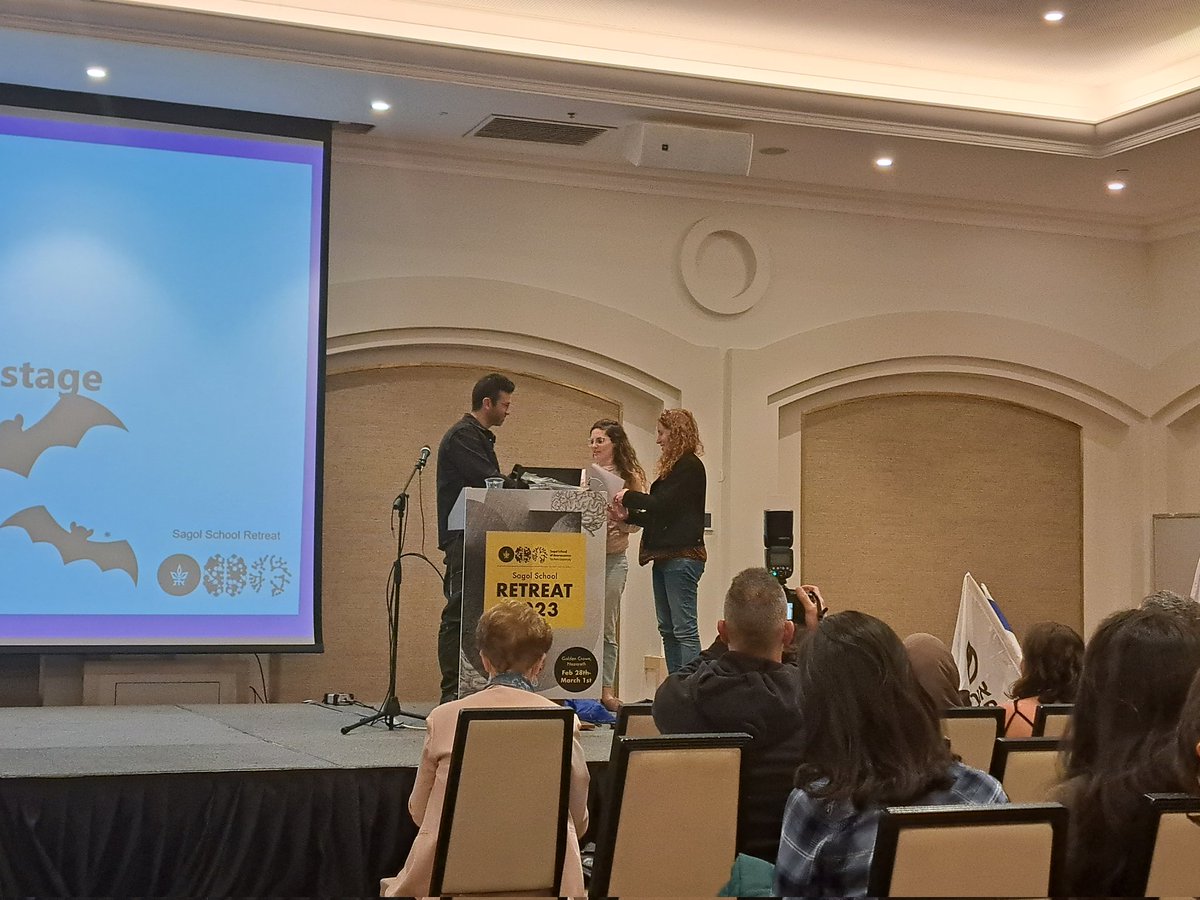
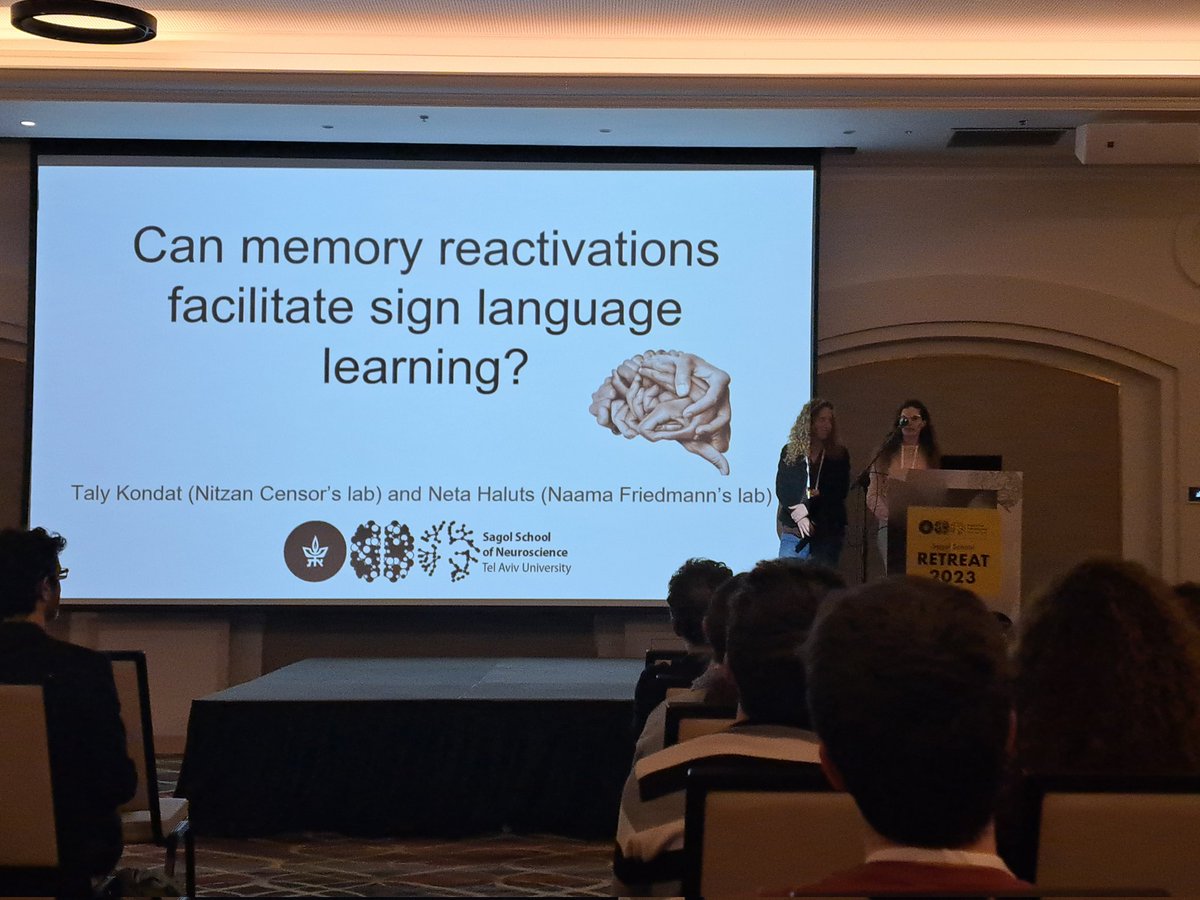
Our lab having fun at the @of_sagol retreat in beautiful Nazareth, with the one and only Taly Kondat presenting and winning the SNIP student award together with @NHaluts, in our collaboration with @FriedmannNaama.
It was great to present our work at the #iscop2023 today, about a specific type of dyslexia, Letter Position Dyslexia, in deaf signers - which sheds light on non-spatial nature of LPD @levy_doron@FriedmannNaama
@NHaluts presenting our work with @levy_doron: letter position dyslexia in 2 deaf signers who make transpositions when they read both written Hebrew and fingerspelled words! Suggesting that reading fingerspelling uses the same process as written words. #lablabTAU#iscop2023
Very interesting collaborations will be presented this Tuesday at the MILA center event! I will present (shortly!) our work (with Hadar Fisher-Green) on dyslexia and syntactic impairments and how they relate to white-matter pathways @FriedmannNaama. You are all invited!
Who wants to hear about some cool research on #Mind, #Brain and #Language?
The Cukier-Goldstein-Goren Center for Mind, Cognition and Language (MILA) invites you to join us in a fascinating event on February 22nd, 5pm (Israel time).
Registration link:
https://t.co/S0mkxEfOGW
Turns out that Akko conference #ISCOP2022 can be fun and interesting even without hummus! @NHaluts is presenting our research with @doronlevy showing a double dissociation betwen impaired
position encoding in numbers and words in two signers of Israeli Sign Language. #signhub
Our new study was just published in Journal of Neurolinguistics, and shows that the effects of thiamine deficiency on language abilities persist into adulthood. @FriedmannNaama@YuvalK_language https://t.co/NO3bD9NMbP
An new paper with @NHaluts and @FriedmannNaama in Journal of Neurolinguistics "The long-lasting effects of thiamine deficiency in infancy on language: A study of a minimal-pair of twins" https://t.co/79OFIzDZk5 >>
Sign language helps us learn about number processing and impairments in number reading! https://t.co/gYBK4fVKS5 @FriedmannNaama@levy_doron in this study we identified a specific type of dysnumeria, a specific impairment in number reading, in a deaf signer.
conclusions:
1) construction of the abstract decimal frame of multi-digit numbers is shared by reading and comprehension.
2) in addition to the decimal-route, there is also a sub-decimal route for number reading (just the sub-lexical routes in reading!)
When asked to read multi-digit Arabic numbers and decide whether they are greater then 5500, our participant made similar errors of decimal shifts in comprehension - suggesting that her deficit is shared by reading-then-signing and comprehension from written multi-digit numbers.
the unique properties of sign language helped us understand better the process of multi-digit number processing, and lead to new insights about the number reading model:
@Doc_Harding Yes there is! check out https://t.co/zohbGjqvsw for types of dysnumeria, one of which is exactly the decimal one you discovered,https://t.co/hM11R07c2F for dysnumeria without dyslexia, and https://t.co/EQIaXBBciO for dysnumeria in sign language! @DrorDotan@NHaluts@levy_doron
Today at #ISCOP21: @NHaluts & @levy_doron presenting a first case of dysnumeria (a deficit in number reading) in a deaf signer: similar to dysnumeria in spoken languages, and with implications to the number model: an abstract number frame share to reading and comprehension!
@yuvalkatz אצלינו הם גם היו חולניים כל השנה הראשונה לחייהם - היו משתעלים ומתעטשים ואוכלים רק אוכל היפואלרגני!!! וכמובן מלא ביקורים אצל הוטרינר. ואז פתאום זה פשוט עבר להם.