Constellation is still alpha: it runs alongside Hasura today, and Hasura still owns metadata authoring.
Missing features include Actions, Event Triggers, REST endpoints, inherited roles, native queries, and computed fields.
We’re sharing it now to get feedback from real Hasura schemas, metadata, and traffic.
GitHub: https://t.co/aXsppHlvdY
We just open-sourced Constellation: a Hasura-compatible GraphQL engine written in Go.
It reads Hasura metadata, generates a compatible schema, and exposes the same /v1/graphql API for the core request path.
Already serving production traffic at Nhost.
• Memory: ~15 MiB vs Hasura’s ~180 MiB
• Latency: ~40ms vs Hasura’s 60–80ms spikes
https://t.co/SrdqUekZNE
TIL: Nhost storage buckets live in `storage.buckets` — a real DB table. So you can create them via SQL migrations, version-control your storage config, and query bucket settings through GraphQL.
No magic config files. Just Postgres.
https://t.co/TEhR1iqdoR
One underrated pattern in Nhost permissions: use `X-Hasura-User-Id` as a column preset on insert.
No client-side user ID passing. No trust issues. The backend sets it automatically from the session.
Users can only ever create data owned by themselves.
https://t.co/rdBdRzJCgs
The service is fully open source. Full writeup with setup steps, config options, and the reasoning behind the auth design here: https://t.co/19LJj9nbHh — feedback welcome on Discord or GitHub.
Introducing the Nhost MCP service:
• Turn any Nhost project into an agentic service AI assistants like Claude can connect to
• AI becomes a new interface to your product
• Deploy to Nhost Run in one click
From API-first → agent-first
Nhost is becoming an agentic platform 🚀
Read more ↓
https://t.co/8uhPGIkSbh
What's next: configuring which projects are accessible to LLMs, expanding beyond read-only on the reference impl, more tools, and eventually enabling the service directly from nhost.toml without needing a separate Run service.
Ever wonder what happens when a user clicks "Sign in with LinkedIn"?
LinkedIn issues an OAuth token → your backend verifies it → a session is created. No passwords stored, no custom auth logic.
Nhost handles all of that for you.
https://t.co/QxUtPLHwQD
Tired of "it works on prod but not locally"?
With the Nhost CLI, you spin up the full stack locally: Postgres, GraphQL APIs, Auth, Storage, Functions, and optionally Run Containers — all with `nhost up`.
Changes via the dashboard auto-generate migrations. Git commit. Deploy. Done.
https://t.co/WwKyxOkehQ
A gotcha with Next.js auth forms: don't put your auth logic directly in client components.
Use server actions instead and you get proper session handling server-side.
https://t.co/RHinTBoJHH
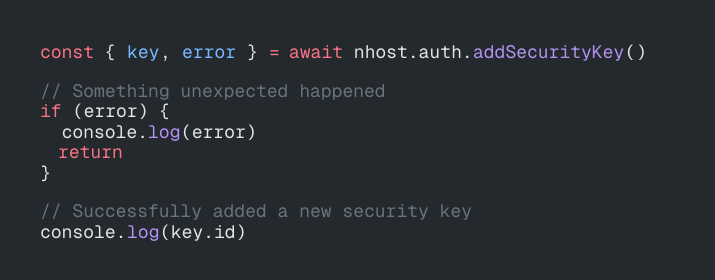
Adding WebAuthn / biometric sign-in to your app is as simple as this.
Touch ID, Face ID, Windows Hello, Yubikeys — all supported out of the box with Nhost Auth.