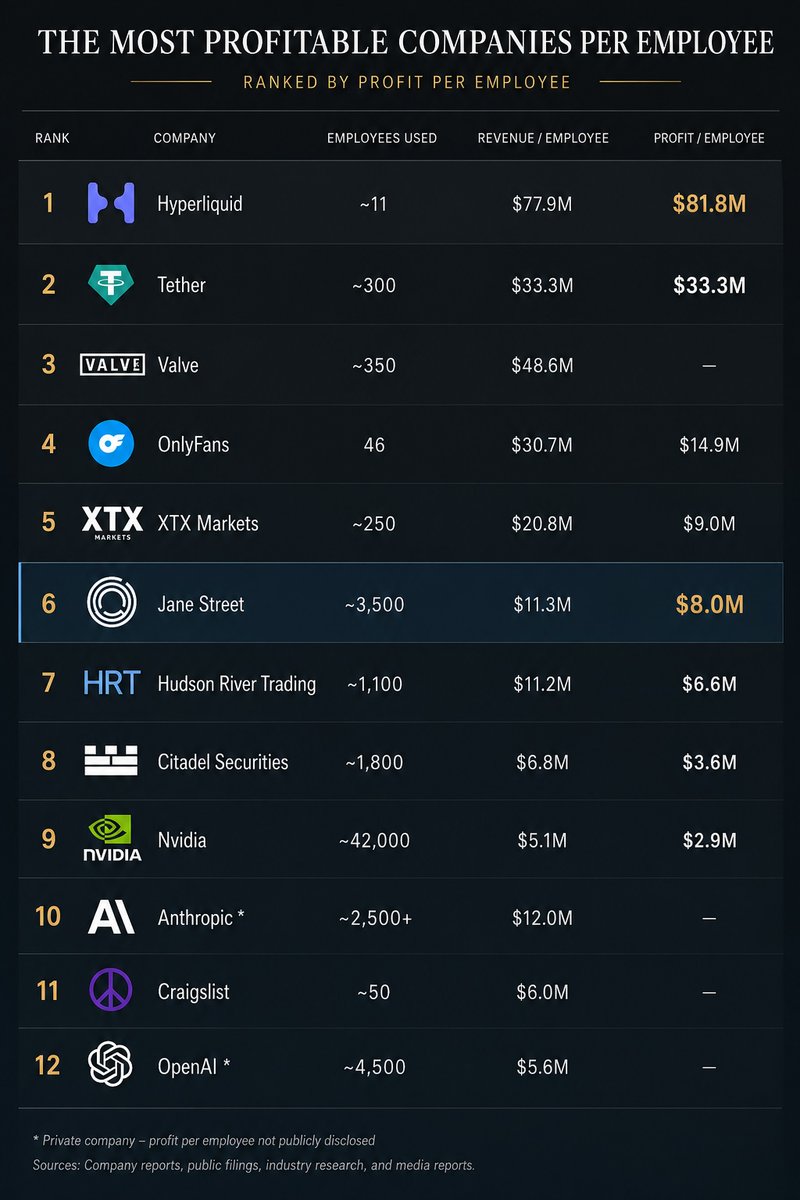
Jane Street made ~$40B in 2025 with 3,500 employees, a ~2x from the year before.
At ~65-70% profit margin, that's $8M profit / employee, the highest for a 1000+ ppl company. High-frequency trading continues to be the most efficient money making engine.
I want to share an old story about my Jane Street interview in 2014. Jane Street was known for hiring a lot of math, physics and CS olympiad winners from top universities and putting them through many rounds - including, for trading roles, a gauntlet of mental math. It was my 6th interview and my final round and I recall being asked "What is the next day after today in DD/MM/YYYY where all the digits are unique?" They'd toy with you and say "You can use a pencil and paper, if you want" but you knew that was an instant no. Painstakingly and as quickly as I could, I came to an answer. "How confident are you that this is correct on a 0-1 probability scale?" the interviewer said. "0.95", I blurted out, not fully knowing how to answer that. "Are you sure?" After thinking harder for a few more seconds, I realized I could've flipped the digits around to get a closer date. I gave the interviewer my answer. It was correct. "0.95 huh?" he chuckled. That's when I knew I failed.
Note: fwiw, other companies that come close in efficiency are
- Tether ($90M+ profit/emp)
- Hyperliquid ($80M+ profit/emp)
and on revenue:
- Valve ($50M/emp)
- OnlyFans ($37M/emp)
- Craigslist ($14M/emp)
- Anthropic ($12M/emp, run rate)
- OpenAI ($8M/emp, run rate)
For comparison, Nvidia is very efficient at scale and is $4.4M/emp.
A Stanford student got reported for academic misconduct last semester.
His research paper was so good his professor assumed he bought it.
The academic integrity hearing lasted 3 hours.
Here's what happened in that room.
The panel asked him to explain his methodology from scratch. He opened his laptop, pulled up https://t.co/LaaeCA6lbD, and started rebuilding the entire paper live in front of them.
First he fed it his raw notes and asked: "You are a research methodology expert. Here are my raw notes. Identify the 3 strongest arguments buried in this data, rank them by originality, and show me exactly where each one challenges or extends existing literature."
The professors went quiet.
Then he ran: "Now simulate a hostile peer reviewer with a PhD in this field. Generate every serious objection they would raise against my thesis. Then tell me which objections actually have merit and which ones I can dismantle."
One professor leaned forward and asked him to stop so she could write down the prompt.
He kept going. "Take my weakest argument and steelman it harder than I did. Show me what it would look like if it were airtight. Then tell me what I'd need to prove to get it there."
Then the one that ended the hearing. "You are my thesis advisor. I have 24 hours before submission. Read this draft and tell me the single change that would move this from a B+ to an A. Be brutal."
He walked them through how he'd used that last output to rewrite his conclusion three times until it held up under every objection in the room.
What took most PhD candidates 6 months of back-and-forth with advisors, he was doing in real-time inside a single workflow.
The panel didn't just clear him.
They gave him the highest grade in the department's history and asked him to present the workflow to faculty.
The irony is beautiful. The paper looked too good to be human because he'd found a way to think harder than most humans bother to.
That's not cheating. That's the new ceiling.
A genie appears.
It offers: never write another line of SQL again, never write a Bash script again, never write a Dockerfile again, never write a benchmark or an elaborate test again — it will all be done for you.
You say: nah, wouldn't make me more productive.
Still one of the greatest moments in Nobel history.
At 2:15 a.m. on Oct. 12, 2020, a security camera caught Prof. Emeritus Robert Wilson in slippers at Prof. Paul Milgrom's front door.
The longtime collaborators, who lived across the street from each other, had jointly won the Sveriges Riksbank Prize in Economic Sciences for their contributions to auction design — but only one had been reachable by phone in the middle of the night.
I know a guy who:
- was the best student in his class
- graduated from Stanford
- interned at Google
And now can't find a decent job anywhere.
If this doesn't scare you, it should.
Google’s AI advantage is insane:
- TPUs
- Demis Hassabis, Noam Shazeer, Jeff Dean
- your browser: Chrome
- your phone: Android
- YouTube, Waymo, Google Maps & Google Earth: the ultimate world model dataset
- world’s largest internal codebase (>2B lines)
- acquired Windsurf - a serious Codex/Claude Code/Cursor contender is brewing