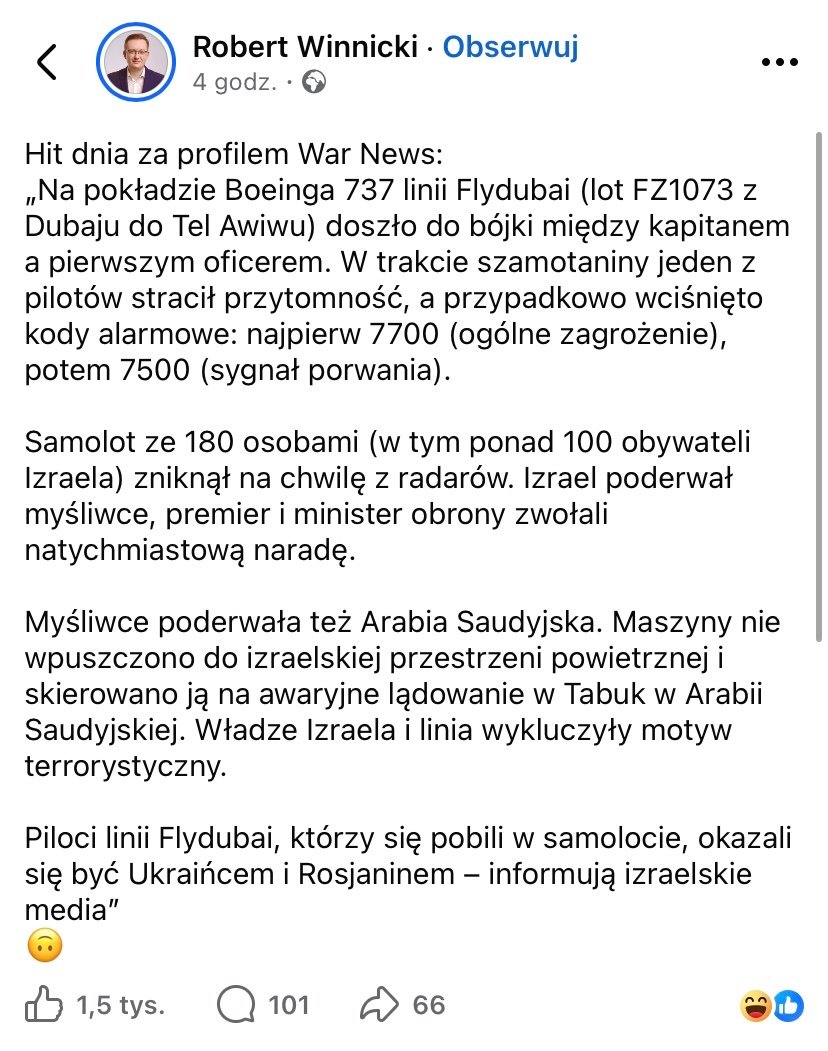
.@RobertWinnicki puścił dziś fejka, że pilotami samolotu flydubai byli Ukrainiec i Rosjanin.
W domyśle, że to Ukrainiec chciał dokonać zamachu.
A potem okazało się, że to nieprawda. Post się skasował
Tak to jest z tymi konfiarzami, że jeden kradnie patelnie, d drugi łże
Zamach na moje życie...Tak!
Wydawało mi się, że po zdjęciu w kajdankach trudno o większą podłość jaką mogę zobaczyć na polskim Facebooku, ale się myliłem!!!
Czy ktoś wreszcie ukróci te działania?
A może Pan Robert Bednarski -szef Facebooka na cały CEE, Pani Ewa Tumanów -Industry Head, Retail & eCommerce CEE, czy Tomasz Parfjanowicz Head of Marketing CEE at Meta i na koniec wielki lobbysta @JacobTurowski Public Policy Director, Central and Eastern Europe, gdyby zobaczyli czy przeczytali o zamachu na siebie-to wreszcie by coś zrobili?
A może @ngleicher, który się wybiela w ostatnim @BIPolska jak to mozolnie walczy ze scamem?
Proponujemy prostą zmianę przepisu o KYC, która położy temu szaleństwu kres -liczę na @bartlomiejpejo, @KGawkowski ,@Kpelczynska ,@McGramat ,@anna_sobolak i wszystkich Posłów i Senatorów, a także Pana Prezydenta @NawrockiKn . Nie pozwalajcie na to by jeden koncern zarabiał brudną kasę na Polakach!
Jeśli zgadzacie się z tym, że trzeba położyć temu kres proszę podajcie dalej!
Trump again blocks previously agreed weapons transfers to Ukraine.
Ihor Romanenko, former Deputy Chief of the General Staff of Ukrainian Armed Forces, explains that following his conversation with Putin, Trump blocked transfer of 3,000 air-to-surface missiles intended for targeting Russia's ballistic missile launchers.
Russia launched a ballistic missiles attack on Kyiv last night. Russian drone attacks on Kyiv are almost 24/7.
According to monitoring channels, energy infrastructure was under attack.
A child was killed in Kyiv region, four more people injured. Private homes, civilian infrastructure was damaged/destroyed.
Relentless Russian terror on Ukrainian civilians.
Russia has moved to a new level of warfare - a regime of constant drone pressure that it can sustain continuously. In 2025–2026, the Shahed evolved from a relatively simple one-way drone into an entire family of systems with different missions. Russia is simultaneously using cheap Gerbera drones as decoys, standard Geran-2s, new jet-powered Geran-4s and heavier Geran-5s, as well as cruise and ballistic missiles. For Ukrainian air defense, this means large numbers of targets appearing simultaneously at different speeds and altitudes, requiring different interception systems.
This is a new type of warfare that no country is prepared for. No country today has air defenses capable of protecting its entire territory for an extended period against thousands of drones combined with cruise and ballistic missiles.
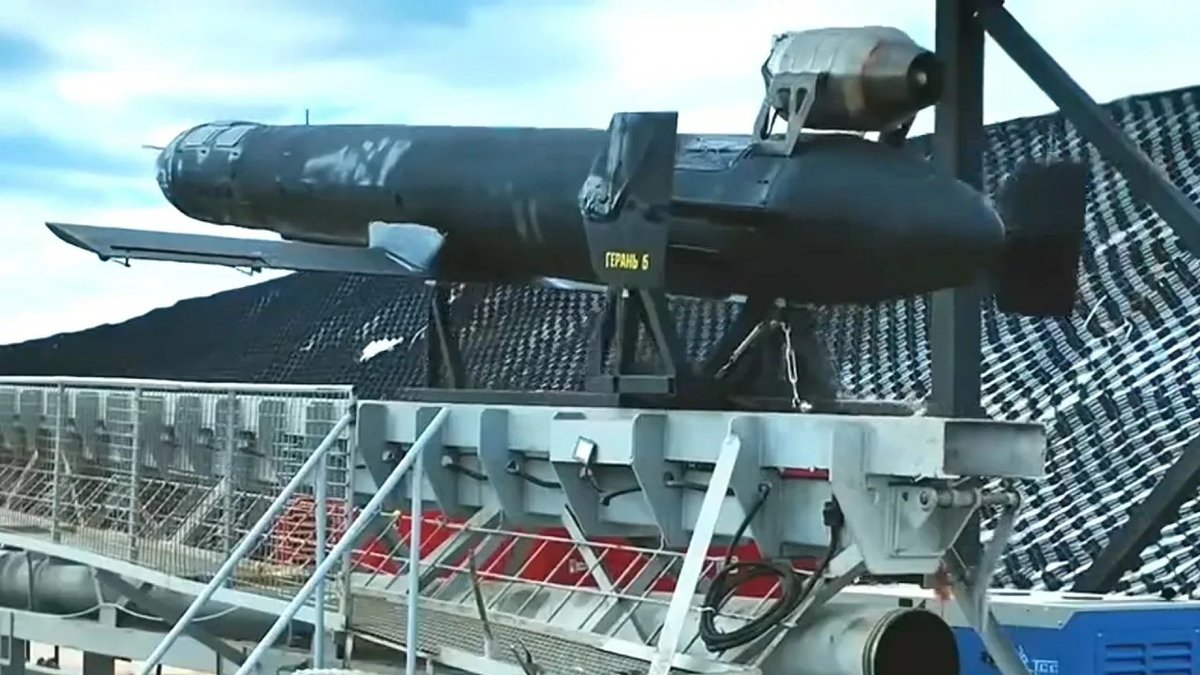
The most important change in 2026 is that Russia has begun using jet-powered drones on a massive scale. The Geran-4 flies at around 320–350 km/h, has a range of about 770 km, and carries around 50 kg of explosives. The significantly larger Geran-5 can reach 450–600 km/h, fly approximately 950 km, and carry around 90 kg. As recently as June, jet-powered drones accounted for around 15% of Russia’s drone use. In July, they were used approximately five times more than in June, and in August their share reached around 56%; in some attacks, two-thirds. On the night of September 27–28, 79 of the 165 drones launched by Russia were jet-powered.
Russia is already producing these drones on a scale that allows them to be used as expendable weapons. According to Ukrainian intelligence, in August Russia was producing around 3,000 Geran-4s and Geran-5s per month and continued to expand its production capacity. More than 2,800 jet-powered drones were reportedly used in August and approximately 2,100 in the first three weeks of September alone. In effect, Russia is creating an intermediate weapon between the old Shahed and a cruise missile: it is significantly faster and more difficult to intercept, but cheap enough for mass production.
The main problem with the new Gerans is that they make cheap ways of countering drones significantly less effective. Older Shaheds were slow and often flew at an altitude of around 1–1.5 km, so mobile fire teams could shoot them down in large numbers. The interception rate exceeded 90%. Jet-powered drones can fly at altitudes of 4–7 km and much faster, leaving far less time to react. According to Ukrainian estimates, around 60% of the jet-powered models are being shot down. Russia does not need to create a drone that cannot be shot down. It is enough to make it so that Ukraine is forced to spend more expensive and scarcer air defense assets on interception.
Russia is simultaneously making drones less vulnerable to Ukrainian electronic warfare. Gerans have been progressively equipped with increasingly sophisticated satellite navigation systems - Kometa-M4, M8, M12, and M16 - as well as Chinese modules capable of operating more effectively in conditions of interference. The Geran-4 has a 16-element NASIR system and inertial navigation, while the Geran-5 uses Kometa-M12. This shows an important feature of the Russian system: Ukraine finds a new way to counter the drones, Russia changes its design or tactics, and the new version then quickly goes into production.
The new Gerans are already ceasing to be simply drones launched toward pre-programmed coordinates. They are being equipped with cameras, mobile modems, SIM cards, Raspberry Pi computers, and equipment for transmitting data between drones. Some individual systems can operate as communication relays for others. This makes it possible to transmit data during flight, see the situation along the route, and maintain communications over a much greater distance. In other words, a network of interconnected systems is gradually taking shape, rather than simply a mass of one-way drones.
Russia is also trying to use the Geran as a platform for other types of weapons. In 2026, Geran-2s carrying FPV drones were recorded: the large drone delivers the FPV drone deep into the Ukrainian rear and can simultaneously transmit a signal to it. Russia is also experimenting with air-to-air missiles on Gerans: variants carrying R-60 missiles and Verba MANPADS have been recorded, and Ukraine shot down a Geran-4 carrying an R-60 missile. Even if such systems are currently used on a limited scale, they create an additional risk for Ukrainian aircraft and helicopters hunting drones.
The tactics of the strikes have also changed: Russia is trying to keep Ukrainian air defenses under pressure practically constantly. Previously, large Shahed attacks occurred mainly at night. Since the end of August, Russia has increasingly been launching drones around the clock. On the night of September 27–28, they entered Ukraine from six directions. At the same time, the airspace may contain cheap decoys, standard Shaheds, jet-powered Gerans, and missiles. Air defenses have to quickly determine what exactly is approaching, which target needs to be intercepted first, and with which weapon. Such a campaign exhausts not only stocks of missiles and ammunition, but also the equipment and personnel who have to operate practically without interruption.
The targets have also changed: Russia is increasingly attacking not individual facilities, but systems on which Ukraine’s normal functioning depends. In addition to energy infrastructure and military facilities, the targets now include railways, fuel infrastructure, Black Sea and Danube ports, grain terminals, shipping, warehouses and logistics centers. In September, telecommunications and data centers were clearly added to this list. On September 27–28, Russia repeatedly attacked the same types of targets in several waves.
We are now witnessing a new Russian model of long-term warfare - an air war that Russia can sustain for a long time and relatively cheaply. Yesterday, Putin increased the size of the Russian army for the fourth time since the beginning of the year - to 1.55 million service members - and he will continue to pursue a breakthrough on the front, which is unlikely for now. At the same time, Russia will continue to strike Ukraine’s economy and infrastructure. Russia no longer needs to rely solely on accumulating large numbers of expensive missiles for individual massive strikes. It now has the ability to maintain the pressure of aerial attacks every day.
Today, it is necessary to reduce Russia’s ability to produce drones - through sanctions and restrictions on the supply of critical components - and to strike military production and launch facilities; whatever is launched should be intercepted using the cheapest means possible.
Russian drones need to be stopped before they are launched.
An hour after bombing Kyiv's Academy of Sciences, Russians have just bombed a hospital, also in the center of the city.
The Dobrobut medical facility is currently burning after a drone strike.
BREAKING:
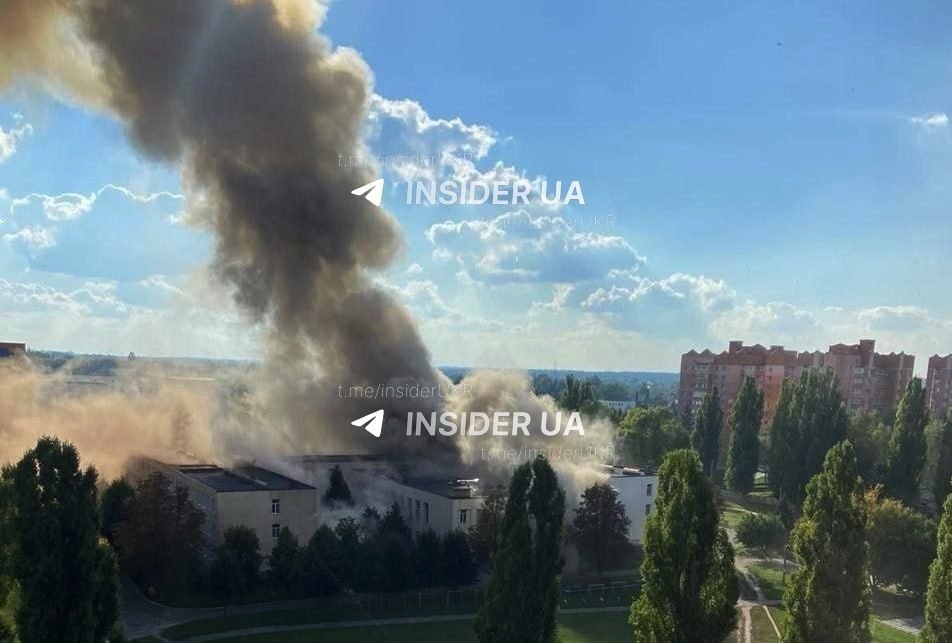
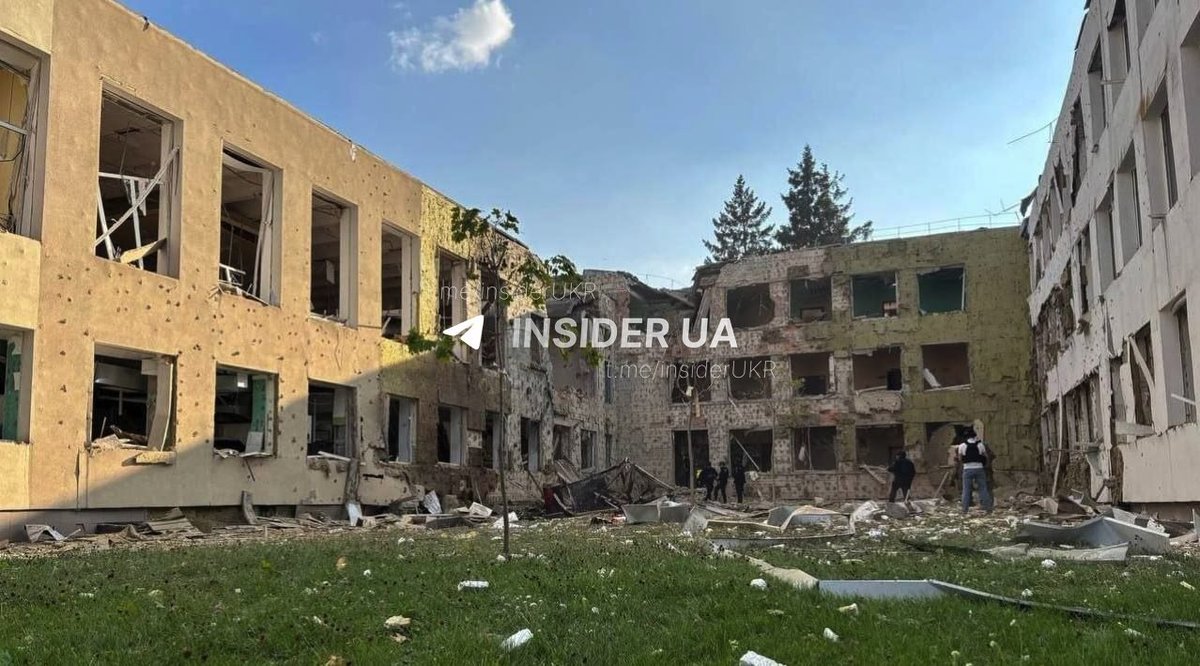
Russian forces dropped a multi-ton guided bomb on a school in Sumy while children were in class.
Dead and wounded have been reported.
Video filmed by one of the students captured the moment of the blast as she ran to a shelter.
Kramatorsk is living through hell right now.
russians just dropped a KAB on a residential building.
russia is killing civilians, destroying homes, and tearing Ukrainian cities apart.
The world must not normalize terror on this scale.
- kandydat PiSu uzyskał najgorszy wynik w historii w Krakowie, nie wszedł do 2 tury, cisza
- kandydatka KO weszła do 2 tury, KOALICJA PRZEGRYWA
Propaganda dla debili.
Russian strikes are incoming from all sides onto Kyiv, in broad daylight.
Markets, gas stations, a hospital, office, kindergartens, residential buildings.
Russian scum cannot push through on the front line, so they are staging genocide in Ukrainian cities.
Many people asked in the comments why we ignore air raid alerts and are outside of shelters during Russian attacks. The answer is simple: alerts last for hours many months in a row. We need to work and live.
The world continues watching a live broadcast of Ukrainians being killed.
🚨 BREAKING: A Russian strike hit the Dobrobut medical center in central Kyiv.
Video shows first responders saving people from the burning hospital as rescue operations continue.
„Prezydent lub jego ludzie uznali, że im gorzej będzie się działo w Polsce, im gorzej będą będą mieli Polacy, tym trudniej będzie miał rząd, więc postanowili działać w taki sposób (…), żeby blokować możliwości obniżenia cen paliw, bo to zaszkodzi rządowi” - mówi pan premier Tusk.
No w tej sytuacji chyba jednym sensownym wyjściem dla pana prezydenta będzie podpisanie ustawy i skierowanie jej do TK w trybie kontroli następczej, co pozwoli zachować względną spójność z pierwotną decyzją, a jednocześnie dać przestrzeń do obniżek cen paliw.
More terrifying footage showing the aftermath of today's russian terrorist attack on Kyiv 😡! There are civilian casualties, the info is to be clarified! @IntlCrimCourt#RussiaTerroristState
Jeszcze nie tak dawno byliśmy z przedstawicielami mojego Instytutu zarówno w Ukraińskiej Akademii Nauk, jak i Agrarnej Akademii Nauk... Trudno się na to patrzy...