The new reconciliation and infrastructure bills could layer hundreds of billions of extra federal dollars to states for priorities including transportation, broadband, workforce development, affordable housing, and climate resilience, @berubea1 says. https://t.co/mq8xR9x7bt
Black and Latino/Hispanic people experienced a staggering 2.9- and 3-year downturn in life expectancy, respectively, compared to 1.2 years for white people from the COVID-19 virus in 2020, @andreperryedu, Ariel Gelrud Shiro & @AnthonyMBarr write. https://t.co/piyyy6kAGj
For the U.S., reducing harmful greenhouse gas (GHG) emissions will require changes in our urban development patterns: building smaller, more energy-efficient homes in areas close to jobs and public transit, @jenny_schuetz & Matt Ring say. https://t.co/4I6cmAAVBX
.@annelies_goger: Letting the expanded eligibility and duration of unemployment insurance programs expire on Labor Day is problematic from an equity perspective. This return to "normalcy" will penalize many of the workers COVID-19 impacted the most. https://t.co/IknKujCByS
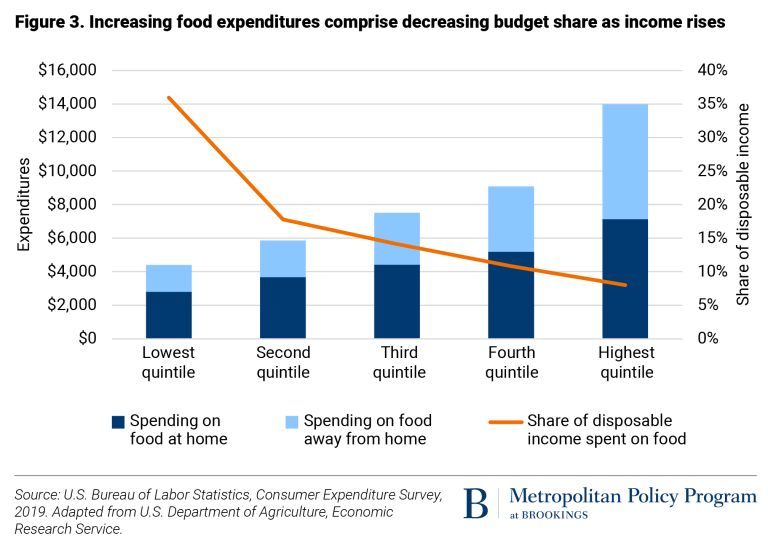
Even with universal access to food retailers, millions of Americans would not be able to afford enough food to meet their household’s needs. The food desert narrative overlooks the basic relationship between supply and demand, @CarolineRGeorge writes. https://t.co/s7W2qJITwq
The nation’s unbalanced innovation investments have been reinforcing preexisting spatial and demographic disparities, and the innovation budget has disenfranchised hundreds of communities and millions of potential innovators, @MarkMuro1 says. https://t.co/1HSNoLx9fP
.@robmaxim: A surge of federal funding focused on countering distress at all levels—from the nation’s unequal overall economic geography down to local community distress—may at last be able to dislodge our stubborn spatial inequality. https://t.co/439S4Fgx5q
The past year has been one long reminder that, for all of the nation’s economic strengths, we are woefully unprepared for our digital future, @AdieTomer says. There are still about 17 million households who don’t have broadband of any kind. https://t.co/N16vjh2JRZ
The historic surge in demand for unemployment benefits during the pandemic laid bare many of the underlying problems that have been festering for decades in labor and education data systems, @annelies_goger & Janie McDermott write in a new report. https://t.co/oK0biGhE1j
Among numerous economic benefits, community ownership can help increase access to and retention of home ownership for low-income households, while helping close the racial wealth gap by distributing land-based wealth intergenerationally, @lohplaces says. https://t.co/NheRZoNTWz
The country has changed significantly since the last great revision of federal infrastructure policies in the 20th century. It’s the perfect time for federal officials to modernize their approach, @AdieTomer, @jwkane1 & @CarolineRGeorge say. https://t.co/4UCeEAtupy
.@MarkMuro1: It doesn’t look like the remote work explosion will magically transform the nation’s interior. Instead, regional leaders will need to make the long-term investments that are the drivers of local economic growth and high standards of living. https://t.co/4M0RUDhQh6
A change in the geography of employment has reduced job opportunities for low-income communities concentrated in urban cores. By 2001, only 1/5 of jobs in large metro areas were within 3 miles of the city center, @82_Streetcar notes. https://t.co/E7EVrryw30
If professional workers who drive the demand for premium-location office space remain working from home, it could have profound impacts on downtown business districts, @jenny_schuetz writes with co-authors. https://t.co/m0hgIbR3EF
With the country on track for mass vaccinations, the worst of COVID-19 may be over. But many of the underlining inequities essential workers face—including low wages, structural racism, and inadequate protections—remain, @MollyKinder & @StatelerLaura say. https://t.co/pOxYcOuwQg
.@andreperryedu & @MollyKinder: The pervasive right-to-work laws in the South and conservative states make organizing efforts like the one at Amazon’s Bessemer, Ala. warehouse particularly difficult. https://t.co/WvirAJsFSo
Local leaders must grapple directly with the intersecting structural, relational, and market forces that render neighborhood poverty so stubbornly difficult to eradicate, @hannamlove, @jvey1, Bill Taft, @EODemetriou write in a new report. https://t.co/54zX3j094E
Launched today, the Metro Monitor 2021 provides localized data on the nation’s largest 192 metro area economies (those with populations of at least 250,000) which together are home to 78% of the nation’s population and contribute 84% of the nation’s GDP. https://t.co/wrIHwAiMeI
Many current fossil fuel hubs are ideal sites for renewable energy production, @AdieTomer, @jwkane1, @CarolineRGeorge note. A quarter of U.S. counties with the most potential for wind and solar electricity generation are also fossil fuel hubs. https://t.co/qCBxK8DyJU
Land ownership is the primary source of wealth and way to access capital in America. The real estate industry has long implicated itself deeply in white supremacy by backing and profiting from racist practices, @lohplaces & @andreperryedu write. https://t.co/VB6s0H08S0