It's important that people like Zuck and Larry Page are willing to move in response to the proposed wealth tax. It shows politicians what will happen if they try things like this.
Apparently unions are proposing a new tax on SF companies whose CEOs are paid too much more than their median SF-based employees. I bet you can immediately think of 3 ways companies could avoid it if the cost became significant, all of which would be worse for the city.
One hour Waymo ride from San Francisco to Menlo Park via highway 280. It’s over, cars are self-driving. Everything else is just about rolling this out to the rest of the world.
This graphic of Trump’s cuts to NASA’s research fleet is insane.
Why do this? Who wants this? Who was complaining we were exploring space too much? The only principle seems to be “if it can’t go directly into Trump or Musk’s own pockets, dump it in the trash.”
Public media is under attack from every direction:
Funding eliminated in the Administration’s budget
Executive order targeting NPR + PBS
Grants to kids' educational programs cut
Save it now @MyPublicMedia: https://t.co/9mrD5ACawm #ProtectMyPublicMedia
Gotta be honest. The @realDonaldTrump EO on healthcare and in particular, drug pricing could save hundreds of billions.
Here is how:
1. Divorce formularies from PBMs. Require them to come from independent organizations with no economic incentive from the formulary
Make them about wellness, not pay for play like a grocery store endcap. This ends rebates and allows for net pricing. It also allows for better care and wellness.
2. Require PBMs to provide ALL claims data to employers, states and manufacturers. The manufacturers need this to provide better results. It’s insane they don’t have this data to analyze and improve patient results.
Plus they current pay 5 to 10 pct of the retail price to get that data so they can do just that. Make it so it’s required and they can save 10pct of RETAIL pricing , which they can use to lower pricing.
This also stops the 340b double dipping problem.
3. Remove the specialty tier and the requirement to buy from any specified pharmacy. There is nothing special about specialty drugs. They call them special to jack up the price. And of course have them divest any that they do.
4. Require that all pharmacies get fully reimbursed for brand drugs and get rid of the Generic Cost Ratio which allows distributors to jack up pricing on generics with the threat of chargebacks and more.. We need independent pharmacies to thrive
5. Remove confidentiality clauses. They prevent companies from talking to manufacturers. It’s insane that your company can’t talk to a GLP1 manufacturer (as an example) to help you put together a wellness plan and get you a better price
6. Stop biosimilar substitution calls. PBMs know that they need to find new sources of margin. They do it by white labeling their own biosimilar versions. That’s fine.
But because that’s where all the margin is, they will put a low cost biosim on the formulary, and when they get a script for the lower cost option, they will have someone call the prescribing doctor to switch to their more expensive version they make more money on. And because employers and manufacturers don’t get their data. They never know
Put me in coach ! I’m here to help.
DOGE quietly deleted the 5 biggest spending cuts it celebrated last week:
* An $8 billion cut at ICE was actually for $8 million
* Three $655 million cuts at USAID were actually a single cut erroneously counted three times
* A $232 million cut at the Social Security Administration was actually for just $565,000
https://t.co/ENDI3n8j94
I learned yesterday the video I made in 2017 explaining how Bitcoin works was taken down, and my channel received a copyright strike (despite it being 100% my own content).
The request seems to have been issued by a company chainpatrol, on behalf of Arbitrum, whose website says they "makes use of advanced LLM scanning" for "Brand Protection for Leading Web3 Companies"
I could be wrong, but it sounds like there's a decent chance this means some bot managed to convince YouTube's bots that some re-upload of that video (of which there has been an incessant onslaught) was the original, and successfully issue the takedown and copyright strike request.
It's naturally a little worrying that it should be possible to use these tools to issue fake takedown requests, considering that it only takes 3 to delete an entire channel.
When we lived in Silicon Valley, I asked an elementary school teacher what were the most important things parents didn't understand. This was number one.
3 ARMED AUTO BURGLARS ARRESTED: SFPD's Drone + ALPR helped officers arrest this crew last week. Hard-working officers and new tech have led to an over 56% DROP in auto burglaries.
The association between residential greenness (NDVI) and reduced depression and anxiety, as assessed from >400,000 @uk_biobank participants
https://t.co/VjpCJylhhj @NatMentHealth
Biotech Math (Pharma Edition)
Or, how the blockbuster model impacts everything in the industry
First, let's gather some data for the top 10 pharma companies:
It's clear these businesses have incredible leverage: a 3.5% increase in revenue translates to a ~8% increase in net income. Said another way, after you pay for all the R&D, manufacturing and sales force costs, the best thing you can do is add more volume to that engine (hence pharma's bias to buy late-stage assets that bolt-on to existing infrastructure)
So, what is Pharma's hurdle rate for a drug to be worth the effort? Here's where I'll do some (directional) math. I'll exclude LLY / NVO from this analysis as outliers given the run-up with GLP-1 hype
$2T aggregate market cap x 7.5% target growth = +$150B
Some portion of that will come from existing assets that outperform - let's say 20%. That leaves the majority ($120B) to come from new assets
The FY25 multiple above (4.6x) is a blend of high-growth assets (new launches, acquisitions) and mature, slow-growing assets. The former is what will drive our remaining $120B gap, and those will command a higher multiple. How much higher should it be?
Looking at the revenue contribution of just high-growth assets (projected >=10% CAGR from 23-26), I'll back out an implied multiple of 9.1x by assuming a low (2x) multiple on mature asset sales
As a gut check, this jives with the previously mentioned leverage that the Pharma model has and when applied to our $120B shortfall, we land at $13B in incremental revenue
But, we also need to factor in LOEs
We see a crazy RR of $36B / year. However, this is a brutal period (Humira, Keytruda, etc.) Historically, the industry averaged ~$10B in LOEs / year, so let's lean that way and call it $15B. Adding that to our incremental revenue figure above gets us $28B
Lastly, looking at the recent history of FDA approvals implies about 10 launches a year.
So to bridge our $28B revenue gap, each asset would need to have peak sales potential of $2.8B / year. I use peak sales because that is a quick way to assess the commercial ceiling of new assets
So, what does this mean for the industry?
♦ It explains why Pharma focuses on mega-TAMs - once you factor in competition, they're the only spots you can get this type of scale their model demands
♦ When it comes to M&A; lots of SMID-cap companies are stuck in no-mans land (<$1B peak sales potential), which will not move the needle enough to justify an acquisition. If you are a SMID-cap bio in this range and your plan is to get acquired by Pharma, you either need to cleanly fit an existing commercial structure or think about ways to add the necessary scale (i.e. merger of equals, etc.)
♦ Pharma is essentially deploying a venture style portfolio approach, which leaves lots of gaps for patients because the opportunity is not big enough; ideally these are captured by smaller companies who can cobble together enough scale to justify a takeout, or stay independent
If you found this interesting, follow @andrewpannu for more biotech analyses & commentary!
I retweeted this because I don't want to believe it. It's therefore important to investigate this phenomenon, because I probably have a bias against seeing it.
Being first-in-class matters a lot
Prior analyses have shown that timing is the most important factor for commercial performance, even ahead of therapeutic value
But when have late entrants ended up dominating the market, and what did they do differently?
I pulled together case studies highlighting 3 different approaches, beyond just better efficacy / safety, and the lessons we can learn from each:
(1) Keytruda among checkpoint inhibitors
Lesson: Smart trial design can close the gap
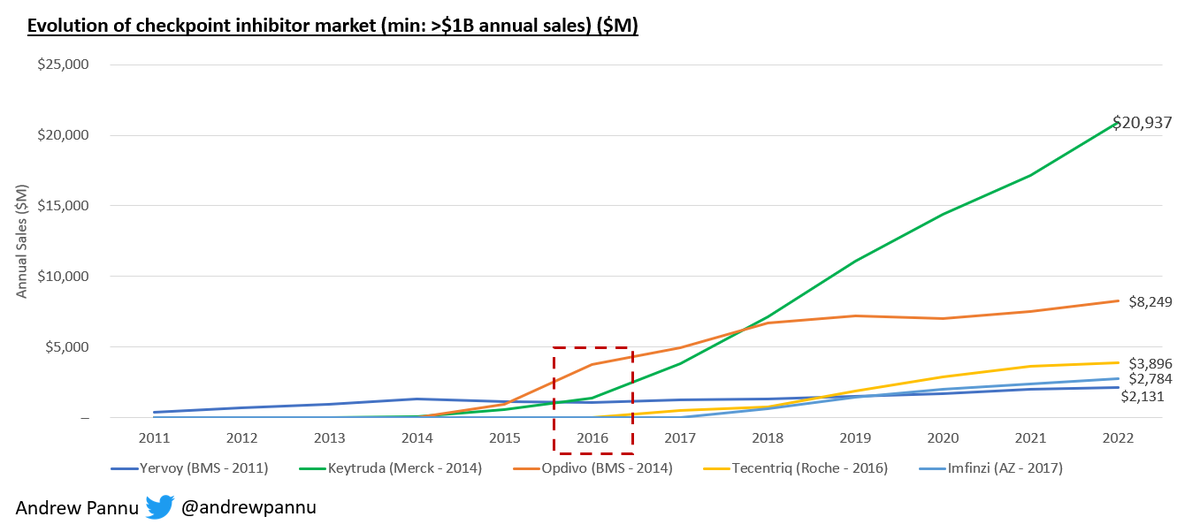
Keytruda was 3 years behind $BMY's Yervoy and basically launched in parallel with their own PD-L1, Opdivo. As late as 2010 Keytruda was little more than a deprioritized asset, but that year BMS published stellar data from a Ph3 study testing Yervoy in metastatic melanoma, which inspired Merck to resurrect the program.
What allowed Merck to implement a rapid development program and get the drug approved just 4.5 years later was also what eventually allowed it to leapfrog both BMS assets commercially: biomarkers. Merck bet big on PD-L1's ability to identify those patients that would respond best, which would be worth the added friction of requiring testing via a companion diagnostic.
In a key 1L NSCLC trial in 2016, Keytruda succeeded in PD-L1 high patients, whereas BMS' Opdivo, which set a far lower PD-L1 hurdle, failed. You can see that inflection point on the chart - thereafter Opdivo tapered off, while Keytruda accelerated to mega-blockbuster status (17+ tumors and 2 tumor-agnostic indications later).
(2) Lipitor among statins
Lesson: Nailing product positioning is key (and spending big on marketing doesn't hurt)
Arguably the most famous example of a late-to-market asset becoming the dominant player, Lipitor was the 5th statin to market, trailing first-in-class Mevacor ($MRK) by 9 years; yet, it reached $13B in peak sales and $125B cumulatively.
Lipitor leaned heavily into it's best-in-class ability to lower cholesterol, capitalizing on the perception that reduction in cholesterol was a leading indicator for preventing heart attacks / early death (data existed to prove this for competitors, but not for Lipitor, so they could not directly promote that benefit, instead free-riding off their competitors)
Backing this up was a massive marketing campaign from Pfizer, as conveniently the year of Lipitor's launch (1997) was also the first year DTC drug ads were allowed.
(3) Vabsymo in anti-VEGF AMD
Lesson: Optimizing for patient compliance & QoL makes a difference
Roche's Vabsymo is competing against Regeneron's Eylea, which is still far and away the market leader in the AMD space, as well as other older drugs. However, Vabsymo has taken the market by storm, achieving blockbuster status just 18 months after approval (& I wanted an example playing out today).
Vabsymo's key benefit is that it is longer-lasting, requiring just 3 annual doses during maintenance as opposed to Eylea's 6. And that matters a lot to patients when dosing is done via eyeball injections.
If you found this interesting, follow
@andrewpannu for more biotech analyses & commentary!
In covering how Egypt cured its population of Hepatitic C thanks to Gilead’s miracle cure Harvoni, @nytimes writes that Gilead charged $1000/pill in the US but Egypt “negotiated” it down to $10. They didn’t negotiate. Egypt had no leverage. The extremely low price was a GIFT from Gilead & the US, whose spillovers benefit poor countries that need our help like Egypt and are taken advantage of by rich countries like Canada and UK (and they have the gall to try to talk us out of it... see the piece about the "European Scorpion" in the next piece).
Just call it a gift. Write about how drug companies did something good because they do a lot of good (yes, also bad… Purdue sucks, Turing price jacked an old drug… but we can talk about the bad without claiming that’s all there is).
Write about how the US premium payor, all the relatively healthy people who put more into healthcare than they take out (for now) created the incentives that makes investment in Harvoni possible. They incentivized the quest to come up with Harvoni that now make's Egypt quest to eradicate it possible.
Everyone who has ever had their their health restored by a medicine can be grateful for the drug industry, its investors (which are many millions of people), doctors, insurance plans, all premium paying people (which is nearly everyone), NIH, and whoever invented the patent system… we should appreciate this remarkable framework that taps human ingenuity to compete to produce such advances.
That competition than also drives down the prices of hepatitis C drugs by over 70% in the US, before they even go generic like most drugs do. Write about that! Every time a drug goes generic, consider that hospitals and nursing homes never do.
When you cover GLP-1s, don’t just talk about their list prices… you surely know better by now… talk about how US insurance plans have negotiated those prices down by 70%. And when someone’s insurance plan doesn’t cover a drug they need, don’t turn on the pharma like it’s a bad guy. Ask why the insurance plan isn’t doing its job.
Does the @nytimes know who gets the best access to medicines in the world? American union members. They negotiate excellent coverage in their contracts, and the healthcare system works very well for them. Write about that negotiation. To people with good insurance, pharma is a source of cures. Most Americans actually say they CAN afford their medicines precisely because their insurance works for them.
Biomedical innovation requires insurance… it always has and always will. You can't expect a company to both invent its medicines and then immediately sell them like they are a generic. Industry invests $200B into R&D every year. That R&D has to be incentivized... but not by the comparatively few patients who need treatment but by all of us who pay premiums. The key to affordable innovation is lower out of pocket costs. Write about that!
OOP should mean "out of premium" not "out of pocket". Forget skin in the game. Who fakes cancer to joyride chemo? Who fakes diabetes to take daily insulin injections? What is there any out of pocket for a medicine your doctor prescribes and your own plan authorizes as appropriate for you? Someone wants a GLP-1 off-label? Insurance doesn't charge an out of pocket... they just deny coverage. Let's not pretend that out of pocket costs are anything except a way of insurance tricking people into thinking they are covered until they get sick and then discouraging them from getting treatment. That's cruel. Write about that.
@nytimes… you don’t have just see the negative in everything the drug industry does. Just suggesting that Egypt "negotiated" with Gilead to get a 99% discount off Harvoni shows your struggle to see things as they are.
With your negative bias against the drug industry (of which I am proudly a part... there's so much science has yet to accomplish and we're doing it every day)... you are goading the public and Congress into shutting down, with price controls a valuable and productive ecosystem.
And no, Medicare negotiation isn’t a true negotiation… what Medicare has been doing all along, relying on the plans it contracts with to negotiate has been how Medicare has long negotiated. There’s a reason the law says Medicare couldn’t “interfere”in that process… because it’s a monopsony… and a monopsony just dictates prices. No one would work for any customer who could just dictate what they would pay after the job was done, and neither will investors who fund R&D. Neither will any pharma board allow profits from today's drugs to be redirected into R&D to make medicines that Medicare can just dictate the prices of once they are made. They will redirect those profits to dividends and put them back into the pockets of all the retirees who are invested in the drug industry to support themselves so they can invest it some other industry.
It’s magical thinking to imagine that price controls won’t shut down the flow of new drugs.
Had the US long ago declared that it would pay as little as Europe for treating Hepatitis C, there wouldn’t have been Harvoni and you wouldn’t be writing about this Egyptian miracle.
Better coverage. @TheEconomist
To learn more about many aspects of the biomedical innovation ecosystem that so many misunderstand, check out https://t.co/zEG72Vbwfa
#biotech @PhRMA@IAmBiotech
https://t.co/MsI8E7Tywk