Everyone’s celebrating new highs.
I’m watching the stocks that didn’t participate.
QQQ closed at a record.
The Dow closed above 51,000 for the first time ever.
Meanwhile, IWM finished red.
Dell’s +33% move and $16.1B AI revenue number were incredible. But one stock carrying the narrative isn’t the same thing as broad market strength.
When indexes make new highs while fewer stocks participate, I pay attention.
Maybe small caps catch up next week and prove me wrong.
If they don’t, this rally is narrower than most people think.
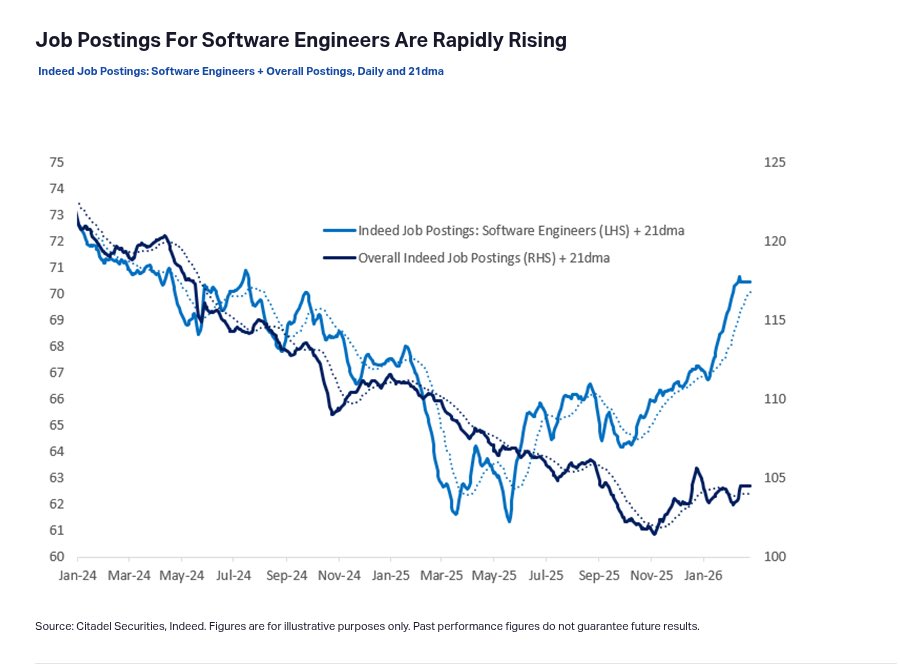
Q: How are job postings for software engineers rising rapidly despite AI agents automating coding?
A: Because there’s far more code to manage than ever before. We’re already seeing a 14x YoY increase in GitHub commits, and it’s accelerating.
AI has dramatically lowered the cost of writing code, so it’s now being used across far more businesses, applications, and use cases.
We’re at the beginning of a massive productivity boom driven by the proliferation of bespoke software throughout the entire economy.
Coding has been AI’s breakout use case this year. The fact that it’s increased demand for software engineers — rather than decreased it — should call into question the entire “AI will cause mass job loss” narrative.
🚨 FORMER TESLA PRESIDENT ADMITS ELON USED THE DOMINO’S PIZZA APP TO REINVENT HOW PEOPLE BUY CARS — AND THE STORY IS BLOWING PEOPLE’S MINDS
Former Tesla president Jon McNeill is going viral after revealing the bizarre moment Elon Musk pulled up the Domino’s pizza app during a meeting… because Tesla customers needed 64 CLICKS just to buy a car online.
Elon’s reaction?
“How many taps does it take to get a pizza?”
Answer:
• 10 taps
Buying a Tesla at the time?
• 64 clicks
• endless loan documents
• nonstop forms
• massive friction
Elon became obsessed with stripping the process down after realizing most of the paperwork wasn’t even legally required.
So Tesla started going bank-to-bank asking:
Why does buying a car need to feel harder than ordering dinner?
Most banks reportedly refused to cooperate.
Then one Midwest bank CEO finally agreed to test a radically simplified system… and Tesla allegedly eliminated around 40 clicks from the process almost overnight.
Now people online are saying this perfectly explains why Tesla disrupted the entire auto industry while traditional dealerships kept drowning customers in paperwork, waiting rooms, and sales tactics.
Did Tesla accidentally expose how outdated the entire car dealership model really was?
📹: kencoleman
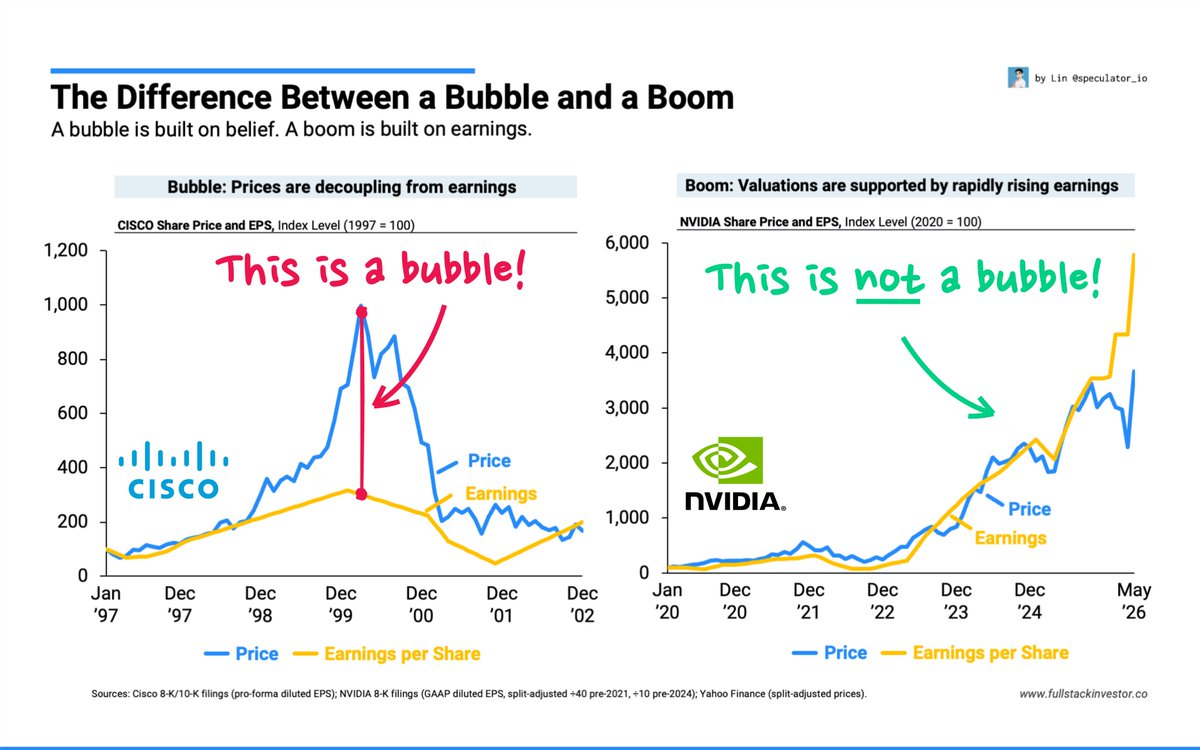
Stop saying “dot com bubble” every time AI stocks go up. It’s lazy analysis.
I personally know people paying for ChatGPT and Claude every single month like it’s Netflix. I know at least 4 people personally that are actively building companies using these tools right now.
This isn’t 1999 where half the market was a random website with zero business model and a Super Bowl ad budget.
These AI companies already have:
• billions in revenue
• insane user growth
• enterprise demand exploding
• developers building entire businesses on top of them
Yes, there’s hype. Yes, some AI companies will absolutely die.
But acting like this is identical to the dot com bubble completely ignores the fact that people are already using these products every single day because they’re genuinely useful.
End of rant
@drantbradley The jig is up. The student loan racket has ran its course. 35 yr run. Not to bad. College was once for the best of the best. We dumbed it down. Invited everyone. And told millions of kids to borrow money to get a bullshit degree. What a joke
The US Ladies played 7 games in Milan. This was their final stat sheet:
• 7-0
• 33 Goals For
• 2 Goals Against
• +31 Goal Differential
• 2 wins over arch rival Canada
A generational Olympic run by the ladies
A 6’6” player shouldn’t have these hands. One of the best goal scorers in the game, and he’s on the Buffalo Sabres, representing Team USA, like he should be.
Tage Thompson.
Eric Weinstein has a theory about what Elon is really building.
“You can’t get to the stars using SpaceX.”
Chemical rockets have a ceiling. They can reach Mars, maybe push deeper into the solar system, but interstellar travel requires physics we don’t have. Breakthroughs that should have happened decades ago but didn’t.
Weinstein thinks Elon sees the problem clearly: modern academia is too broken to deliver them. Too slow, too political, too captured by incentives that reward safe mediocrity over risky genius.
So Elon stopped waiting.
xAI isn’t a chatbot company. It’s a research engine built to solve the problems human institutions have failed to crack. Grok is the tool designed to unlock the physics that gets us past chemical propulsion.
SpaceX builds the rockets. xAI finds the way through.
One gets the headlines. The other might actually get us to the stars.
A city on the Moon will cost somewhere between $100B and $500B, require thousands of Starship flights, and demand a decade of nonstop construction in a place where the temperature swings 400°C between day and night, the dust cuts through metal seals like sandpaper, and a single cracked habitat window means everyone inside is dead in about 90 seconds.
Musk just announced SpaceX is doing it anyway. Here’s the actual engineering path.
You build at the south pole. Specifically the rims and floors of craters like Shackleton and Cabeus, where temperatures in permanent shadow drop below -230°C. NASA estimates 600 million metric tons of water ice are buried in these craters under about 40 cm of dry regolith. That water becomes your oxygen supply, your drinking water, your radiation shielding, and 78% of your rocket propellant by mass. The crater rims get near-continuous sunlight for solar power. You build where the resources are.
Getting there is where it gets wild. Every Starship lunar mission requires 10-15 tanker flights to fill 1,200 tons of propellant in Earth orbit before the ship can even leave. One cargo delivery to the lunar surface burns through roughly 12 Starship launches. Starship V3 lands 100 metric tons per trip. The Moon is 2 days away with launch windows every 10 days. Mars gets one window every 26 months with a 6-month flight. That 13x iteration advantage is why Musk pivoted.
The first 20-30 landings are all cargo. No humans. You’re sending solar arrays for the crater rims targeting 100+ kW continuous, nuclear fission reactors for the 14-day lunar night, ISRU rigs that mine ice from regolith and electrolyze it into hydrogen and oxygen, pressurized hab modules, and autonomous rovers that 3D-print structures from lunar soil using concentrated solar heat. Each landed Starship also stays as a permanent building. 50 meters tall, 9 meters wide, 1,100 cubic meters of pressurized volume. The ISS has 916 cubic meters and took 13 years to assemble. Three Starships on the surface already exceed that.
The economics flip the moment you start producing oxygen on the Moon. You stop shipping 78% of your propellant from Earth. Tanker flights per mission drop from 15 to about 4. Every ton produced locally frees up mass budget on the next inbound Starship for more construction equipment, food systems, and mining hardware. The base starts building the base. That’s what “self-growing” means. Compound logistics where each delivery makes the next delivery cheaper.
2027: first uncrewed Starship lunar landing. SpaceX told investors March 2027. 2028-2030: cargo buildup, 30-50 deliveries, all robotic, ISRU prototypes go operational. 2030-2032: first crews arrive, probably 6-12 people, 6-month rotations, running equipment maintenance and scaling propellant production. 2033-2035: permanent population hits 50-100, propellant depot goes up in low lunar orbit so arriving ships refuel before descent. 2035 onward: population grows past 100, agricultural modules come online, the base becomes partially self-sustaining.
The unsolved problems are real. Lunar dust is electrostatically charged and sharp as broken glass. It shreds seals, clogs machinery, and embeds in lung tissue. Nobody has a long-duration fix. Radiation on the surface runs 200x Earth’s dose. Regolith shelters and water shielding help but add enormous construction overhead. The 14-day night drops temperatures to -173°C and kills all solar power, and the only flight-ready nuclear reactors produce 1-10 kW, far below what a growing base demands. What years of 1/6 gravity do to human bone density and cardiovascular systems is completely unknown.
SpaceX is valued at a trillion dollars and just told investors the Moon comes first. They’re betting that proving lunar logistics at commercial cadence builds the playbook for Mars. The Moon is a 2-day test lab with a 12-day resupply cycle. Mars is a 6-month voyage with a 2.5-year wait if anything breaks. It makes sense.
Life cannot just be about one sad thing after another.
There must also be things that make us super excited and inspired about the future. This is one of things. Bigtime.
Last month my intern asked for help with a Kubernetes error.
He was stuck on a YAML file.
He looked desperate.
I make $275,000 a year.
I haven't written a line of code since 2017.
I don't even know what a "pod" is.
But I didn't tell him that.
I leaned back in my Herman Miller chair.
I said, "Stop trying to code. Start prompting."
I told him to paste the error into ChatGPT.
He did.
The AI told him to delete the cluster.
He did.
Production went down instantly.
The CEO called me screaming.
I didn't panic.
I told the CEO we were "testing our disaster recovery protocols."
He was impressed by my foresight.
I got a bonus.
The intern got fired.
Innovation requires sacrifice.
Just not mine.