Starting in the next few weeks, I’ll be creating content around finance, trading, psychology, emerging technology, and life in general on my new YouTube channel, NickSpeaksFinance.
I’m excited to share what I’m learning, my thoughts on the markets, trade ideas, new tools I’m experimenting with, and lessons I pick up along the way.
Give it a follow if that sounds interesting to you:
https://t.co/UwbMCWuseA
A useful way to work with any LLM—especially on complex coding tasks—is to stop giving it everything at once.
Instead, break the work into batches, with clear rules and acceptance criteria for each one.
For example, I’m building @SumlinoApp, a sidebar workspace that helps accountants and CPAs stay organized during month-end close.
It’s easy to throw a long list of problems, features, and design changes at an AI agent and tell it to “fix everything.” The problem is that this creates more opportunities for the model to lose context, introduce regressions, or make unnecessary changes.
A better approach:
Batch #1 — Fix XYZ
Batch #2 — Adjust XYZ
Batch #3 — Implement XYZ
For each batch, define:
The specific problem
-What files or areas can be changed
-What should not be changed
-What success looks like
-Then, before moving on, require the agent to:
Review its changes
-Run the relevant tests
-Check for regressions
-Confirm the acceptance criteria were met
-Review the diff for unrelated changes
-Commit/push the completed work
-Summarize what changed
Only then should it move to the next batch.
The goal isn’t just to give an AI better instructions. It’s to give the agent a clear finish line for each piece of work.
Batch → Implement → Test → Verify → Commit → Next Batch
I’ve found that treating AI coding agents more like engineers working through scoped tickets—and less like a magic “fix everything” button—creates a much cleaner development process.
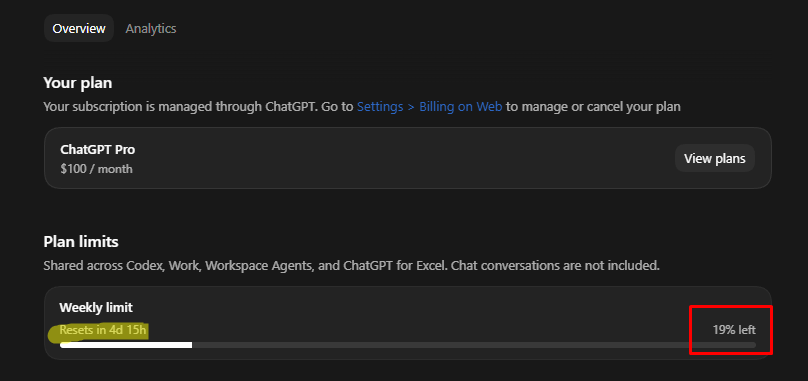
The fact that I still have usage left after the amount of work I’ve been throwing at GPT-6 Astra on High reasoning effort is pretty incredible..
Still amazed by the the computer mode.
I only have the $20 @cursor_ai subscription, but I’ve noticed my usage has been burning FAST with regular Grok bot usage lately.
Not sure if it’s just recency bias, but it definitely feels like I’m going through my usage much faster than before.
I’ve been really enjoying Codex recently. As someone who’s technical but not necessarily a coder, it’s been an incredibly useful tool—especially when paired with the right rules, guidelines, and skills.
I haven’t tried Opus 5.5 yet, but I may start implementing it for some of the frontend work on projects I’m building.
That said, I’m still very impressed with Astra’s frontend capabilities, and its backend work and overall usage have been more than enough for what I need.
Also really enjoying the new Computer Mode update.
A technological revolution can completely change the world....and still be a terrible trade.
Being right about AI, the internet, railroads, or any other major innovation does not automatically mean being right about the companies, valuations, or timing.
I wrote about the difference between identifying the future and actually making money from it:
https://t.co/ewoRShAZWu
I agree with you. Not a doomer either, but the pace is getting uncomfortable — especially around agents that can already replicate research and the direction that points toward recursive self-improvement.
My own worry is a bit more personal. I use different models for different work and they’re incredibly useful. I can hand an AI the right context and get a surprisingly strong first draft of something like an HVAC financial model..
That’s the problem though.. I get the output, but I skip the messy middle where I’d normally learn the structure, the constraints, and the tradeoffs myself. I end up with less real context than if I’d built more of it by hand.
The analogy that stuck with me is hiking. You hear about a beautiful waterfall and take a helicopter straight there. The view is still amazing. Then you look back and realize the trail would have shown you a dozen other waterfalls you never even knew existed.
That’s how AI feels to me right now. It can get you somewhere impressive, fast. It also quietly removes the path that used to teach you how you got there.
One aspect of trading I ponder is the ability to just sit.
Sit and watch. Sit and listen. Sit and simply observe what is going on around you in this vast, moving world.
With how fast-paced everything is, you can easily become distracted and stuck in an endless algorithmic loop where you are constantly fed information because that is what you have trained your mind to want to see.
It may be informative, but it could also very well be noise.
Just like the markets, a lot of short-term market movement can be noise.
Patience is one of the most valuable character traits you can work to develop, and I believe it will become even more important as we move forward in a world where information and data are milliseconds away.
We live in a world where it takes a human barely any time to find what they want. But the flip side of that is that when they can't find what they want in that short period of time, they give up.
The ability to sit, observe, and wait without feeling the need to constantly act is becoming increasingly rare.
Have patience.
It's fascinating when you actually take the time to realize that every aspect of our lives is an art.
I find myself falling into a trap that isn't talked about enough, and that trap is being afraid of change or afraid of the unknown.
We become comfortable with routines, relationships, jobs, ideas, and even versions of ourselves simply because they are familiar. Familiarity can easily disguise itself as certainty. We begin to assume that staying where we are is somehow safer than moving toward something we don't fully understand.
There is actually a psychological concept behind this called status quo bias. Researchers William Samuelson and Richard Zeckhauser found that people have a disproportionate tendency to stick with their current situation rather than choose an alternative, even when change may be beneficial.
I can see this in my own life.
I was once in a job I didn't particularly enjoy, but it had become routine. I knew what every day was going to look like, I knew what was expected of me, and there was a certain level of comfort in that predictability....
Read more here: https://t.co/SnXXDjHLQB
A technological revolution can completely change the world....and still be a terrible trade.
Being right about AI, the internet, railroads, or any other major innovation does not automatically mean being right about the companies, valuations, or timing.
I wrote about the difference between identifying the future and actually making money from it:
https://t.co/ewoRShAZWu
I have been trying to find time to expand my knowledge of all the new AI models that have been released lately, including OpenAI’s GPT-6 Astra and Claude's Fable 5.1.
With all these major technological advancements, I began thinking about the relationship between technological shifts and equity returns:
https://t.co/ewoRShAZWu
I’m a big fan of @bot and what the team has been able to accomplish over the last few months, especially in recent weeks.
Usage costs are one thing I think could stunt growth in the short term, which markets may react negatively to. Over time, though, I expect those costs to come down as models become more efficient and everyday tasks can increasingly be routed to smaller, cheaper models. Open-source models are already showing how inexpensive inference can become for many everyday tasks.
Regardless, I’m a big fan of the product. I’ve already implemented a few bots into my daily workflow that help me continue studying for my CMA while also making my trading workflow more efficient.
One thing to always remember: use these new and exciting technologies as tools, not as replacements for thinking. Build workflows that help you learn, challenge your thinking, and become more efficient rather than just getting a dopamine hit from the feeling of “fake” productivity.
@traderearl@trader1sz@GrammLary I don’t think you have say on sources when you seem to be worried about losing your funded accounts which have a negative EV in the long run.
WEF is widely used by well known economists both in public and private.
I actually agree that AI could be fundamentally different from previous technological revolutions, and none of us know exactly where it ends up. I mean I use it every day in my FP&A role.
Where I disagree is jumping from “AI is capable of replacing a massive amount of labor” to “eventually there will basically be no jobs and everyone will live equally on UBI.”
Those are two completely different claims. Even your example of using AI in your own businesses demonstrates that AI can increase the productivity and profitability of business ownership.
That could make ownership and capital an even bigger source of wealth rather than eliminate wealth creation. History doesn’t prove AI will create more jobs than it destroys, but I don’t think the evidence currently proves the opposite either.
This is such a terrible take. We’ve heard this with every major technological revolution. In 1850, ~50% of U.S. workers were in agriculture; today it’s under 2%. Those jobs disappeared, but entirely new industries and careers replaced them.
The WEF estimates AI and other structural changes could displace 92M jobs by 2030 while creating 170M new ones.
STOCK MARKET BOOM FUELS EARLY RETIREMENT
Older Americans are leaving the workforce at a faster pace.
Labor participation among people aged 55+ has dropped from above 40% pre-pandemic to 36.9% in July.
Bank of America economists point to rising wealth as a key driver.
With the S&P 500 up nearly 40% over the past two years, bigger 401(k) balances may be making early retirement easier for many Americans.