My key takeaways from the $GOOGL (Alphabet) Q3 2026 earnings call.
1. Search slowed while query growth hit a five-year high. Search and other ads grew 12% to $63.3B, down from Q2. The deceleration has four parts. FX was the biggest drag. The EU ended its de minimis exemption (duty-free treatment for cheap parcels), which hit APAC retail advertisers. World Cup media budgets landed in June instead of July. And AI Mode queries grew fast on a surface with "lower monetization" than classic Search. The first three wash out over time. The fourth is structural: more usage on a surface that earns less per query.
2. The EPS miss is mostly a SpaceX mark. Revenue grew 25% to $127.6B. Operating income grew 30% to $40.6B, a 31.8% margin. EPS came in at $2.12 against $3.02 expected because OI&E (other income and expense, the non-operating line where investment gains and losses land) swung to negative $8.2B. Most of that was an unrealized loss on the SpaceX stake after its share price fell. My rough math: after tax, that mark costs around $0.55 a share, so it explains more than half the $0.90 gap but not all of it.
3. Q4 Search is already guided softer. Lapping last year's Search acceleration cost about 3 points of growth in Q3 and will cost a couple more in Q4. FX gets slightly worse at current spot rates, mostly in Search and YouTube. The rest of Services won't make up the difference: YouTube ads grew only 9% to $11.2B, and Network grew 1% to $7.5B.
4. The AI Mode ad fix is rolling out but not proven. Ads in AI Mode go international for the first time, and multi-turn ads (ads that stay in a back-and-forth conversation) launch in the U.S. The evidence offered: inside AI Mode, sponsored and organic product listings get similar click-through rates. AI Mode queries run about 3x longer than classic searches, and most are incremental, meaning they would not have happened otherwise. What's missing is any number on how far AI Mode revenue per query trails classic Search. Agentic commerce (AI agents that shop and buy for users) is called additive, and consumer agents arrive in the Gemini app later this year. No revenue is attached to it yet.
5. Cloud doubled. Revenue grew 103% to $30.7B. Operating income was $11.1B, more than triple last year. Margin was 36.2% versus 23.7% a year ago. Backlog (signed contracts not yet booked as revenue) reached $561B, and just over 55% of it, about $310B, converts within 24 months. Two caveats. TPU system sales contributed to the growth but were not sized, and Cloud growth excluding TPUs was described as very strong with no number attached. Also, the rented third-party compute capacity came online only at the very end of Q3, so its margin drag lands in Q4.
6. TPU economics stay private. A TPU is Google's in-house AI chip, sold here as full racks with networking, storage and software. One analyst framed a TPU system at roughly $35B per gigawatt and asked how much of that becomes revenue and at what margin. Neither got an answer, because product-level financials are not disclosed. The cash cycle is clear. A signed contract shows up in backlog, Google builds inventory, and cash arrives on delivery. Inventory is only built against committed contracts. There are nearly 100 TPU customers, including Anthropic (directly and through Broadcom) and Apple, which is scaling pretraining on TPUs. New distribution comes through Oracle and Crux AI, a joint venture with Blackstone. The meaningful revenue ramp is 2027.
7. Free cash flow went negative. Q3 FCF was negative $9.1B on $51.4B of capex. Operating cash flow of $42.3B also absorbed the TPU inventory build and a $5.2B payment on a 2018 EC fine. Trailing twelve-month FCF is $19.7B. The 2026 capex guide is unchanged at $195B to $205B, and 2027 rises significantly, with numbers on the Q4 call. On top of that sit $924B in future purchase commitments and $152B in leases that haven't started and other obligations. Those are contractual maximums, and some have volume flexibility.
8. The return math is stated, not shown. Return on invested capital is said to stay meaningfully above the cost of capital, with no figure. Compute allocation is described as a long-range plan run on ROIC discipline, with no ranking of who gets capacity first. Cloud says it could serve a lot more demand with more capacity. About 65% of Q3 infrastructure spend went to servers and networking depreciated over six years, while TPU 8t claims up to 2.7x the training performance of the prior generation. My view: six years is a long life for hardware that loses that much ground each generation. Shorter lives would mean higher depreciation on top of the capex.
9. First-party model APIs process nearly 32B tokens (units of text an AI model reads or writes) per minute, up 40% QoQ and more than 4x YoY. In its first week on developer platforms, Gemini 4 Argon ramped 3.5x faster than Gemini 3, even with capacity limits. Customers who used Gemini Enterprise in Q3 2025 have more than quadrupled their spend. The Gemini app is at 1B users. This is the clearest evidence that the capex has real buyers.
Bottom line: The operating business beat. Revenue grew 25%, operating income grew 30%, Cloud doubled at a 36% margin, and the headline EPS miss is mostly a paper loss on SpaceX. The stock still fell about 10% after hours, from $322.22 to $288.35, because the market is now pricing cash, not growth. Quarterly FCF is negative, capex runs near $200B and rises again in 2027, commitments total about $1T, and the biggest profit pool is slowing as usage shifts to a surface that earns less per query. Management described every link between the spend and the payoff and did not put any number on them.
$META bull thesis in a nutshell:
It’s is projected to overtake Google in ad revenue this year.
Search will be mostly AI, so advertisers will shift spending from $GOOG to $META. Thus, it’ll will also capture a higher share of incremental ad dollars.
How can you be bearish?
I have partnered with Dynatyze to build the BEST DRAFT GUIDE in the industry and it’s available through Patreon (preview below).
https://t.co/iZHsqhx6zr
If you bought $MU everyday at market close and sold at market open, your return would be 138,330,342%
If you bought $MU everyday at market open and sold at market close, your return would be -99.2%
Almost all of $MU gains have come from overnight moves
I am going to set up a trading agent that buys $1000 of $MU everyday right at market close and it will sell it at market open the next day
This will be a fun experiment
The Big Tech Bond Paradox, Explained:
1. The United States just hit $40T in debt. The only way for us to deal with this is growth because no political party is ready to cut spending.
2. How are we getting that growth? AI CapEx. That CapEx is coming from Big Tech companies like Meta, Google, Microsoft, Amazon, Oracle.
3. How have those Big Tech companies been funding the capex? Well, initially it was their free cash flow, but that dried up so now, it's by issuing bonds. Google issued a 100 year bond with a 6% yield. Meta and Oracle have 6-8% yields as well.
4. The US 10-year treasury is yielding 4.7% and the 30-year is yielding 5.2%. The US sells these treasuries in order to fund the government. People buy them with an expectation that it is the safest return they can get because the US will never default on their debt. The yields that are currently being offered are the highest in decades.
5. What's the problem? Well, the Big Tech companies are giving bond yields at 200-300 basis points ABOVE what the US Treasury is offering...which is an issue because if you are a credit investor and don't think that Meta or Google are going out of business...why would you not buy their debt over the US debt? As a result, people are SELLING US treasuries, causing yields to go higher, and buying Big Tech corporate debt.
The paradox in all of this is that Big Tech NEEDS to issue this debt in order to continue to spend on capex and that same capex growth is what is supposed to solve our debt issues! If Big Tech stopped spending on capex, we wouldn't have any growth, but in order for them to grow, they have to issue bonds with high coupons and take away money from the long end of the curve for US treasuries, causing the highest yields we've seen in 20 years.
The simple way to resolve all of this is to end the Iran War because oil prices will go down, inflation expectations will go down, and credit markets will buy up US treasuries yielding 4.5-4.7% since they will be getting a great yield on lower inflation expectations.
The problem is, the war hasn't stopped for months and the market doesn't think it's stopping anytime soon...which means until it does, we have to deal with higher oil prices, higher yields on bonds, and more uncertainty for stocks if the credit market continues to scream that they need yields to come down.
In 1-2 years $GOOG should be at $600+ and here's why:
1. Revenue: $119.8B, up 24% — BULLISH
The first thing that jumps out at me is that this is Alphabet's 12th straight quarter of double digit growth, and it's accelerating, not fading. A company this size growing 24% shouldn't be normal, but here we are. US revenue alone ripped 32%. That's my green light right at the top.
2. Google Cloud: +82% to $24.8B — BULLISH
This is the number I care about most, and it's the headline everyone will lead with. Cloud didn't just grow, it accelerated into the 80s on enterprise AI demand. When I'm sizing up whether Google is winning the AI buildout, this line is my scoreboard, and right now it's flashing green.
3. Cloud operating income tripled to $8.8B — BULLISH
Here's what most people miss: I'm not just watching Cloud's top line, I'm watching whether it makes money. Margins went from ~21% to ~36% year over year.
That tells me this isn't growth I'm paying for with burned cash, it's growth with real leverage underneath it. To me, that's more bullish than the 82% itself.
4. Operating income +30%, margin 34% — BULLISH
This is the combo I always hunt for: spending aggressively on AI while expanding margins. Most companies do one or the other. Alphabet did both this quarter, and that's the sign of a business with genuine pricing power and discipline.
5. EPS $9.11, up 294% — NEUTRAL (and here's your trap)
Don't let anyone sell you that 294% number. When I dig in, $6.26 of that EPS came from a one time $99B unrealized gain on their equity stakes, paper money, not the business. Strip it out and core EPS is around $2.85 vs $2.31, so really ~23% growth.
Still great. But quote the 294% headline and someone smarter in the replies will eat you alive.
6. Free cash flow went NEGATIVE: -$5.86B — BEARISH
This is the one that made me sit up. For the first time I can remember, Alphabet burned cash for the quarter. Trailing twelve FCF is still $53B, but the trajectory is falling off a cliff as they spend. I'm not panicking, but I'm watching this like a hawk, and so should you.
7. CapEx doubled to $44.9B — MIXED
Here's the direct cause of that negative FCF: they're spending like crazy on AI infrastructure. I read this two ways at once, bullish if you believe the buildout pays off, bearish if you care about near term cash. I lean toward "this is the price of staying in the game."
8. Buybacks went to ZERO, and they raised ~$70B in equity and debt — BEARISH/NEUTRAL
This is the structural shift nobody's talking about. A year ago Google bought back $13B of stock. This quarter? Zero. Instead they raised ~$50B in equity and $20B in notes, and doubled their long term debt. When a cash machine flips into a capital raiser, I take note. That's dilution and leverage where there used to be neither.
9. Search +17% to $63.3B — BULLISH
This is my favorite point, because it kills the biggest bear case on the stock. Everyone's been screaming "AI is going to kill Google Search." The data says the opposite: AI features are driving query growth. Until this line breaks, the "Search is dying" thesis is dead in the water.
10. Gemini traction is real — BULLISH
Numbers don't lie: 950M monthly actives on the Gemini app, 22B API tokens a minute, and roughly 90% of the Fortune 100 on Gemini Enterprise. When I want proof Google's AI is being used and not just demoed, this is it, and it flows straight into those Cloud numbers.
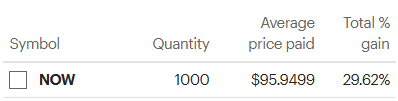
I'm up about 30% on $NOW .
I bought 1,000 shares at $95.95.
Tomorrow I plan to:
1. Sell all 1,000 shares
2. Buy March 19, 2027 $150 LEAPS, for roughly $21.00.
If $NOW hits $200 early 2027 or before, those LEAPS will now be worth $60.00 or so.
If $NOW hits $220 early 2027 or before, those LEAPS will now be worth $75.00 or so.
My stop would be where I'm back to my original investment.
What do you guys think? This trade would multiple the possible returns, using house money with my stop loss.
🚨 BREAKING VIDEO: Footage from central Israel captures an impact amid ongoing ballistic missile fire by the Iranian regime. Two people were murdered in the latest barrage targeting central Israel.
BREAKING: AI can now analyze stocks like Wall Street analysts (for free).
Here are 10 insane Claude prompts that replace $2,000/month Bloomberg terminals (Save for later)
Current situation:
1. Oil prices are below $59/barrel for the first time since May
2. 10Y Note Yield is down 10 basis points to 4.05%
3. Natural gas prices are down -5% to new monthly lows
4. Copper prices are down -5% in biggest drop since July
5. The Fed is expected to cut rates 3 times in 2025
6. S&P 500 is still trading up over +32% in 6 months
Is the trade war accomplishing all of Trump's goals at once?
This is unprecedented:
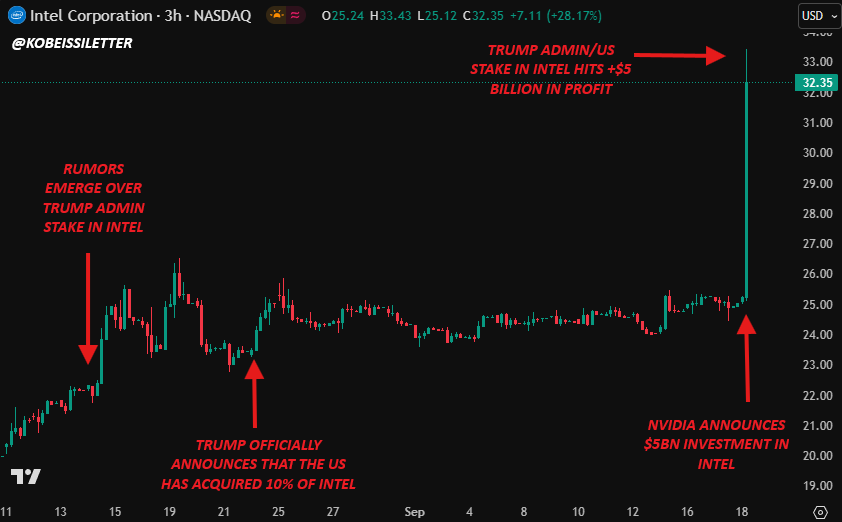
On August 22nd, President Trump announced that the US took a 10% stake in Intel, $INTC, worth ~$11 billion.
Today, 27 days later, NVIDIA made a massive investment in Intel, sending the US' position +$5 BILLION higher.
What just happened?
(a thread)
The China situation:
Nvidia did ZERO H20 chip sales to China during Q2 2025 but posted a record $46.7 BILLION in revenue.
And, Nvidia STILL saw $2.8 billion in revenue from China despite H20 sales coming to a halt.
How is this possible? Let us explain.
(a thread)
Shocking stat of the day:
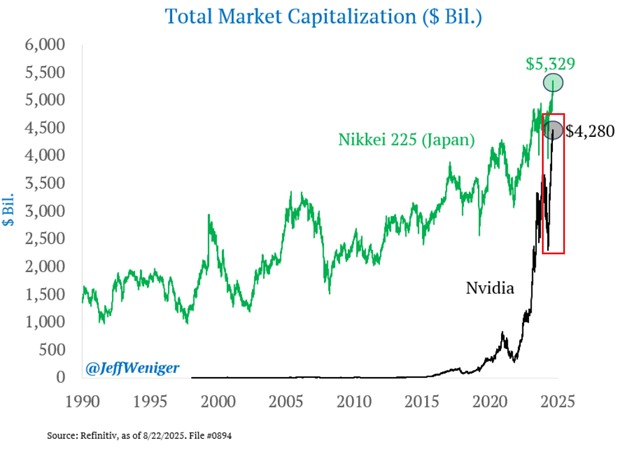
Nvidia’s, $NVDA, market cap is now ~$1 trillion below the Japan’s Nikkei 225 index.
The Japanese stock market is the second largest in the world, only behind the United States.
This means Nvidia is larger than the United Kingdom, China, and Canada’s entire stock markets.
This comes as Nvidia’s market value has DOUBLED over the last 16 months, to ~$4.3 trillion.
Nvidia, $NVDA, also accounts for 4.94% of the MSCI All Country World Index (ACWI), in line with Japan’s 4.97% share.
Nvidia is making history.