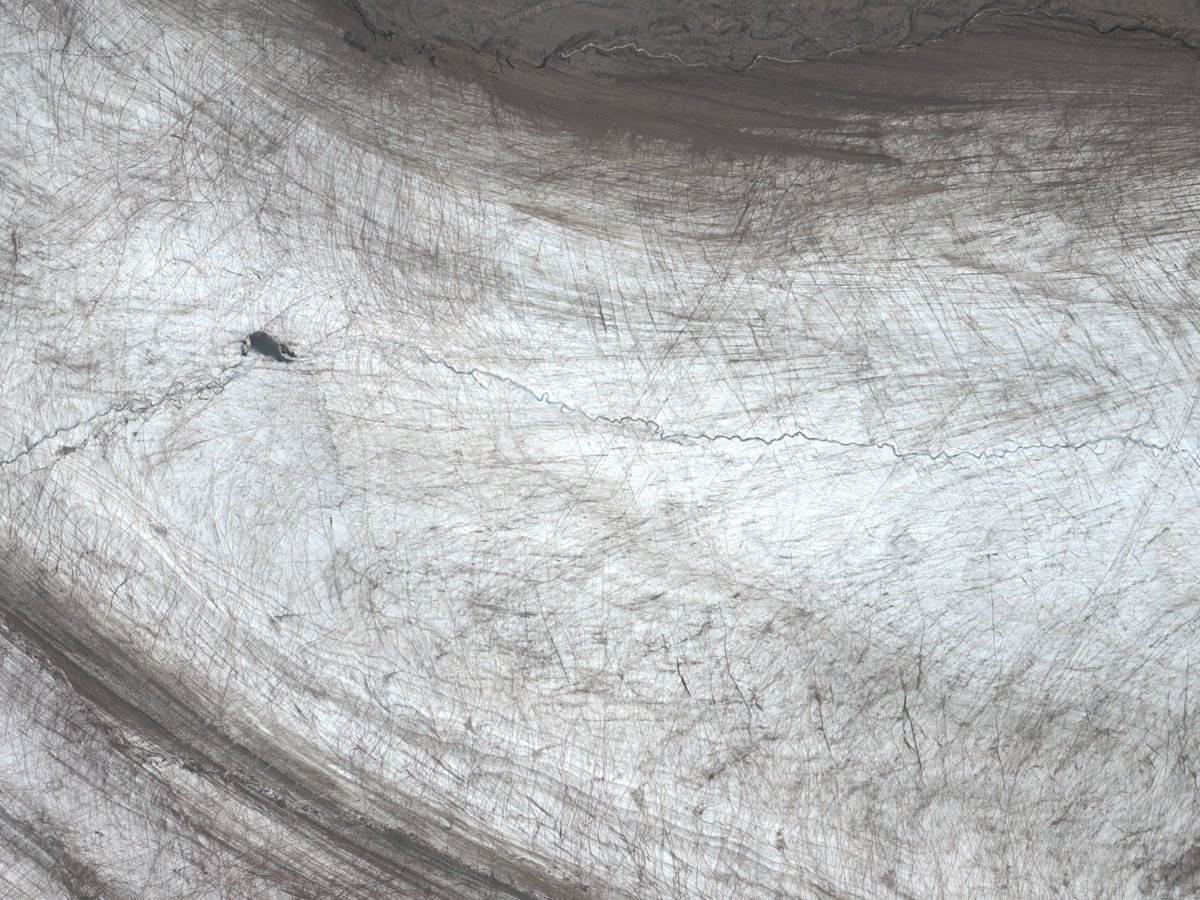
Great collaboration with @NORCEresearch and @sios_svalbard in the context of my SIOS-Access project GLASS. We managed to survey all glaciers in the Brøggerhalvøya peninsula (Svalbard) with a hyperspectral sensor in order to map glacier algae and cryoconite!
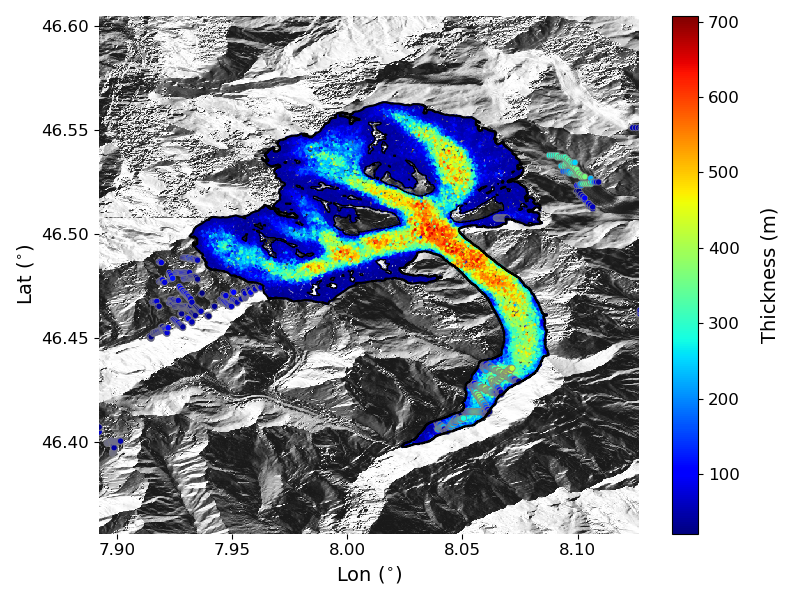
ICEBOOST is a machine learning model that generates ice thickness maps for any of the world's glaciers.
It is trained with 3.7 million data. Its error is up to 40% lower than existing models.
Preprint:
https://t.co/FblvM3XDMh
#MSCA#ClimateChangeAI
Last call 📢 we have one open Industrial PhD position on Trustworthy AI with Graph Neural Networks @ Ca'Foscari University 🎯 Deadline today, July 16th at 2PM (Italian time zone) Apply here https://t.co/ExKypynnOO or text me
In machine learning, a model can be guided by data in several ways.
However, if the model can generalize well enough, it doesn't care about extra data.
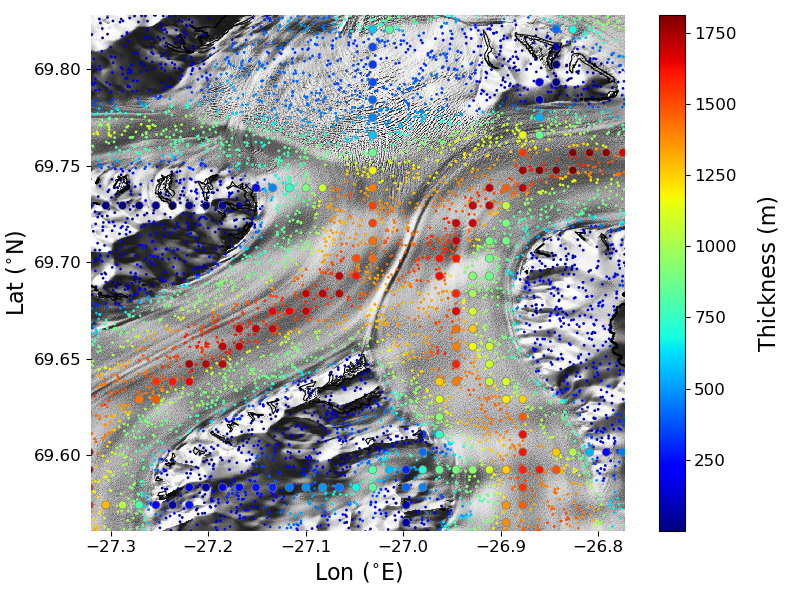
Modeling deep ice canyons in Greenland. Big circles are measurements.
Gradient Boosted Trees.
📢 Lavora con noi!
Ancora qualche giorno per partecipare al bando per assegno di ricerca di ISP (sede di Milano).
Tema: “Analisi di dati e immagini satellitari per lo studio dell’ambiente montano”
👇👇👇
https://t.co/MefrBDlM6g
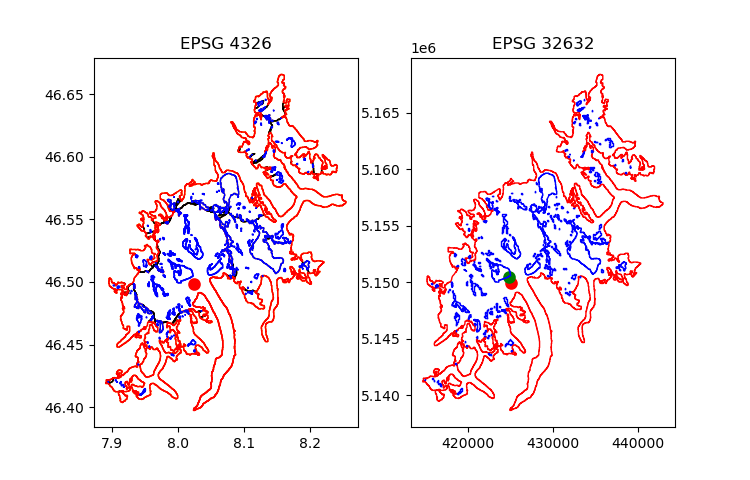
The distance between a point inside a glacier and the glacier borders may be a powerful predictor for the ice thickness at that location.
The distance calculation has to account for the presence of nunataks (regions with no ice, blue).
Aletsch and sorrounding glaciers.
Map of surface latitude slope over the Aletsch glacier in the eastern Bernese Alps, along with randomly generated locations inside the glacier perimeter.
I am investigating how good the slope can be as a predictor of ice thickness when fed to Graph neural network.
Today my second Marie Curie Fellowship starts with @CaFoscari, @uciess, @NASAJPL
The SKYNET project goal: better constrain the ice volume of Earth's glaciers, using generative AI.
@MSCActions, @erignot, @CarloBarbante
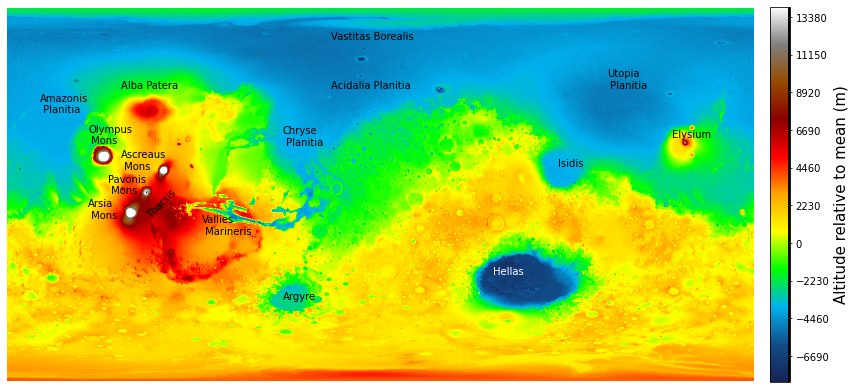
The elevation pattern of mars.
Data: Mars Orbiter Laser Altimeter (MOLA)
** Mars has no sea level - the altitude scale has therefore another zero. The zero is Mars gravitational and rotational equipotential surface, called aeroid.
@TerribleMaps From an algorithm perspective, try to fit as many switzerland as possible inside a fixed region, being allowed to rotate switzerland but not overlap. Maximization problem. Whoever created the map has been thinking.
In the process of investigating to which extent #NeuralNetworks can predict subglacial topographies and ice volumes in high-mountain Asia glaciers.
@ClimateChangeAI
📢Bando per assegno di ricerca postdottorale sul progetto ICENET.
Sei dottore di ricerca in Informatica, Fisica, Matematica o Ingegneria?
🧊Vuoi fare ricerca nel campo del deep learning applicato allo studio dei ghiacciai in Asia?
Info 👉👉 https://t.co/eeUso14qHP
🗓️30/09/22
On this day in 1934 Marie Skłodowska-Curie passed away. Her legacy is present through the @MSCActions👇
❄️The #EUfunded ICELEARNING project is using a new technique based on #MachineLearning 🤖analysing ice cores and learn more about our climatic past.
👉https://t.co/iobxZYx8pd
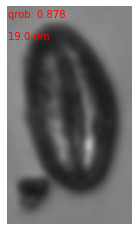
Possible 14,000 yr old Amphora diatom imaged by Flow Imaging Microscopy in Greenland ice. A training dataset would allow to train a neural network to identify (and count) these rare particles
Our project ICENET, "Estimate the ice volume of all glaciers in High Mountain Asia with deep learning" just started at @cnrisp and @UCIrvine
Looking forward to work with @erignot and @CarloBarbante
Thanks to @ClimateChangeAI and to the program sponsors.
We are excited to announce the awardees of the 2022 @ClimateChangeAI Innovation Grants! 🏆
We are funding 13 projects at the intersection of climate change and AI at a total of $1.8M.
Learn more about the successful proposals & selection process here: https://t.co/fmI1jlUAbZ
🔬Venti ricercatrici e ricercatori di 9 nazionalità e provenienti da università e centri di ricerca di tutto il mondo arriveranno a Ca’ Foscari grazie ai finanziamenti «Marie Skłodowska-Curie».
@MSCActions @CmccClimate#CervelliInItalia sul @Corriere ↩️ https://t.co/GvnCVS0T5n
Quando il ghiaccio sparì dal Nord Atlantico
@cnrisp e @CaFoscari dimostrano che nell’ultima era glaciale-nel Nord Atlantico-le riduzioni di ghiaccio marino si verificarono nell’arco di 250 anni in concomitanza con eventi di rapido aumento delle temperature
https://t.co/bEjVlDgjYI
A 120 000-year record of sea ice in the North Atlantic? - This study provides the first ice-core-based history of sea ice in the North Atlantic Ocean,reaching 120000 years back in time.This record was obtained from bromine and sodium measurements in the RECAP ice core-#Greenland