@Claude1079@marcosscriven That's an interesting idea still, the possibility of porting musashi to a pi pico. Even if one only gets performance on par with real 68000 it's still neat.
@Claude1079 Well, that's very interesting..!
How about if you read in a loop and then change an output pin as soon as the input pin changes, how long is the latency between the change on the input pin to the change on the output pin?
@LIV2 And you have double checked that the pin is set as an input? It seems odd that an input pin would break from feeding it any voltage (in the allowed range) during operations. I think (again, ?) that latch-up is most likely in a very short time after the device is powered on.
@realGeorgeHotz @hsultan75 I think I see where you are going with this, i.e., build on public cloud technologies. But the problem is that at Twitter scale the AWS bill would be astronomical. So building own infrastructure is unfortunately necessary, and that is still hard and labor intensive.
@ahmetb If they expect me to do work (the exercise) for free for multiple hours then that says something about how they do not respect/value my time, and probably it would not be a place where I would feel valued and respected anyway. Pass.
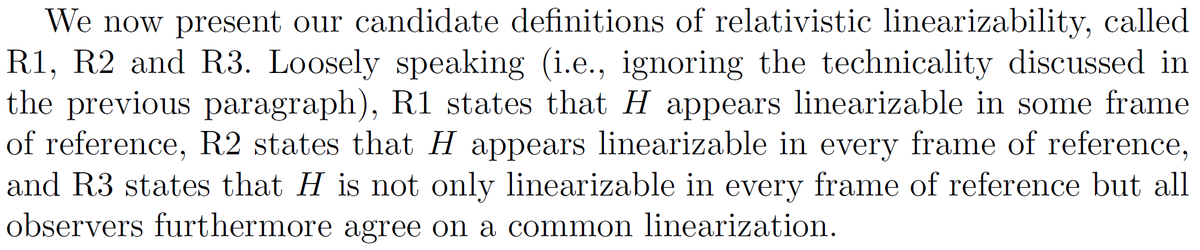
@joe_hellerstein@MarcJBrooker@shachaf@rystsov The first post was mentioning causality and light cones, and I mostly agree with his point of view. But there is one property of linearizability that requires a total ordering of events (compositionality), so it's not quite interchangeable with relativistic R1-linearizability.
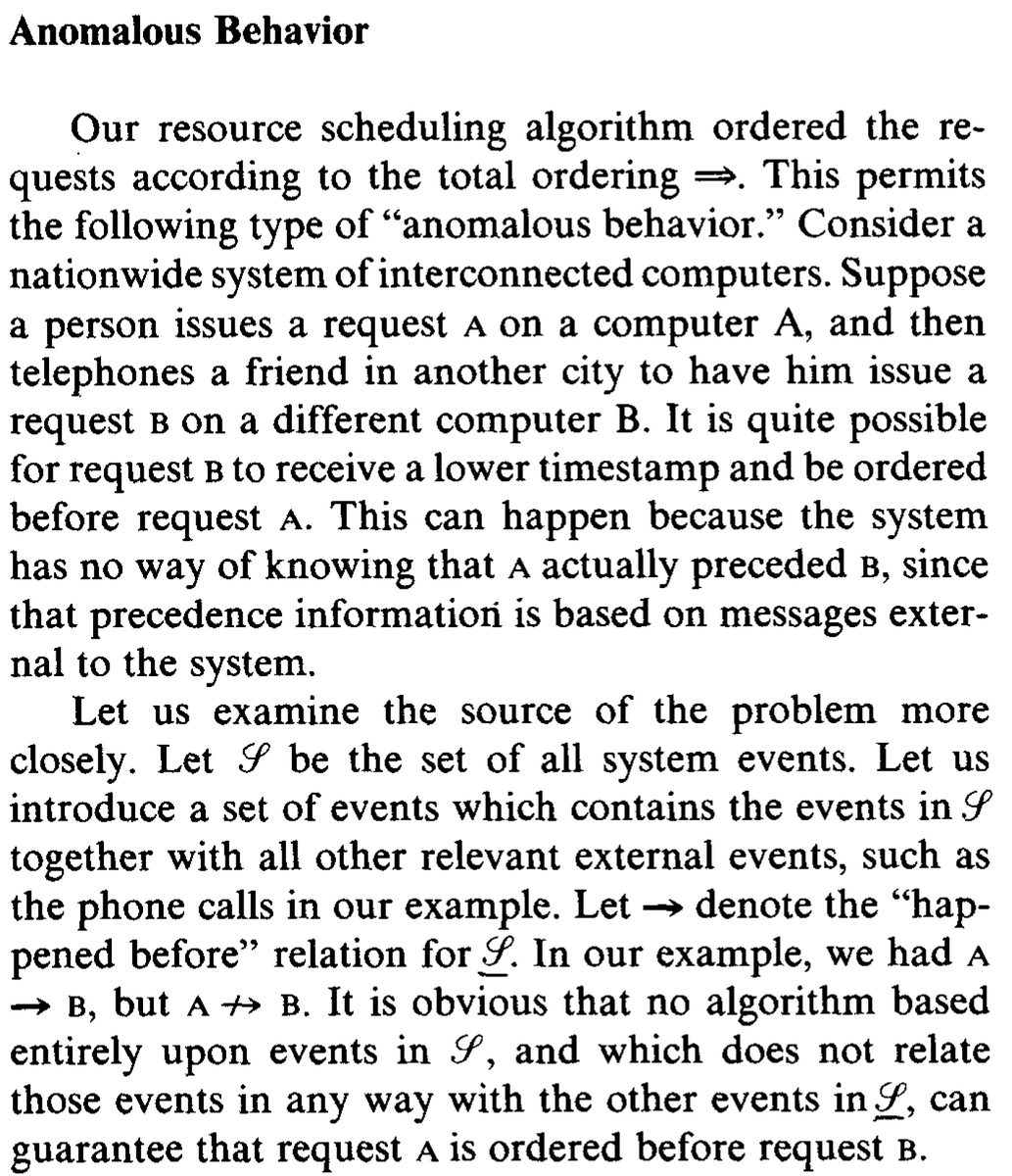
@joe_hellerstein@MarcJBrooker@shachaf@rystsov My claim is that an algorithm that is to avoid such anomalous behaviors, i.e. order operations consistently with the "fat arrow" partial ordering, must either use coordination or synchronized clocks. Hence, linearizability requiring a total order is not the problem in itself.
@joe_hellerstein@MarcJBrooker@shachaf@rystsov In Lamport's text, the "fat arrow" relation is a partial order on events, not a total order. The problem is that the relation contains orderings of events that are not observable by the system (hence external).
@joe_hellerstein@MarcJBrooker@shachaf@rystsov I think the original definition of external consistency is from this thesis, https://t.co/7JpTqqkSFX, and the author (Gifford) uses a similar example as Lamport does when describing anomalous behavior.
@joe_hellerstein@MarcJBrooker@shachaf@rystsov External consistency isn't that well defined tbh. But I understand it to mean that executions are free from anomalous behaviors as described in the text above (the text is from Lamport's Time, Clocks paper, https://t.co/QyLs7yaaef).
@joe_hellerstein@MarcJBrooker@shachaf@rystsov The critical property that linearizability ensures is external consistency. Ensuring external consistency necessitates up front coordination. External consistency is what you are sacrificing when using coordination avoiding algorithms.
@joe_hellerstein@MarcJBrooker@shachaf@rystsov No this is not right. The lightcone "could influence" relation is a partial order just like the "happens before" relation (Lamport). Replacing happens before with could influence gives a correctness condition essentially as constraining as linearizability.
@shachaf It is conceivable to create an algorithm using clocks that has executions that are linearizable in one frame of reference, but not in another.
@shachaf The downside to this definition is that it's not a local property (as described in the original paper) so doesn't give compositionality. In practice this is irrelevant in most (non-relativistic) situations; just pick a frame of reference to linearize in.