there's a version of the @sortlist story that fits in a tweet. four of us started it in brussels in 2014, raised about €18m across three rounds, crossed 4,000 paying agencies on the platform, currently on our way to $10m arr, and i got handed the ceo seat last june.
that version is true and also useless.
here's the longer one with the unfiltered details.
in 2013 we were running a small digital marketing agency on the side of school. four of us, all at solvay business school in brussels: thibaut, charles, michael, and me. we were billing decent money for that age, and the work itself was fine, nothing remarkable.
the question that ended up mattering came from our clients.
every project ended the same way. somebody would say 'next quarter we need an agency for seo, or paid, or content, who should we hire?' we'd recommend someone, they'd come back happy, and we never made a cent on the recommendation.
at some point one of us said it out loud. the recommendation was the actual product, and the agency work was just how we kept getting asked the question.
so we built sortlist.
except for the first stretch sortlist was really just a consultancy that called itself a marketplace. four students in a dorm room, hand-registering the first wave of agencies into the platform ourselves and manually matching the companies that came in to the agencies that fit them. we were the algorithm.
this is the part most marketplace founders won't admit. marketplaces almost always start as services, and the platform layer comes later.
in february 2015, lean fund handed us €550k. that wasn't validation so much as permission to stop running the side agency and bet the whole thing on the marketplace.
then comes the part of the story that sounds the same in every founder bio. we raised a €2m series a in 2019, acquired a Spanish competitor and then a german one through 2020, and closed an €11m series b in 2021. by then we'd crossed 4,000 paying agencies on the platform, 600,000 buyers were searching for one every month, and customers like mastercard, revolut, renault and accor were on it.
i could stop writing here and the post would do well. it's a clean arc with tidy numbers from a dorm room to a series b, the kind of thing that gets pinned to a profile. but the next two years are the part i actually want to write about.
in 2022 and 2023, sortlist almost died.
the post-zirp world arrived faster than our growth targets could adjust, and we'd hired into a future that wasn't coming. so we cut headcount from 140 to 70 across those two years, roughly half the company. on a podcast earlier this year i admitted, publicly for the first time, that i'd considered leaving during that stretch. i didn't, but it wasn't a clean no.
survival is mostly a series of decisions you don't broadcast. we hit operational profitability in 2024, and the road there wasn't anything you'd want to teach.
on june 3rd 2025, thibaut, who'd led sortlist for eleven years as ceo, handed me the seat. nothing was broken and we hadn't fallen out. it was a collective decision about what the next chapter needs, which is a different operating posture than the last one did. that's the cleanest way i know to describe it. handoffs like this get read as pivots more often than they should. most of them are just operating-posture changes that the outside can't see.
six months later, in december 2025, we made the largest acquisition in our history when we bought overloop, a brussels-based outbound platform with customers across the world. we framed it publicly as an outbound move, although inside the company we'd already decided it was the start of our ai bet.
in january 2026 i told the team we were going all-in on ai. our non-engineers started shipping production code through an internal slack-to-claude bot, and an experiment with claude running as an sdr landed real customer meetings inside two weeks.
betting a 12-year-old company on ai is a different exercise than starting one fresh, and most of the playbooks being published this year are written by people doing the second.
twelve years from four students hand-registering agencies in a brussels dorm, we're betting the next chapter on the proposition that the next decade of agency-finding doesn't look like the last one. that's the actual stake. everything else is just funding rounds.
i'm on x because the conversations about what ai does to services businesses, about agencies, about outbound, about the things i've actually spent twelve years inside of, are happening on this platform now. they aren't on linkedin anymore.
if you're new, here's what i'm going to be writing about:
- the agency economy and what's actually happening to it.
- signal-based outbound, before everyone calls it something else.
- what it looks like to bet a 12-year-old company on ai instead of starting a new one.
- the small operator decisions that compound, the ones that don't make it into the founder podcasts.
and occasionally, when it's worth it, the part of the story i usually leave out.
that's me. welcome.
If you're running cold outbound on AI tools right now and your reply rates are flat, you're probably building the stack in the wrong order.
Here's the order that actually works:
1. Signals first.
> The triggers worth watching: reposted jobs, fundraising rounds, M&A filings, tenders and RFPs, competitor engagement.
> Each one marks a different buying moment.
> Pick four and wire them in before you touch anything else.
2. Scoring next.
> ICP fit x signal recency x buying-stage weight.
> A reposted job in the last seven days at an ICP-fit account beats a job posting from six weeks ago at a non-ICP account.
> Decide who to act on this week, then who falls into next month.
3. Message context last.
> Pass the exact role being reposted, the exact funding amount, the exact tender description into whatever writes the first line.
> Generic "fits your ICP" filler tells the model nothing useful.
Each layer of this stack feeds the next.
Signal triggers scoring > scoring filters who matters this week > context shapes the message itself
Run this loop.
@levelsio Happened when private equities started to take over and wanted more EBITDA juice.
Less water, less cleaning = more margins.
The eco message is just a marketing technique towards the customers.
Intent data is the loudest and the most poorly used category in B2B sales right now.
Most teams track one signal type (job postings) and ignore the rest.
Four buckets actually matter when you run outbound:
Job, Social, Company, Funding.
Job postings sit at the entry of the first bucket. The other thirteen signals across the four rarely get touched.
Take Job signals for instance.
A first-time job posting and a reposted job are completely different triggers.
When a role gets reposted three weeks later, the hiring manager has already burned through the obvious candidate list, the budget conversation happened a month ago, and the urgency is real. We write that first message acknowledging the situation directly. The "congrats on the new role" filler gets ignored when the role isn't new.
The Funding bucket has its own rhythm.
A fresh round opens a window of roughly ninety days where the CEO signs checks she wouldn't sign twelve months later.
Past that window the budget is committed to the incumbent stack and you're queueing behind whoever moved faster. Simply put, the signal expires.
The Company bucket is where the most expensive signal lives: tenders and RFPs. They cost more to track than anything else in the catalog, and almost nobody runs them.
Public procurement filings tell you exactly who has budget locked in. The teams that act on them either apply directly or reach the incumbents being challenged.
M&A gets read as a press release. The reality is a restructuring event: a new CFO is incoming, the vendor list is about to get reviewed, the incumbents are nervous, and fresh stack decisions get made in the first ninety days.
The highest-conviction trigger we have is two signals stacking on the same account in the same week:
1. A reposted job plus a closed round.
2. A tender filing plus an M&A inside the same vertical.
Those accounts go straight to the top of the list.
@Pickanagency Bullshit: you can pick the one you want based on your preferences (filters) directly on the directory.
Pay to receive the brief = how you get answers in minutes and not weeks. Shows companies looking that the hand picked agencies matched actually care.
Every single intent signal worth watching in 2026:
JOB
1. Job postings. They opened a role you can map to a pain you solve. Send the hiring manager three lines, quoting the JD back at them. Don't pitch the product yet.
2. Reposted jobs. Same role, listed twice. The first attempt didn't close. Show up with the candidate-shaped alternative before they burn another quarter.
3. Hiring campaigns. Multiple roles inside a short window. A whole function is scaling. Pitch what makes the new team productive on day one. The tool sale comes later.
4. Job changes. Your champion moves, or a buyer you lost lands somewhere new. Reach out in week one with something useful. New hires get a 60-day budget window. Almost nobody hits it.
SOCIAL
1. Competitor tracking. They engage with a competitor's content or page. The highest-intent social signal you'll buy. Skip the us-vs-them copy. Lead with the second-order problem the competitor won't solve, the one their customer hits in month three.
2. Social mentions. A decision-maker writes about a topic in your space on LinkedIn. Comment in their thread before you DM. Send a useful resource before you send a pitch.
3. Post reactions. They liked or reposted industry content. The thinnest signal you'll work with, useless on its own and worth something only when stacked under heavier signals.
4. Influencer post reactions. Engagement on a thought leader's post. Read it as topic curiosity and nothing more.
5. Company post reactions. Someone reacted to your target company's page. Useful for warming an account already in your pipeline. Don't open a new account off it.
6. New followers. New follows on a competitor or partner page. Treat this as market-map intel. It tells you who is interested in the category weeks before they show up in a job posting or an RFP.
COMPANY
1. New companies. A company was just registered. No vendor relationships, nothing locked in. Be the first one in their inbox with a starter package. Save the enterprise pitch for later.
2. Tenders & RFPs. Procurement opens. The highest stated intent on the entire list. Budget approved, scope written, timeline locked. This is a response motion, not an outbound one, and without an RFP playbook the signal is wasted.
FUNDING
1. Fundraising. The company just raised. Budget opens in the quarter after the close, rarely on the day of it. Time your outreach to 30-60 days post-announce. Day one their inbox is a graveyard.
2. Mergers & Acquisitions. They bought or got bought. Stack consolidations and vendor reviews follow inside the first 90 days. Pitch the migration help, the integration, the thing that survives the post-deal cleanup.
Take things further by stacking the intent signals on top of each other, and get better response rates as a result.
Some examples:
> Reposted jobs + Fundraising on the same account is a scaling team with budget approved.
> Tenders & RFPs + M&A on the same account is a company rewriting procurement rules after a consolidation.
Note: Two signals together aren't additive, they multiply.
$400 a month. 14 AI agents working 24/7. That's my new headcount.
They scrape, write, analyze, engage. Last night they monitored fundraising rounds, hires at competitors, accounts that mentioned a problem we solve.
We were going to hire 5 more developers this year. We're not. The budget is going to agents and tokens from the major model vendors instead.
In a few years, companies will have a salary budget and a token budget. Anyone who doesn't grasp what's playing out right now will be at the back of the pack within months.
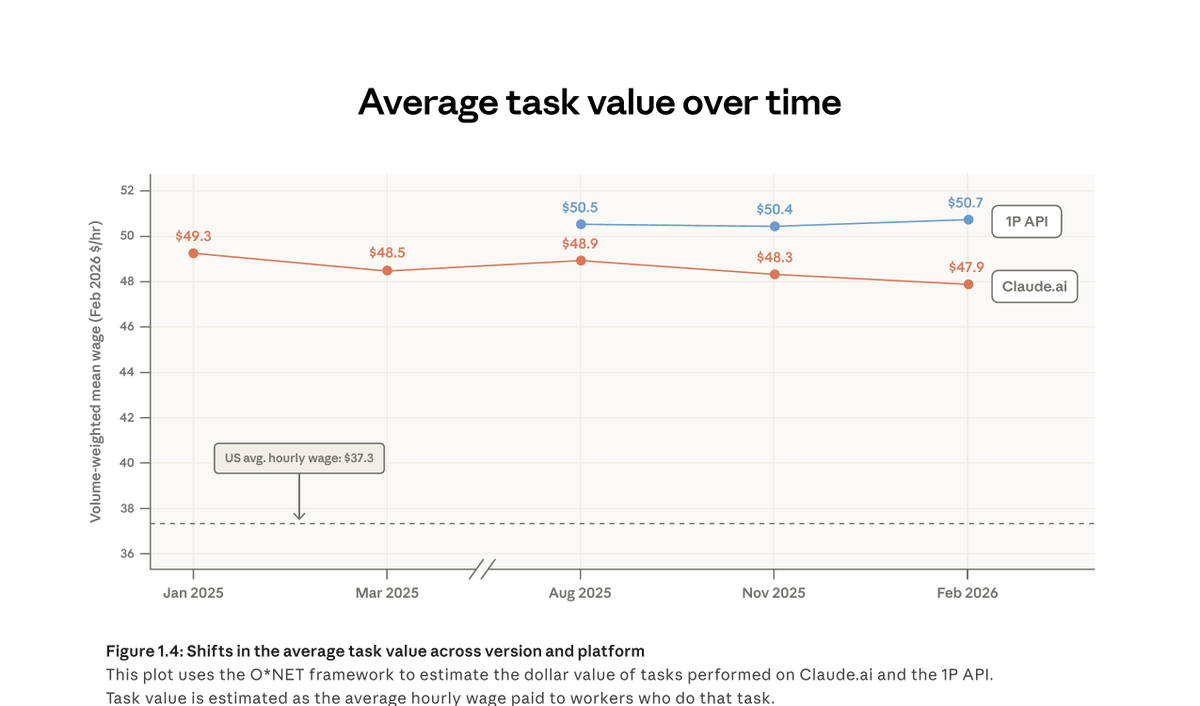
Anthropic measured every task running through Claude and asked what a human would get paid to do the same work. $47.9 an hour on the web app. $50.7 an hour through the API. The US average hourly wage is $37.3.
These models are doing the work that pays above the human average. Engineering, analysis, ops, sales prep. The salaried kind.
Inside Sortlist, we built Sara to do exactly that kind of work.
She reviews PRs, fixes bugs from Notion tickets, investigates Sentry errors, answers codebase questions in Slack.
Since January, more than 70 people at Sortlist can contribute to the codebase: PMs, designers, data analysts.
They send Sara a Slack message: "hey, can you fix this?" A developer reviews. Tests pass. It ships.
Looks like the future of hiring will revolve around delegating spend to humans vs tokens.