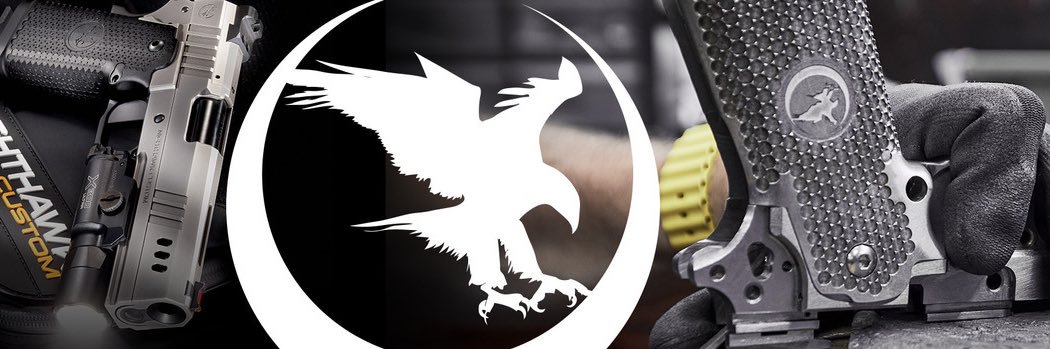
It’s not just what we make. It’s how we make it // Nighthawk Custom // The quintessential American handgun manufacturer proudly producing the quintessential American handgun since 2004
The A5 system is one of the most misunderstood “upgrades” in the entire industry. Most people who find it transformative are going from an overgassed, underbuffed rifle with a standard spring to something that’s finally somewhat balanced - but don’t fully understand why it feels better. From an engineering standpoint - if two rifles have the same gas input and reciprocating mass (BCG + buffer), the primary mechanical difference affecting the recoil impulse between a carbine system and an A5 system is the spring. Despite what many folks say on the internet - the stroke length (distance the BCG + buffer travel rearward) is identical between a carbine and an A5 system, but the longer rifle-length spring has a flatter force curve so operates through a smaller percentage of its compression range. Essentially - it allows the carrier to decelerate and reverse direction more gradually, reducing peak forces and creating a smoother perceived recoil impulse. Another big one people get wrong - the A5 system doesn’t magically increase the amount of mass the operating system can move. It literally just offers more space to package that mass because the buffer is physically longer. Having said all that - I do run it on some rifles and can feel a slight difference. I run mine with a Tubbs flat-wire spring which is even more linear in its compression compared to a traditional rifle spring. Side by side with a well tuned carbine system on the same upper - the carbine system “feels” slightly snappier, but quicker in how it reciprocates - and A5 with the Tubbs feels softer, but slightly slower.
Available as a single or double stack - the Nighthawk Fire Hawk utilizes the same comp as our Sand Hawk, but features beautifully blended ball cuts for that unmistakable 1911 front end
From raw billet steel to heirloom-quality craftsmanship // By controlling every step of the process in-house, we ensure every detail meets the standards you’ve come to expect from Nighthawk
I saw you have gun design experience which is what’s most baffling. You surely understand that everything in design is a trade off. If it’s a trade off YOU personally don’t like - that’s something else entirely, but it doesn’t mean the gun is inherently flawed? You can’t build an LMG with a pencil barrel then complain that it heats up too fast. We build 1911s with nice triggers because far more people value that knowing they shouldn’t drop the slide on an empty chamber all the time - vs building a 1911 where you can drop the slide full force 100k times but the trigger pull’s compromised. 🙈
@himynameisNinja@Tobias_Arms@Smith_WessonInc There is no one size fits all answer. Depends on slide mass, spring weight etc. It’s not going to cause some catastrophic failure all of a sudden. It’s more of a gradually wearing away of certain surfaces. No different than how a knife eventually dulls as you use it.
@Tobias_Arms@Smith_WessonInc I’m out. lol. I’ve explained it all politely, offered to let a world class 1911 gunsmith show you…but clearly you already have all the answers. God bless 🫡
It’s not about whether we “believe in the durability.” Everything in design and engineering is a compromise. Would we rather offer a finely tuned, super crisp trigger - or one that can be dropped on an empty chamber 10k times. Would you rather have sticky, grippy tires - or tires that’ll last 100k miles etc. We do tours and if you ever come in I’ll literally let you sit with a gunsmith who can show you all of this in real time.
We have 6 gunsmiths here at Nighthawk who have been inducted into the American Pistolsmiths guild. If gave them 10 identical 1911s with identical round counts and one had its slide repeatedly dropped on an empty chamber they’d be able to identify which one in about 10 seconds.
Without a cartridge to act as a buffer, the slide travels faster than intended and that metal on metal shock can degrade finely tuned triggers, damage the sear and hammer, and stress the barrel lugs, link, and slide stop. Most higher end 1911s generally have a more precise, delicate sear engagement. When the slide slams forward on an empty chamber, the inertia can cause the sear to "bounce" off the hammer. Over time that can round off some of the precise mating surfaces and ruin all the hard work that went into your trigger job among other things.
Without a cartridge to act as a buffer, the slide travels faster than intended and that metal on metal shock can degrade finely tuned triggers, damage the sear and hammer, and stress the barrel lugs, link, and slide stop. Most higher end 1911s generally have a more precise, delicate sear engagement. When the slide slams forward on an empty chamber, the inertia can cause the sear to "bounce" off the hammer. Over time that can round off some of the precise mating surfaces and ruin all the hard work that went into your trigger job.