🧠 Linking closed-loop control to temporal learning in living neural networks: In a new PNAS paper, Sono et al. show that engineered biological neural networks can be trained online to autonomously generate structured temporal signals. By combining modular in-vitro cortical networks with real-time decoding and stimulation, they demonstrate that living neurons can sustain learned temporal outputs in a reservoir-computing framework.
Using the MaxOne HD-MEA with PDMS microfluidic structures onto MaxOne+ chips (Fig.1), the team engineered two modular network architectures, lattice and hierarchical, and compared them with homogeneous cultures. They found that modular networks reduced excessive global synchrony and supported more distributed activity patterns (Fig.2).
Now, moving to the training phase — which network has better learning capabilities? Those with less global synchrony. Using the MaxLab Live API module for electrical stimulation-based online training, the authors show that these modular configurations display improved learning performance when trained on different temporal waveforms. These inputs can be learned and transiently maintained by the network, highlighting how structured connectivity enhances the computational capacity of living neural systems.
👉 Read the full article here https://t.co/Sjv9RqYYNQ
👏 Congratulations to Yuki Sono, Hideaki Yamamoto, Yusei Nishi, Takuma Sumi, Yuya Sato, Ayumi Hirano-Iwata, Prof. Yuichi Katori, and Shigeo Sato from the Research Institute of Electrical Communication, Tohoku University; Department of Electronic Engineering, Graduate School of Engineering, Tohoku University; WPI-AIMR (Advanced Institute for Materials Research), Tohoku University; Hotchkiss Brain Institute, University of Calgary; Department of Biomedical Engineering, Graduate School of Biomedical Engineering, Tohoku University; Research Organization for Nano & Life Innovation, Waseda University; School of Systems Information Science, Future University Hakodate; and the IRCN (International Research Center for Neurointelligence, The University of Tokyo).
#Neurocomputing #HDMEA #Electrophysiology #MaxOne #PDMS
マーブル・ブルーの不安感:
脳の���綱(たづな)核のアストロサイトが不安の程度を左右することを発見しました。
※ X(twitter)のリポストで研究支援!いいねよりもリポストでお願い!
Anxiety control by astrocytes in the lateral habenula. Neuroscience Research 2024
https://t.co/YrVh5Mh6IJ
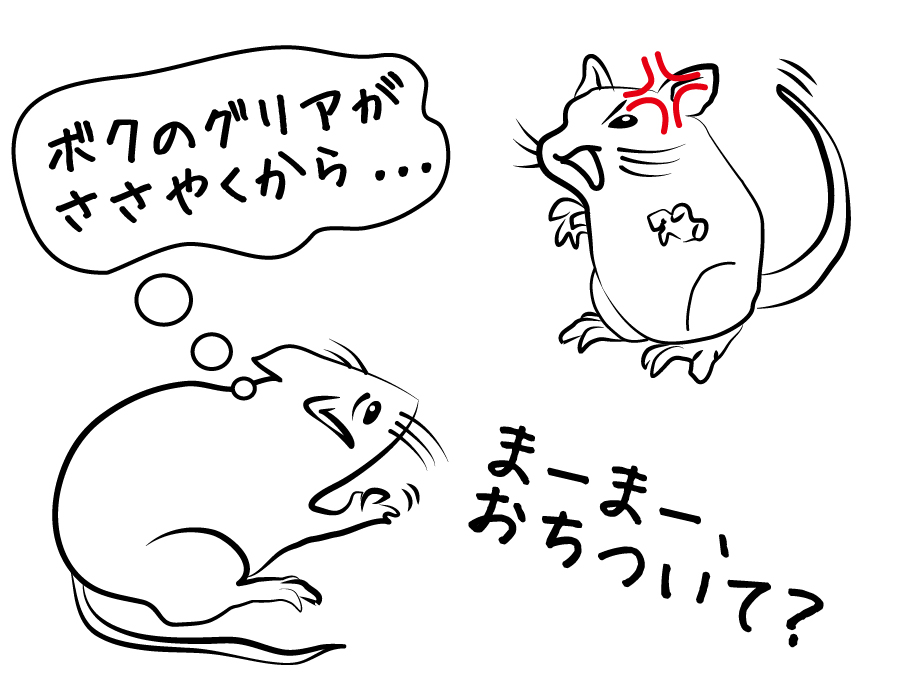
ケンカのゆくえはグリアしだい
小脳グリア細胞は、マウスの攻撃性を調整するボリュームの役割を果たす役割があることが解明された。
※ X(twitter)でリポストするだけで研究支援になります!いいねよりもリポストでお願い!
Glial tone of aggression. Neurosci Res 2023
https://t.co/vwhH9BWSM0
@YMorizawa@KoMatsui@NatureNeuro
Morizawa YM, ..., Matsui K (2022)
Synaptic pruning through glial synapse engulfment during motor learning.
Nature Neuroscience
https://t.co/tTkpJT8DYh
Please enjoy with sound.
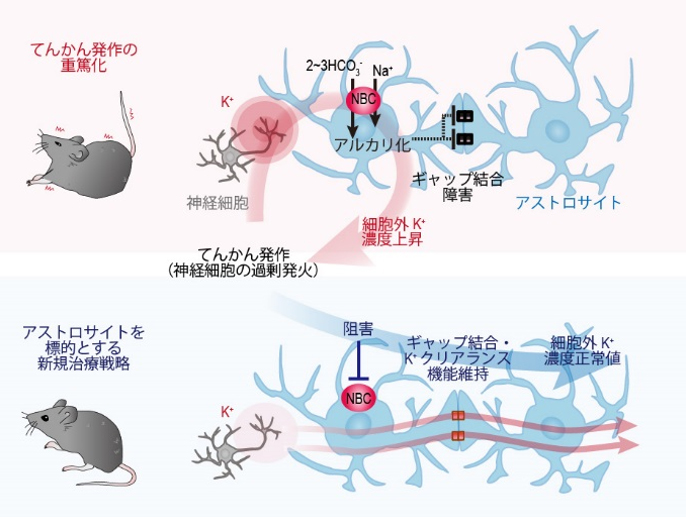
Glial Hyper-drive for Triggering Epileptic Seizures
https://t.co/1UeETXsUk8
** Please repost to support our science! **
Astrocytes play a significant part in triggering epileptic seizures, facilitating the hyper-drive of the neural circuit.
東北大学 大学院生命科学研究科 超回路脳機能分野(松井広教授研究室)の井樋慶一客員名誉教授との共著論文を発表。リポストして研究応援!
https://t.co/2LHpDvUfjW
Sato T, ..., Ikoma Y, ..., Matsui K, Itoi K (2023)
Journal of Neuroendocrinology, e13351.
https://t.co/0xh14xKTpL