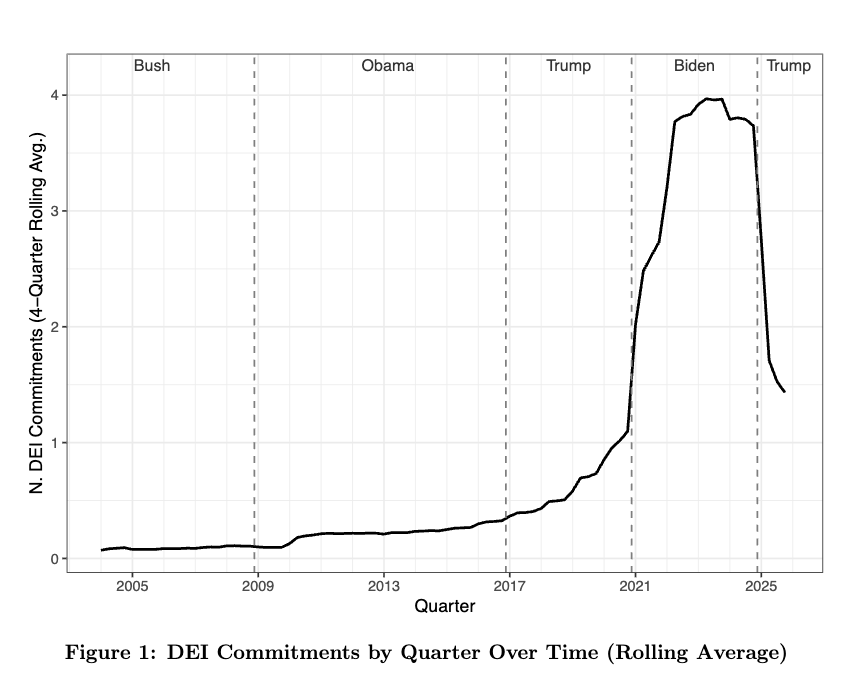
The rise and fall of wokeness: DEI commitments in corporate securities disclosures filed with the SEC. To me this seems a trailing indicator; most other measures of wokeness take off well before 2019 and peak in 2020 or 2021. But the shape! That's what a moral fashion looks like.
Dr. Mike Israetel on the economic fallacy he says explains why AI won't cause mass unemployment:
"Once we have 4 billion robots doing labor in the world, which we're like orders of magnitude off of that currently, then we've just only doubled the human workforce."
"From 1700 to today, we've 10 or 20x'd the human labor force. And, seemingly, the economy's not like, ah, we don't need any more people, that's enough. We could just consistently have better jobs and pay people even more money."
"This idea that robots are gonna show up and all of a sudden we're all completely unemployed makes a technical fallacy in economics called lump of labor fallacy. It's the idea that all the jobs currently are the only jobs that could be."
"Imagine in 1750, you're like, well, 98% of us work in farming, and then you come back from the future and you're like, you guys, 2% of people in the 1990s work in farming. It'd be like, so everyone's starving to death? Like, no, no, we're super fat, actually."
@misraetel
mass surveillance is coming
> first 5 votes fail
> have another vote
> invoke technicality to require majority to vote AGAINST rather than requiring majority to vote FOR
> do it when everyone's on vacation so not enough numbers to vote against
demonic creatures
🇪🇺 Chat Control has passed 😔
They can and will now legally scan any person's messages, emails and photos you send without a warrant
The way they passed this law when the majority of the European Parliament was against it will shock you:
They waited until most EP members were on holiday so only a few were present and then created an "urgent" vote for it to pass it through
There's nothing democratic about any of it and big powerful forces are behind this that can manipulate the EU for whatever they want
Democracy in Europe died a bit today 😔
This is why no one in any Western country can cut any welfare spending ever and why we keep going further and further into debt.
Because any time anyone reduces spending on anything, an example can be wheeled out of a person who suffered or even died as a result.
On this basis, there can never be too much spending, too much aid or too much tax.
Indeed, the author of the tweet I am quoting will almost certainly oppose paying taxes of 100% or having 100% of his country's GDP be used in aid to the developing world. Despite the fact that his failure to give all his/his country's money away is demonstrably killing people right now. How many lives could be saved by having all of his money go to Africa? How many millions could be saved by having all of the federal budget be sent to the poorest parts of the world?
Here's one of Michael Crichton's very finest quotes, especially applicable to climate "science":
"I want to pause here and talk about this notion of consensus, and the rise of what has been called consensus science.
I regard consensus science as an extremely pernicious development that ought to be stopped cold in its tracks. Historically, the claim of consensus has been the first refuge of scoundrels; it is a way to avoid debate by claiming that the matter is already settled.
Whenever you hear the consensus of scientists agrees on something or other, reach for your wallet, because you’re being had.
Let’s be clear: the work of science has nothing whatever to do with consensus. Consensus is the business of politics. Science, on the contrary, requires only one investigator who happens to be right ... In science, consensus is irrelevant."
Best to everyone,
w.
A retired paper merchant with no background in science decided to string a telegraph wire across the entire Atlantic Ocean. It failed so completely that people called it a hoax and a stock scam. He spent twelve years and crossed the ocean more than thirty times proving them wrong.
His name was Cyrus Field. In 1854 he was rich and restless, staring at a globe in his living room, when the idea hit. Back then a letter from London to New York went by ship, about ten days if the weather held. Field wanted to drop a copper wire two thousand miles across a seabed no human had ever seen, and make that message land in minutes.
The experts said it couldn't be done, and they had good reasons. Nobody had ever built a wire that long. It would weigh thousands of tons, more than any ship could hold. And nobody knew if an electric signal could even survive two thousand miles underwater. When Congress voted to help pay for it, the bill scraped through the Senate by one vote.
Then came the failures. The 1857 cable snapped after three hundred miles and sank into two miles of water. In 1858 a storm nearly sank the ship hauling it, and the cable broke, and broke, and broke. Field talked his exhausted backers into one last try that summer, and it held. Queen Victoria sent the US president a 98-word note. It took about sixteen hours to crawl down the wire. New York threw a party so wild the fireworks set City Hall on fire, and Tiffany sold off chunks of leftover cable as souvenirs.
Three weeks and 732 messages later, it went dead. An engineer had forced two thousand volts through the line trying to speed it up, and cooked the insulation. The mood flipped fast. By the end of 1858 people were calling it a fraud to drive up the share price, and Field went from national hero to suspected con man.
The Civil War ate the next few years. When it ended, Field found fresh backing and a new ship: Brunel's Great Eastern, the only ship big enough to carry the whole cable at once. In 1865, with a few hundred miles to go, the cable snapped and vanished into the deep. He brushed it off. "We've learned a great deal," he said, "and next summer we'll lay the cable without a doubt."
In July 1866, he did. Then his crew steamed back out, fished up the cable lost the year before, and finished that one too. Two working lines.
The new cable carried words eighty times faster than the first one. A message between two continents went from ten days to minutes.
Betting against Cyrus Field was the rational move, and the pessimists were proven right almost every single time. But the one outcome that rewired how the whole world communicates came from the lone man who stayed optimistic and was right.
The European policy on AC can only be described as sadomasochistic environmental policy enforcement
Intentionally inflicting pain on their population to get more political buy-in for decarbonization
Sinking their national economies for 2-3 weeks of Chinas CO2 output
The open society and its enemy, Soros.
While he named his Open Society Foundations after Karl Popper’s “The Open Society and Its Enemies,” his project stands as a philosophical inversion of everything Popper defended.
Popper’s open society rested on critical rationalism, the recognition that no one possesses final truth, that institutions must remain open to criticism and piecemeal reform, and that democracy functions as a method for removing rulers without bloodshed.
He rejected historicism, the belief in iron laws of history that justify sacrificing present generations for a utopian future, and warned that such thinking inevitably produces closed, authoritarian societies.
Soros has repurposed the label to advance a grand project of engineered demographic transformation.
Through mass immigration, multiculturalism as official policy, and diversity mandates that prioritize group identity over individual merit and assimilation, his foundations actively dissolve the cultural continuity and social trust that make rational criticism and incremental change possible.
Popper understood that openness requires a stable framework, a shared language of reason, basic cohesion, and institutions citizens feel they collectively own.
Soros treats those foundations as obstacles to be overcome in the name of an abstract, borderless openness.
The concrete results are visible. Parallel societies that operate under different norms, public spaces where debate on the scale and selection of immigration is treated as illegitimate, and the rise of identity based hierarchies that close off dissent in the name of equity.
These are certainly not expansions of the open society, but new forms of closure, tribal in character, enforced through institutional capture rather than overt dictatorship, yet hostile to the very critical spirit Popper placed at the center of civilized life.
Philosophically, Soros replaces Popper’s falsification and humility before reality with a new historicism, the conviction that global multiculturalism and open borders represent inevitable moral progress, and that resistance from actual existing communities constitutes the new enemy.
The machinery funded in the name of openness does not test its own assumptions against evidence, it suppresses the questions.
Those who still value the ideal of an open society should read Popper on their own terms.
They will find that Soros has not extended the open society, but has supplied its most sophisticated contemporary enemies.
I was wrong about the Midjourney ultra-sound scanner.
Well, maybe not wrong, but at a minimum I missed something obvious because I was thinking like a doctor who's been practicing for 25 years.
And I didn't explain my point well.
First, where I was wrong:
All historical precendent that showed that widespread screening imaging is net neutral or harmful was imaging that was expensive, inconvenient, gated by physicians and couldn't practically be repeated frequently short term.
If the Midjourney ultrasound is high resolution, harmless, inexpensive and convenient, people can get an initial scan, then if there are abnormalities concerning for cancer, they can get weekly follow up scans to see if it's growing/changing, and if it's not, they can leave it alone.
In retrospect, that is obvious but it never occurred to me.
Now, you'd assume that that approach would have to lead to it being useful and saving lives, and it probably will. But we won't really know it does until we have a couple years of data. Lots of things that seem obvious in medicine end up being wrong once we collect data.
Second, what I didn't explain well:
It's not that I think non-doctors are 'too dumb' to use the results effectively.
Its that historically it was literally impossible to use the results effectively, and that is super, super counterintuitive. It seems obvious that finding stuff early is beneficial, but experience has shown that it isn't.
Here's why:
The vast majority of abnormalities (i.e. possible cancer) isn't cancer - like over 90% of them, ends up being harmless - something thay your body could have handled on it's own.
But the only way to find out was to have invasive, risky procedures to biopsy or remove what was found.
And overall, the side effects from all the risky, invasive procedures to track down the over 90% of stuff that was harmless equal or outweigh the benefit from removing the less than 10% of stuff that wasn't harmless.
If the MIdjourney device can be repeated frequently, like weekly, at a low cost and is harmless, it could negate the need for the risky, invasive procedures.
Not saying it will, but it seems like it could and I confidently posted yesterday that it was a bad idea.
I was wrong to confidently post that.
@rravnikarNOV25 Saj vem, samo žalosti me, ker že leta gledam, da se sposobni ljudje, z najboljšimi nameni trudijo in trudijo, spremeni pa se bolj malo ali pa nič, zato se včasih sprašujem, če ne bi bili bolj uspešni manj diplomatski pristopi. "Administrativna stavka"?
@rravnikarNOV25 Čas bo, da se vprašate, če vam drugi najvišji položaj v zbornici ne omogoča, da dosežete vsaj 1% lažji delovni proces za svoje kolege, zakaj ga držite, morda si ga zasluži kdo bolj sposoben, kdo z jajci, ki bo segel dlje xa, med strašne 'odločevalce'?😉
A Scandinavian economist once boasted to Milton Friedman:
“In Scandinavia, we have no poverty.”
Friedman replied:
“That’s interesting, because in America, among Scandinavians, we have no poverty, either.”
@rravnikarNOV25 Pa še to, a nismo tudi zdravniki vplačniki v blagajno ZZZS in kdo bolje od nas pozna naš delovni proces? Kako lahko pričakujemo od pacientov, da se bodo borili za naše pogoje, da lahko v 5min v naši ambulanti sploh pravilno prepoznajo probleme, ki jih mi gledamo vsak dan cel dan?
@rravnikarNOV25 Kratkoročno zagotavljenje oskrbe, na način preobremenjenosti, ki večino mladih odvrača od družinske medicine, dolgoročno pripelje v razmere, ki jih gledamo danes in so gotovo bolj škodljive, kot če bi se leta nazaj vsi 'uprli' in takrat začasno poslabšali oskrbo.