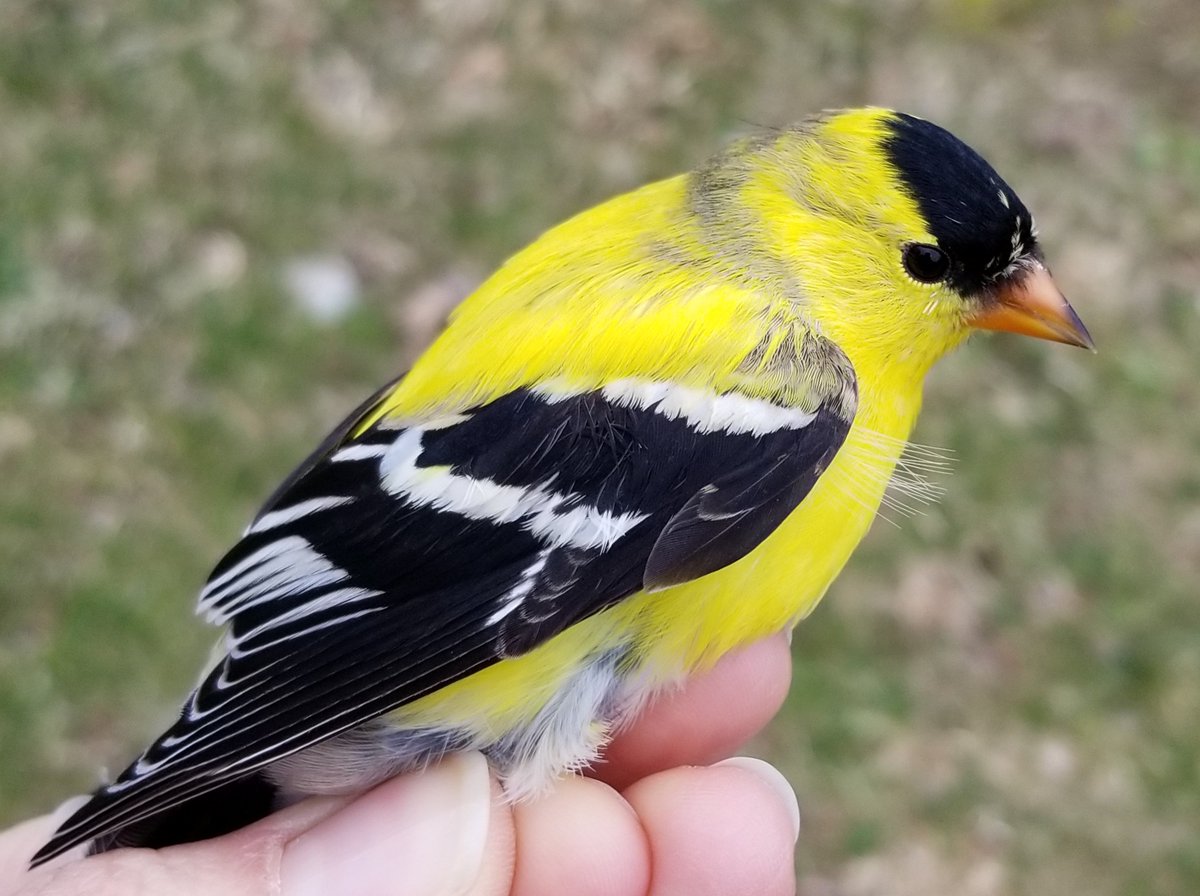
New paper is out in Ecology Letters!
We found a trade-off between innovation and survival: more innovative bird species are more likely to die from collisions with human-made structures.
Full text here: https://t.co/w7PFiOju3u
New in @sciencemagazine, we show that spatial cognitive ability is associated with longevity in food-caching Mountain Chickadees. And @CognitiveEcol’s photo was selected for the cover! #ScienceResearch. https://t.co/kFGuldkW94
1/n
Fascinated by animal innovation? 💡🐭 Feeling at home on the field? 🌲🌳 Having fun using Lego and camera traps? 📸 Then come do your MSc thesis with me in beautiful Abruzzo National Park! 🗻 Here a few more details, or just get in touch!
Short video on our recent discovery: Vocal learning complexity is linked with problem-solving skills in birds.
Thanks @ScienceMagazine for the video and co-authors @CoutNini and @erichjarvis. Complete article here: https://t.co/jU6c9HO2RJ
Here is the press release for our latest research! @G_Blackburn_ looks at the impact of multiple anthropogenic stressors and find they have an additive (negative) effect on magpie behaviour:
https://t.co/MoacjHCkKh
🎙️📻
Jean-Nicolas Audet @NikAudet discute @Anneeslumiere sur @icipremierere, des tests pour mesurer l'intelligence des oiseaux et leur taux d'innovation, qui leur permettent de s'adapter à leur environnement.
▶️ https://t.co/h1dLRDlSHw
#soutienCRSNG#BantingCanada#CRSNG_BPD
So immensely proud to see my PhD work out today in @Nature!
Combining neuroscience and ethology to an unprecedented degree in primates, we uncover neural signatures of social support and grooming reciprocity—building blocks of relationships.
https://t.co/hAGkBSMDiU 🧵👇
A model for the evolution of intelligence: @mcgillu study finds ability to solve food puzzles is the only predictor of innovation, brain size in wild birds 🧠🐦⬛https://t.co/srD01qeoxe
@McGillScience@NikAudet
@ninicout@erichjarvis Our results thus suggest that only problem-solving tasks should be used when the goal is to assess innovativeness (often referred to as “behavioral flexibility”). Other “behavioral flexibility” measurements appear to be unrelated to innovation or brain size (or to each other!).
@ninicout@erichjarvis Using a battery of behavioral tests on 203 individuals of 15 avian species, we showed that problem-solving performance is associated with field innovation and brain size, but not associative learning, reversal learning, or self-control.
A new study tested 23 avian species, including the blue jay, and discovered that species with greater vocal learning abilities have greater problem-solving abilities and bigger brains.
Learn more this week in Science: https://t.co/sWuO7JY0WS