@drmbikaner Sir, why private vehicles are not allowed to drop passengers near stairs from back side gate near platform number six. Senior citizens are facing trouble to take luggage and walk this far in midst of traffic near entry gate. Although huge space is available near stair
I seriously don't have words to thank @praffulgarg97 enough for this video and creating awareness in a very suitable and clear manner.
●Right now, We, the Jain community, are heartbroken. Girnar’s 5th Peak is not just land—it is sacred. It is where Bhagwan #Neminath attained Moksha. Generations have revered it with folded hands and tearful eyes.
●Why must we beg for our right to worship on our own ancient tirth? ●Why this silence from those sworn to uphold justice?
●We do not ask for privilege. We plead for fairness.
●We do not threaten. We pray for listening ears.
●We do not incite. We invoke compassion.
We hope to get more of such support from creators like you in the near future 🙏❤️
#JainRightToGirnar5thPeak
#Jainism
@ndtv@WalterJLindner@VishnuNDTV Germany first needs to learn humanity and compassion towards mankind.
Germans have snatched away an innocent Indian Baby from her mothers arms. Cruel and Heart wrenching. 💔 #SaveAriha
The assertion that Jain Tirthankars and monks consumed meat in ancient times is a blatant misinterpretation of Jain scriptures. This erroneous claim, propagated by certain scholars, particularly Prof. Ludwig Alsdorf, relies on distorted translations and a failure to grasp the essence of Jain ahimsa. I will try to dismantle these allegations, proving beyond doubt that Jainism has always upheld strict vegetarianism.
Alsdorf misinterprets three instances from Jain canonical texts, twisting their meanings to support his flawed hypothesis:
- Shri Ayara (Acharanga) Sutra: Alsdorf incorrectly claims that a passage permits monks to consume meat with fewer bones. However, early translator Hermann Jacobi later revised his initial interpretation, clarifying that the terms “meat with many bones” and “fish with many bones” were metaphorical expressions for food that contains large waste portions. The phrase does not advocate meat consumption. Instead, matsya-phala and mamsa-phala are actually names of certain plants. One can refer the Sanskrit lexicon to know more.
- Shri Dasaveyaliya (Dashavaikalika) Sutra: This text, too, has been falsely cited as evidence of Jain monks consuming meat. The listed items in the Scripture refer only to plant-based foods. Ayurvedic terminology often uses animal names metaphorically (e.g., kapoti for a type of plant), reinforcing that these passages do not refer to actual meat consumption.
- Shri Bhagvati Sutra: Alsdorf dubiously claims that Lord Mahavira instructed his disciple to fetch “cock meat.” Scholars like Padmanabh Jaini and Bal Patil have time and again refuted this claim, showing that kukkuta-mamsa in this context actually refers to a medicinal fruit, Aegle Mamelos (Bel fruit), not chicken meat.
Jainism’s absolute commitment to ahimsa inherently prohibits any harm to even microbes, let alone the possibility of meat consumption by monks or laity. Unlike Buddhism, where intent determines morality, Jainism holds practitioners responsible for both intent and action. Even accepting meat, regardless of intent, violates the Jain principle of non-violence.
Moreover, if Jain monks had ever consumed meat, there would be:
- A historical record of debates on the issue within Jain circles.
- Sects or subgroups that still practice meat consumption.
- Direct scriptural commandments permitting meat, akin to some sects of Buddhism.
None of these exist, proving that meat consumption was never a part of Jainism.
Despite overwhelming evidence against Jain meat-eating, some scholars continue propagating this myth. This is ~
- To pull Jainism down from its moral high ground. Jainism’s strict vegetarianism is unparalleled. Those from meat-eating backgrounds seek to dilute its ethical superiority.
- If even Jains once ate meat, vegetarianism loses its historical sanctity.
- Unlike Jacobi, who revised his view upon further study, many scholars refuse to correct their mistakes.
The claim that Jain monks or Tirthankars consumed meat is not just incorrect—it is an insult to the very foundation of Jain philosophy. It is based on deliberate misinterpretations, poor linguistic analysis, and a failure to appreciate Jain principles. Jainism’s stance on ahimsa is absolute and non-negotiable. No true Jain—monk or layperson—has ever or will ever partake in the consumption of meat.
@JagoJainJagore बहुत दुःखद समाचार
जिनेश्वर देव साध्वी जी को जल्द स्वस्थ करें
विचारणीय-आए दिन सड़क हादसे सुनने में आते हैं क्या इनके पीछे के कारणो को खोजा गया। पूर्व में जितने भी सड़क हादसे साधु संतों के साथ हुए हैं उनका विश्लेषण कर समाधान निकालना आवश्यक है।
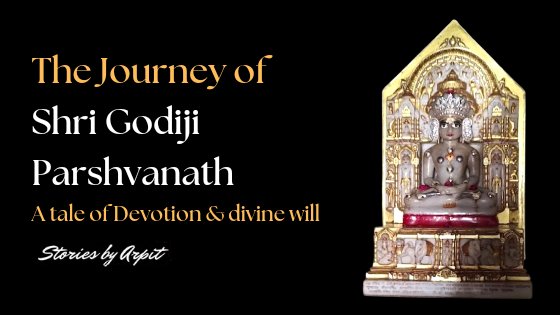
🌟 The fascinating journey of Shri Godiji Parshvanath 🌟
Do you know the fascinating history behind the divine pratima of Shri Godi Parshvanath?
➡️ How did it travel from Gujarat to Sindh (now in Pakistan) and back to India?
➡️ How many devoted souls contributed to protect and recover this sacred pratima?
➡️ What divine interventions shaped its remarkable journey?
✨ Dive into an extraordinary saga of devotion, divine intervention, and perseverance that transcends borders and time. This is more than history; it’s a story of spiritual power and unwavering faith.
📖 Read the full story now: https://t.co/ZFFm18pdGm
👉 Don’t forget to share your thoughts and spread the word!
#jain #jainism #godi #parshvanath #parshwanath #godiji #parasnath
#Mantra Limbs (5d/6) - #uṣṇih Chandas. 28 Syllables total that can be arranged in 2 verses of 8 syllables plus one verse of 12 syllables. 8+8+12=28
@mmpandit
#Mantra Limbs (5c/6) - #Gāyatrī Chandas - 24 syllables in 1 verse of 8 syllables in each stanza. 3x8 meaning 3 steps of the pāda (8) are used to reach the goal The 3 steps - bhū-bhuva-svaḥ. The 3 steps taken to cover the 3 lokas by Śrī Vāmana (avatāra). @mmpandit
#Mantra Limbs (5b/6) - Chandas. Vedic rishis understood the quality of sound. One way is the use of Pada/Foot. 1 pada=4 Aksharas. 2 feet x 4=8 Aksharas. This is the concept of Gayatri Pada. #Vedicscience#science#Soundwave@mmpandit
RT for wider reach :)
#Mantra Limbs (5a/6) - Chandas. The Vedic Meter. The sound #RESONANCE of the Mantra. Ancient method to encryption. The modern sound wave. 21 total, 6 are used frequently. Each Chandas is a perfect sound wave resonating with the mantra.
@mmpandit RT for wider reach :)
#Mantra Limbs (3/6) - Bija, the seed. Minus the seed, there is no propagation in value. Bija is the Rajas energy that is the fuel of internal creation. Bija is given by the Guru. Just the Bija chanting can bring in immense #transformation. @mmpandit. RT for wider reach :)
#Mantra Limbs (4/6) - Shakti, the energy to move. This is Kinetic energy (Devata - Potential energy). The feminine power of the divine mother. Mantra is null if there is no #Shakti, the movement towards the #Spirituality.
@mmpandit RT for wider reach :)
#Mantra Limbs (2/6) - DEVATA. Every mantra has a deity with qualities and traits the sadhaka wants to inculcate. This is the #potential energy of the mantra that has to be reached. The form of the Deity is used as an affirmation in #Meditation. @mmpandit
RT for wider reach :)