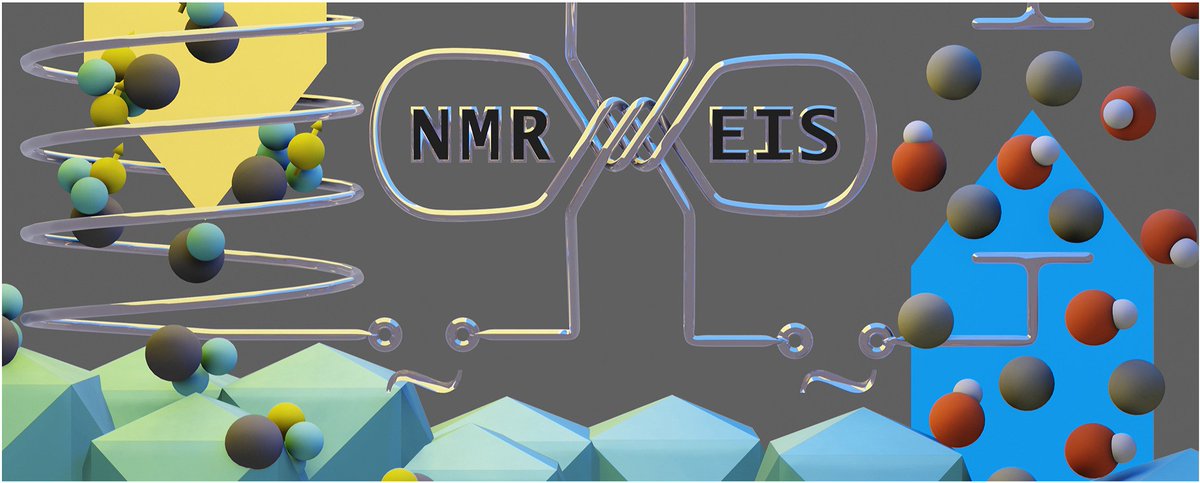
Wanna monitor crystal formation from nano- to macroscale in real time? In our recent publication we show how NMR and impedance spectroscopy can do the job, yet provide complementary insights.
https://t.co/E0ws08dRMg
Turns out, the liquid did not come alive, and the strangely dancing surface was caused by the Marangoni effect. Still a really nice project and super cool collaboration with PFM @jkulinz.
Link to publication:
https://t.co/aux4X5wTP1
When I first saw this liquid's strange surface behavior, I was quite intrigued. My PI at the time suggested locking it in a box with a message, 'We come in peace,' in case the liquid came alive overnight.
An absolutely bonkers stat from this Nature article on Nobel Prize winners.
"702 out of 736 researchers who have won science and economics prizes up to 2023 are part of the same academic family"
https://t.co/qC3AeqwnSM
1/5 Studying phase transitions, like the self-assembly of crystals in a liquid, often requires advanced and expensive techniques. In some cases, simpler methods, such as conductivity measurements, can also reveal valuable insights. For example, they can reveal how much of
4/5 Our latest article dives deep into the theory of error rejection in DIS. We outline its strengths and limitations, offering guidelines for when to choose DIS over conventional impedance spectroscopy.
5/6 Our latest article dives deep into how error rejection of DIS works. We outline the strengths and limitations of the method and offer guidelines on when to choose DIS over conventional impedance spectroscopy.
5/6 In our latest article, we investigate in detail how error rejection of DIS works. With our findings we can clearly define the strengths and limitations of this method, as well as formulate guidelines when it should be considered instead of conventional impedance spectroscopy.