🇵🇷♊️ Philly. Gen X. WFH Residential Title Examiner. 80s Queen. Horror. Sailor mouth. Loves: music/TV/film/hoops. #sidehustles: Production Assistant, Actor
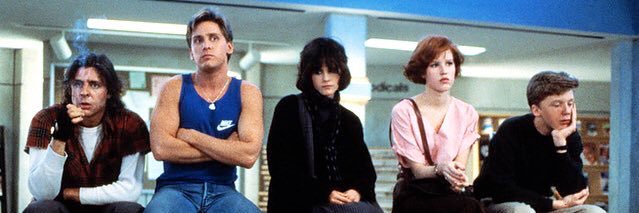
Weeks into filming The Breakfast Club, John Hughes made a decision: Judd Nelson had to go.
It wasn't a passing frustration. Molly Ringwald later described Hughes as angrier than she had ever seen him — not the managed tension of a director having a rough day, but something final. Something absolute. The set went still. Everyone understood what it meant.
Nelson had arrived with a commitment that made people uncomfortable. Trained in the method tradition at the Stella Adler Conservatory, he had decided before shooting began that he would never step out of character. Not between takes. Not at lunch. Not for anyone.
The character was John Bender — hostile, wounded, probing for weakness in everyone around him, turning every room into a test of who would break first. Staying in that character continuously meant staying sharp and needling and unpredictable. The set, much of the time, felt like the library in the film.
His primary target was Ringwald.
She later said she understood. She could see the method behind the provocation — that the discomfort Nelson created between takes was the same discomfort that made their scenes together feel raw instead of rehearsed. She was a professional. She recognized a professional working.
Hughes did not see it that way.
When he said he wanted Nelson removed, the cast faced a quiet crisis. Bender wasn't a supporting role. He was the engine — the force pushing every other character toward the truth the whole film was built around. Recasting weeks in, with the chemistry already forming, wasn't a minor adjustment. It was a potential collapse.
So they walked in together.
Ringwald went first — the person Nelson had been targeting, the one whose discomfort had set everything off. Ally Sheedy went. Anthony Michael Hall went. Emilio Estevez went. They told Hughes that what looked like provocation was commitment. That the discomfort was the point. That Bender was working because Nelson was working.
Paul Gleason — the veteran playing Principal Vernon, a man who had spent a career learning to tell the difference between someone causing problems and someone solving them unusually — added his voice. Nelson deserved to finish.
Hughes listened. He changed his mind.
Nelson stayed. He fought for every corner of the character — including the scene where Bender describes his father burning him with a cigar. Hughes wanted the cruelty to read as careless, accidental. Nelson pushed back hard. He had built this character from the inside, and the inside required deliberate damage — a father who chose to hurt his son, because only that specific intentional cruelty could explain the specific intentional damage Bender aimed at everyone around him.
He won that argument too.
The scene plays exactly as Nelson wanted it. Bender describes his father with the flat affect of someone who processed horror by draining all the feeling out of it. The emptiness is more disturbing than anger would have been. Roger Ebert, reviewing the film on its release in February 1985, called Bender the strong center of the movie.
The Breakfast Club cost around a million dollars to make. It earned fifty-one million. It became one of the defining films of a generation — not as a time capsule, but as something that kept finding new audiences for decades, because what it said about identity, and the gap between who we appear to be and who we actually are, was true enough to stay true.
Nelson said afterward that Hughes was one of the only directors he ever worked with who genuinely wanted collaboration — who would hear a better argument and change his position. Working with others later made him understand how rare that was.
He also said, simply, that he never wanted to be difficult. He just didn't want to fail the character.
He didn't fail him.
But the Bender that ended up on screen — the one generations of teenagers recognized as the most honest portrait of a certain kind of hurt they had never seen named before — exists because four young actors walked into a hard conversation with their director and asked him to give a fifth one more time.
A film about strangers choosing to protect each other was saved by strangers choosing to protect each other.
*That's either a coincidence. Or it was always the only way it could have worked.
Ancient yt lady almost hit me w/ her car in a Beverly Hills parking lot & then tried to blame me for ‘walking near her car’
Was delighted to reply-
‘This isn’t the 1950’s hagfish, there’s cameras everywhere, ya better scoot before I call the cops & get your license revoked’⚡️
"Us showing up is a form of resistance."
This is from an interview I took with Chris Rabb at the second No Kings rally in October 2025.
Can't speak for the other candidates, but Rabb had a large presence at the No Kings and May Day rallies and I believe that helped him.
Colman Domingo spoke to Men's Health about his experience coming out as gay to his family in the 1990s. The first person he told was his older brother:
"I told him that I was gay. He looked at me and was just like, 'What?' He just couldn’t believe it. Eventually, he said, 'I don’t care, man. I love you anyway.' And he just hugged me. Then he said, 'Have you told anyone else?' I said, no. He said, 'Alright, this stays between you and me.”’
Her sister found out two days later:
"She was pissed off. I said, 'Look, yes, it was really hard for me to tell him.' She said, 'No, no, no. Why didn’t you tell me first?' She was pissed off because she didn’t get the information first.’
Some time later, he told his mother—who accepted it calmly. Twenty minutes later, the phone rings and she says:
“I talked to your stepfather.” She puts him on and he says, in his blue-collar masculine way, “You’re a good boy and there’s nothing you can tell me that would make me stop loving you.”’
🔗https://t.co/qHS6o9eE2y
Talking Heads performing “Once in a Lifetime” at The Pantages Theatre in 1983 feels like watching a nervous breakdown turn into art. The groove keeps moving, David Byrne looks like he’s receiving messages from another planet, and the whole performance captures that strange feeling of waking up inside your own life and wondering how you got there.