Starting Season#14 of the SGEM with this SRMA on the pharmacological interventions for the acute treatment of hyperkalemia.
https://t.co/L62ski8boO #EBM#FOAMed@KirstyChallen
Great work by @PeterCaroeeLind - even small changes in potassium is associated with increased risk of in-hospital cardiac arrest
Potassium Levels and In-Hospital Cardiac Arrest: A Matched... : Critical Care Medicine https://t.co/MqcU28dDGz
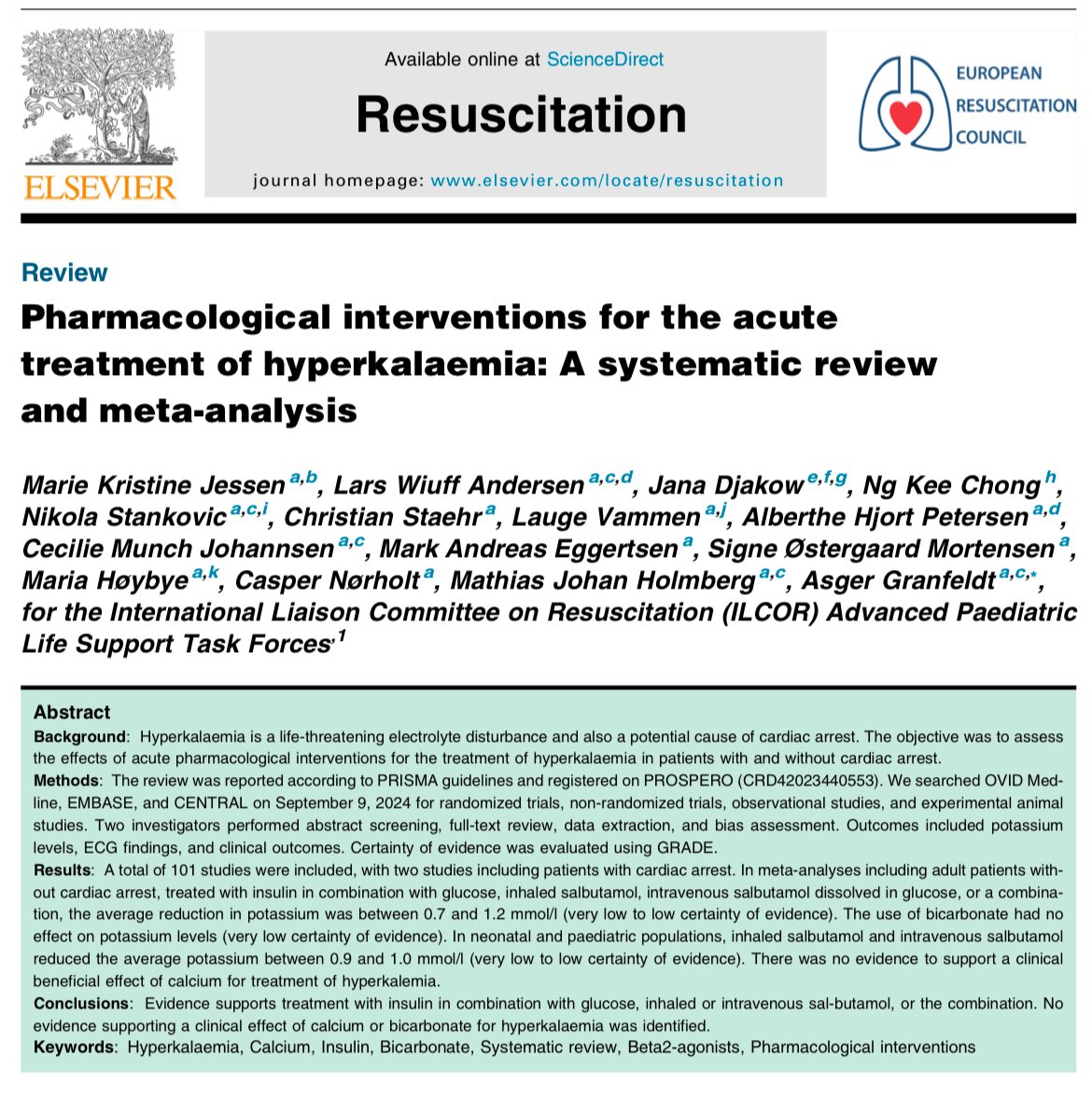
Hyperkalemia management: No supporting clinical effect was identified for calcium or bicarbonate. Is it time to rewrite all the order sets? 🎩 tip to the authors.
https://t.co/Sfr6vCn6le
Should you use calcium to treat #hyperkalemia? 💉 Our new systematic review in @ResusJournal (https://t.co/OA9lFnzyEN) found no evidence supporting calcium for hyperkalemia management.
Thanks to @AsgerGranfeldt & @MarieKJessen for inviting me to be part of this work!
@Ilcor_org
This was a tough one. 40000 abstracts screened. Limited evidence for the use of calcium for Hyperkalaemia
Pharmacological Interventions for the Acute Treatment of Hyperkalaemia: A Systematic Review and Meta-analysis - Resuscitation https://t.co/9bFi2M3MVP
@LarsWAndersen1
Important letter by @LarsWAndersen1 on limitations of observational studies
Observational studies and causal questions in resuscitation research– ... https://t.co/KhAg0ajpxv
Another study from our group trying to increase our understanding of in-hospital cardiac arrest
Great work by @PeterCaroeeLind
Blood laboratory analyses preceding in‐hospital cardiac arrest: A matched case–control study https://t.co/NRmHMoOG6Y
Our updated review on temp control is now online - its all about the methods
Temperature Control After Adult Cardiac Arrest: An Updated Systematic ... https://t.co/RmXL1xelBe
@LW_Andersen @jas_soar @JerryPNolan @mathiasholmb @Ilcor_org
Today the Bicarbonate for In-Hospital Cardiac Arrest
– A Randomized, Double-Blind, Placebo-Controlled Trial started at Aarhus University Hospital. Soon it will be recruiting patients at 22 hospitals across Denmark https://t.co/cXT06uuFhN @LW_Andersen @nikostanko
In this study of patients with in-hospital cardiac arrest, high assets💰 were associated with:
⬆️ higher survival
⏲️ longer duration of resuscitation among patients without return of spontaneous circulation
But the effect size may potentially be small
🔗https://t.co/qS8Gy3LK7I
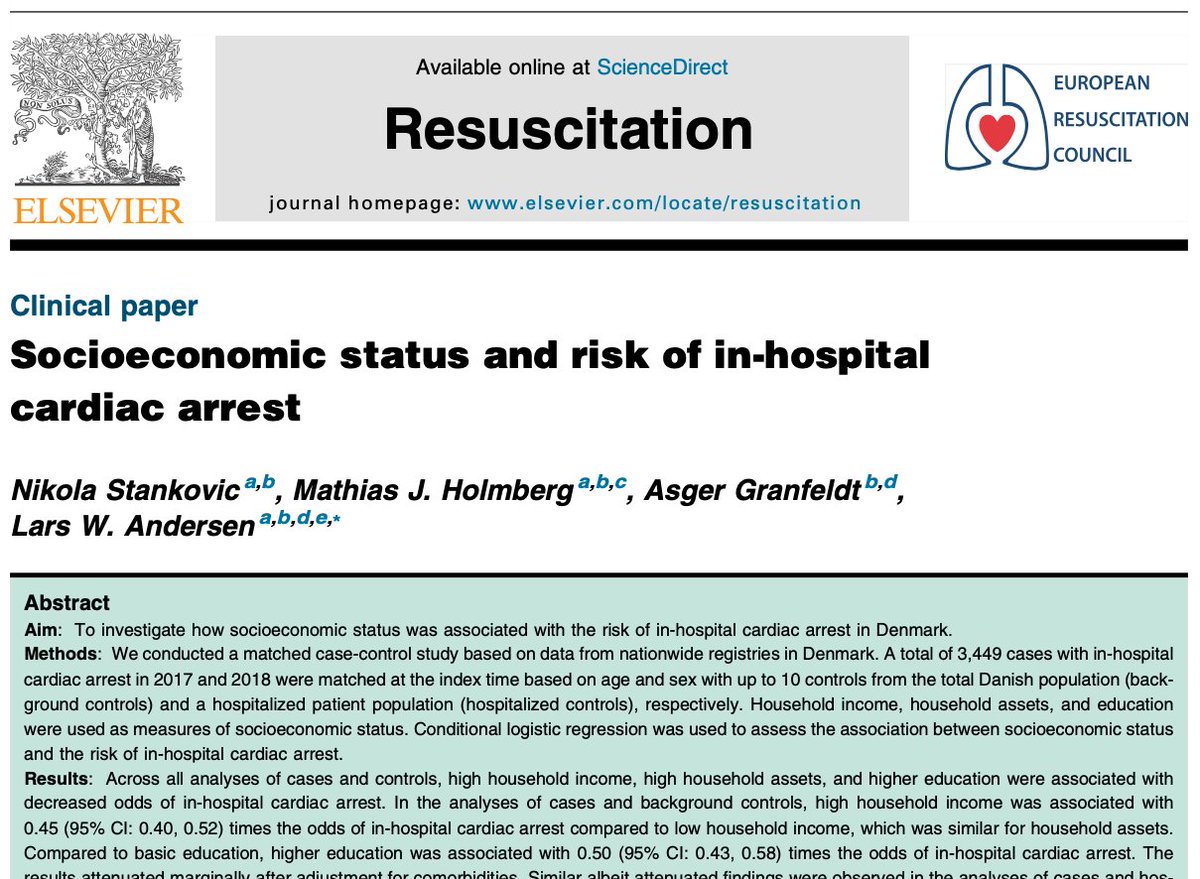
In this study, high socioeconomic status was associated with lower⬇️ odds of in-hospital cardiac arrest.
The findings were consistent across income💵, assets💰, and education📚 and persisted after adjustment for comorbidities.
🔗https://t.co/pVHuiyJMUv
@ResusJournal
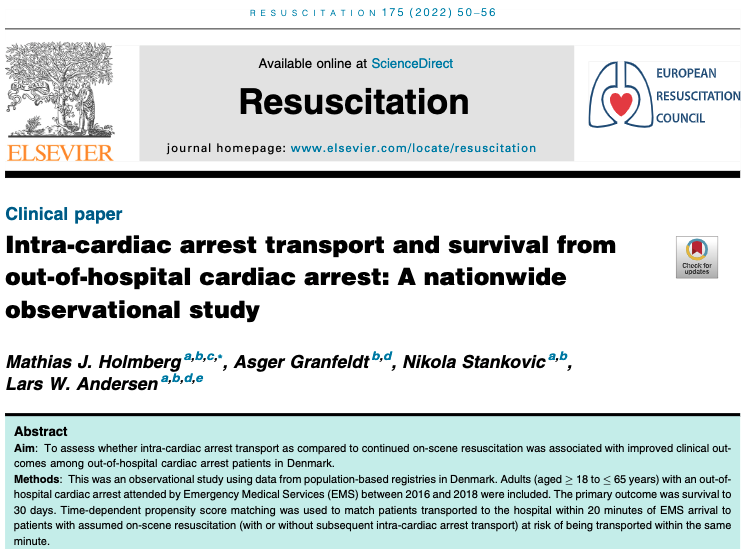
In this study, intra-cardiac arrest transport was associated with a non-significant increase⬆️ in survival within 20 min of EMS on-scene arrival among patients aged 18-65 years.🚑
However, the results should be interpreted carefully.
🔗https://t.co/esSPIFZcvb
@ResusJournal
What is collider bias and why is avoidance of collider bias important?
👉Collider bias is a threat to validity in observational studies and RCTs, but is often less readily recognized than confounding.
📄https://t.co/CaCJKnGvic
@JAMA_current#epitwitter#medtwitter
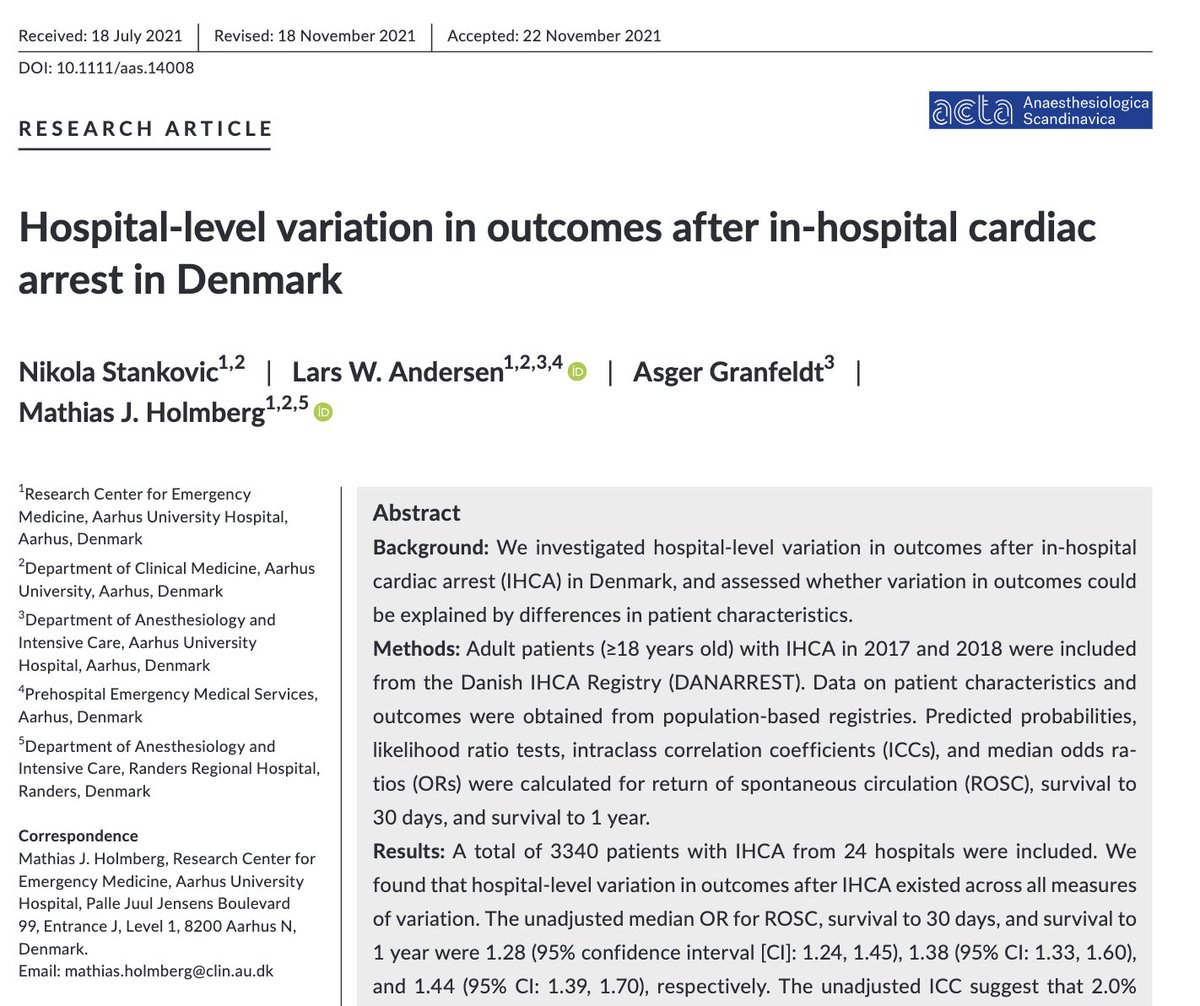
In this 📝, outcomes after in-hospital cardiac arrest varied across hospitals in Denmark.
However, most of the total individual variation in outcomes was attributable to patient-level variation.
🔗https://t.co/nhodRi0hkp
@nikostanko@LarsWAndersen1@AsgerGranfeldt @mathiasholmb
RCT found treatment with intravenous or intraosseous calcium did not significantly improve return of spontaneous circulation among adults with out-of-hospital cardiac arrest https://t.co/p23an21sM0