On the night of May 20, 2025, a little girl in a faded pink frock fell asleep on her mother’s lap at Chhatrapati Shivaji Maharaj Terminus. Her parents, simple people from Solapur, had come to Mumbai for her father’s treatment. They were exhausted. Just for a moment, the mother closed her eyes.
When she opened them, her daughter was gone.
Six months.
Six months of walking from police station to police station.
Six months of showing the same crumpled photograph to strangers on trains, in slums, in orphanages.
Six months of the father not sleeping, the mother not eating, both of them growing hollow-eyed, whispering the same name into the dark: “Aarohi… Aarohi…”
In Varanasi, a thousand kilometres away, a tiny girl with no memory of her real name was learning to call herself “Kashi.” She had been found crying near the railway tracks in June, barefoot and terrified. The orphanage gave her food, a bed, and a new name. She smiled easily, because children always do, but sometimes at night she clutched the edge of her blanket and asked for “Aai” — Marathi for mother — and no one understood.
Back in Mumbai, the police refused to close the file. They printed posters with Aarohi’s face, stuck them on every platform from Lokmanya Tilak Terminus to Bhusawal to Varanasi Cantt. They ran newspaper ads, knocked on doors, begged journalists for help. Six months is a long time for hope to stay alive, but some officers carried her photograph in their shirt pockets like it was their own child.
Then, on November 13, a local reporter in Varanasi saw the poster. Something clicked. He had seen a girl who spoke Marathi words in her sleep. He made a phone call.
The next morning, a Mumbai Police inspector sat in front of a laptop in Varanasi and opened a video call. On the screen appeared a little girl in a pink frock — the same colour she was wearing the day she vanished. The mother, standing behind the officer in Mumbai, saw her daughter and collapsed without a sound. The father just kept repeating, “That’s my Aarohi… that’s my baby…”
They flew her back on Children’s Day — November 14.
When the plane landed, the entire Mumbai Crime Branch was waiting. They had bought her balloons and a new frock, sky blue this time. But the moment the little girl stepped out and saw the sea of khaki uniforms, she did something no one expected.
She ran.
Not away — toward them.
Tiny legs pumping, arms outstretched, she threw herself at the nearest officer and laughed — the purest, clearest laugh that had been missing from the world for half a year. The officer, a tough man who had seen everything, felt his eyes burn. He lifted her high, and she wrapped her arms around his neck like he was family.
Her parents were crying too hard to walk. So the policemen carried their daughter to them.
The mother touched her face again and again, as if checking she was real. The father fell to his knees and pressed his forehead to his child’s tiny feet, sobbing words no one could understand except God.
And the little girl? She just kept smiling, looking from her parents to the officers and back again, completely unaware that she had turned an entire police station into a sobbing, laughing, praying family.
Six months of darkness ended in one hug.
Aarohi is home now.
The kidnapper is still out there, but that is tomorrow’s fight.
Today, a mother is singing lullabies again.
Today, a father is smiling in his sleep.
And somewhere in Mumbai, there are policemen who will never forget the weight of a four-year-old girl in their arms — the weight of an entire life returned.
Sometimes the uniform doesn’t just catch thieves.
Sometimes it carries lost children all the way back to their mothers’ hearts.
The kindness of people in India never ceases to astonish me. Today, once again, my 85-year-old father in Bengaluru, who has been particularly difficult after his brain injury, insisted on going out to Xerox some document, visit the bank, and get some printout on stamp paper. He asked me to hire a driver for his car. My sister, the attendant, and I accompanied him dutifully, knowing well that any attempt to explain how these errands could be handled over the phone would only lead to an emotional meltdown.
But this time, we took a different approach. We decided not to intervene—not to offer help, not to reason, not to invite reprimand. We would simply let him carry out his missions on his own, in his own way. Secretly, we hoped he might encounter a bit of resistance from the outside world and perhaps learn a lesson when bank staff or vendors refused to indulge his impatience. Like Thomson and Thompson of Tintin fame, my sister and I sat in the background, nervously anticipating a series of explosions, while the attendant trailed behind my father like a shadow.
But Ram Ram the people of India, with their deep wells of patience and respect for elders! Even when my father barged into the Chief Manager’s room at the bank and presented his list of demands, no one rebuked him. They listened, tried to understand, and genuinely attempted to help. At the xerox shop, when he waved his phone and declared he needed a copy of a document, the vendor asked him to email or WhatsApp it. Watching from the car, my sister and I were stunned when the vendor patiently guided my father through the process of sending the file. He even offered him a chair and showed no irritation, despite repeated pestering.
At another location, when my father began hustling ahead without waiting for instructions, the lady there simply said, “Sir, please don’t start scanning before even knowing how much you have to pay. Hang on, Sir.” Her tone was kind, not curt.
And so, my father returned home with a sense of accomplishment No one scolded him. No one dismissed him. No one even frowned. Perhaps these strangers saw their own father or grandfather in him. I recalled the words of William Durant:
“India will teach us the tolerance and gentleness of a mature mind, the understanding spirit, and a unifying, pacifying love for all human beings.”
These are not just any children, they are survivors of the Holocaust in Gaza, whom Israeli propaganda has tried to dehumanize.
Don't stop being their voice, and don't stop demanding that they be free in their own land.
Please, don't stop talking about Palestine.
Breaking: Five journalists were killed in an Israeli airstrike on the “Al-Quds Today” broadcasting van near Al-Awda Hospital in Nuseirat, central Gaza.
• Faisal Abu Al-Qumsan (Reporter)
• Fadi Hassouna (Editor)
• Ibrahim Sheikh Ali (Journalist)
• Mohammed Al-Lada’a (Editor)
• Ayman Al-Jiddi (Journalist)
Hi @SamsungIndia I bought your company's refrigerator from @cromaretail in Pune on 24 October which had major water leakage issues. It was supposed to be replaced long ago but is still pending. How much longer do I have to wait??
Warning: Avoid @nobrokercom at all costs! ⚠️Worst experience with NoBroker's Movers & Packers! They came hours late, used minimal packaging & damaged several of my belongings. To top it off, I paid double the initial quote thanks to hidden costs. #NoBroker#BadExperience#Avoid
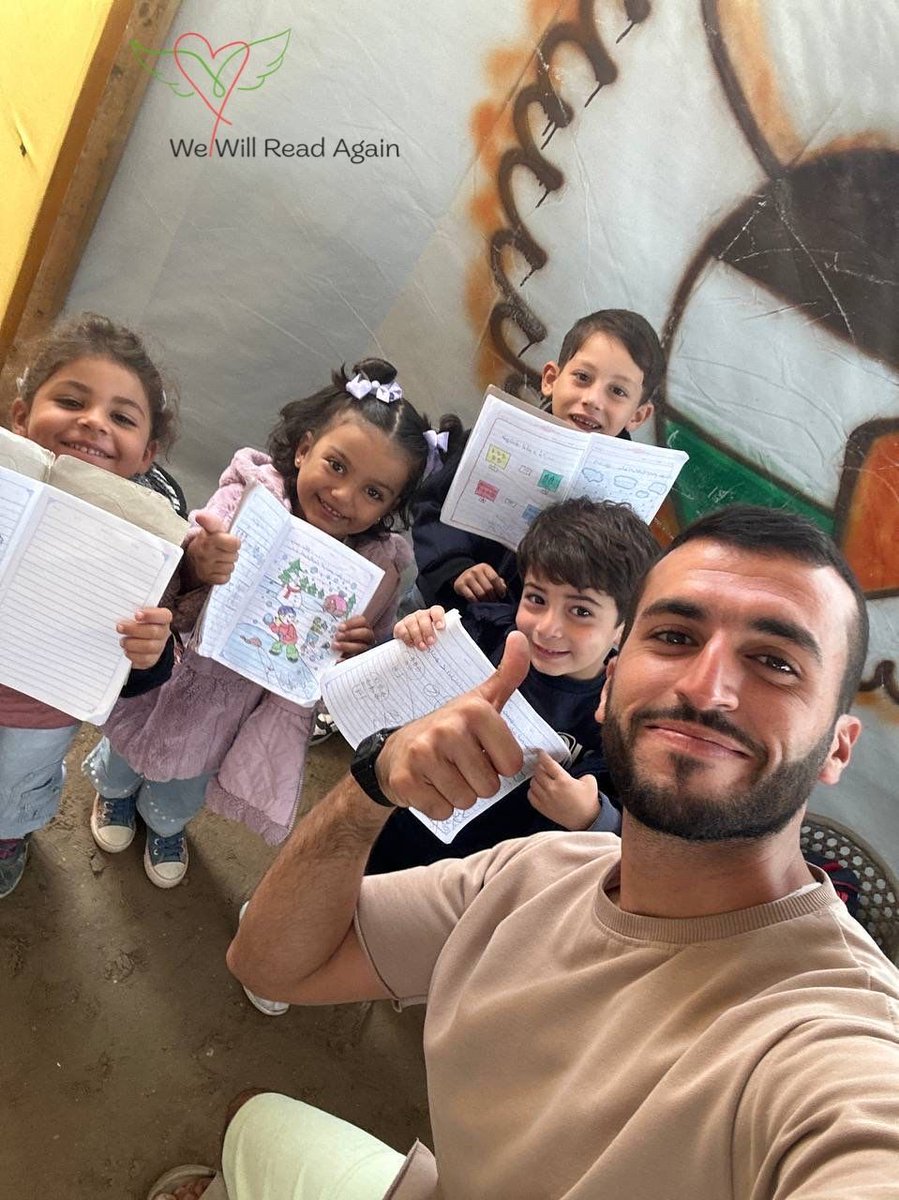
Seeing our little ones proudly holding up their notebooks fills us with hope and reminds us of the power of learning.
Just look at their adorable smiles!
P.S. Proud teacher, too!
❤️🖤🤍💚
#WeWillReadAgain
A mother from #Jabalia says:
“They took all the children from their mothers and put them inside what resembled a pit or a hole. The tank came to circle around them repeatedly until their bones cracked under the pressure of dust and sand, amidst the screams of children and the wailing of mothers.
“After that, the soldiers came and started throwing the children towards the mothers, and whoever caught a child was ordered to carry him and move away quickly, with no guarantee that the child would be their own.
“Many mothers carried children who were not their own, and were forced to leave with them, leaving their own children in the hands of other mothers. This marked the beginning of a new chapter of suffering, with mothers searching for their children in the arms of other women, trying to calm the children they held until they found their real mothers.“
Israeli public media is posting the Jabalia death march as the ultimate victory picture of Israel's genocide.
Children, men & women caged in a concentration camp, starved & bombed, then rounded up & forced to move to the next concentration camp to be caged, starved, & bombed!
Israeli Soldiers destroy a young Lebanese girls dresses, mocking her.
Imagine this in your home? To your daughter? By an invading Army standing in your child's bedroom
The British did it to us in Ireland. We never surrendered.
It was them that left.
I usually air my strongest non-footballing opinions elsewhere, but this is the biggest platform I have, and some things just need to be said.
Rarely am I left speechless, but I find myself struggling to even begin, because no collection of words could even begin to capture the magnitude of horror, cruelty, and sheer atrocity of what’s going on in Gaza.
The fact that this is openly taking place in the 21st century is a grotesque reminder that despite all our supposed progress, we remain complicit in allowing the darkest corners of cruelty to thrive unchecked.
To say I’m disgusted would be the understatement of my life.
Incredible. The AP describing Israel’s plan to exterminate 300,000 people through starvation as an attempt to “starve out Hamas” which only incidentally will starve everyone else.
Demented.