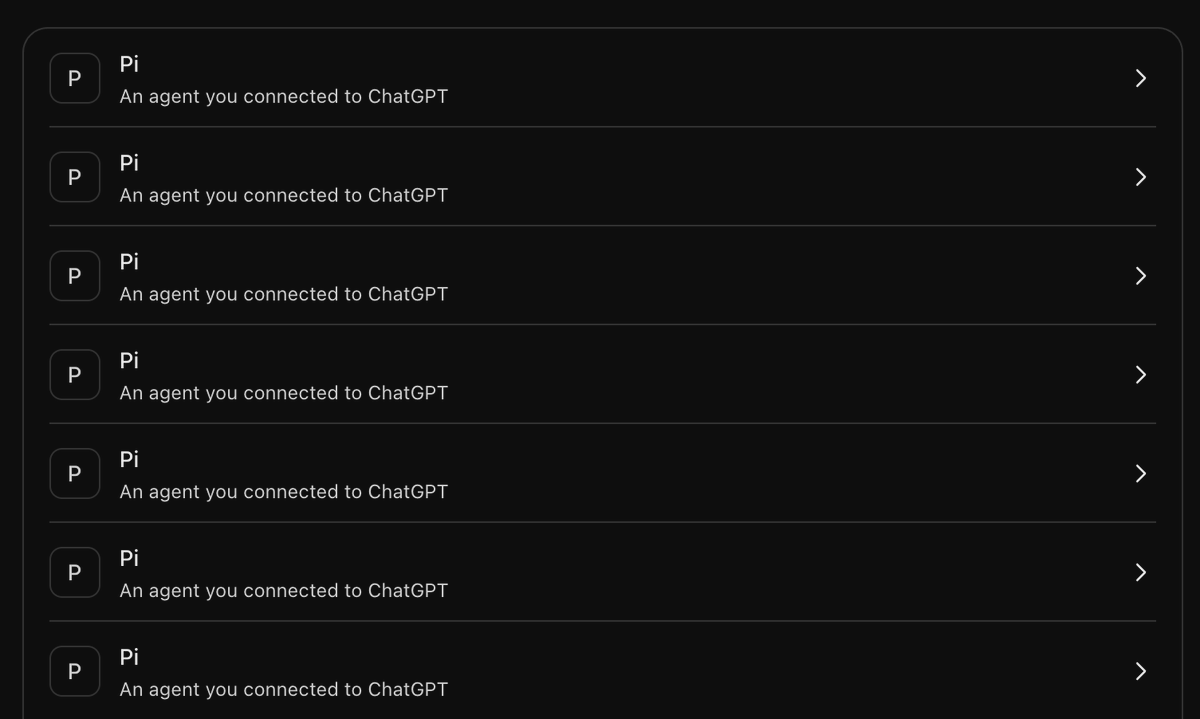
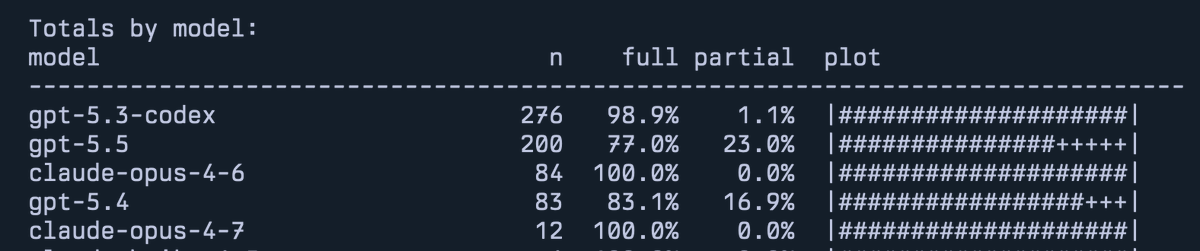
Oh my...it could've been done better for such a fundamental auth mechanism...
It's really exciting that pi finally has first-tier OAuth support from OpenAI, and also frustrating I can only work with it for awhile then go into a loop: login -> work -> token expired (failed to refresh token)
also annoying that a new app created every login and I can't delete them...
https://t.co/aMdE8Ds5JD
@OpenAI
We introduce TherapeuticsBench Preclinical Pharmacology (TxBench-PP), a verifiable benchmark for small-molecule preclinical pharmacology and the first focused slice of a broader benchmarking effort across drug-discovery stages and therapeutic modalities.
TxBench-PP tests whether agents can recover accurate conclusions from realistic assay artifacts rather than memorized facts from the literature. The benchmark contains 100 evaluations indexed by program stage, assay type, and task structure, spanning mechanism-of-action (MoA) and pharmacodynamic (PD) reasoning, compound-target engagement, causal target validation, developability and safety, and translational efficacy.
The strongest model-harness configuration was Claude Opus 4.8 + Pi at 59.3%, followed by GPT-5.5 + Pi at 55.3%.
While experiments are rate-limited by natural processes, human decisions and organizational consensus often make up significant components of program timelines in drug discovery. Agents promise to accelerate discovery, development, and translation by compressing these interpretation and decision-making loops.
However, the practical use of agentic systems in industrial workflows requires standardized and trusted methods of evaluating performance. This is especially challenging in drug discovery because the ecosystem is a sprawling landscape of assay categories, development stages, therapeutic modalities, and decision types.
Benchmarks must therefore measure realistic tasks while providing focused treatment of the many local scientific judgments that make up the biotech ecosystem.
We evaluated 16 model-harness configurations, comprising 11 models across three agent harnesses, on 100 preclinical pharmacology tasks. Each configuration was run three independent times per task, yielding 4,800 agent trajectories.
Performance varied by program stage: accuracy ranged from 27% in screening and hit prioritization to 55% in drug response. Difficult program stages involved decisions across QC, statistics, and chemical or biological judgment of molecular candidates.
Trajectory analysis reveals gaps in scientific judgement. Failures included incorrect perception of assay outputs, reliance on literature priors over supplied evidence, and assay-specific reasoning mistakes.
Manuscript, results and subset of evals/trajectories available below:
🎬 You can ask Argent to record a flow, then replay the sequence of taps, swipes, pinches and types in one go.
Catch regressions, A/B test a change, or move the app into a specific state, saving time and tokens.
Legend List 3.0 is here! 🎉
✨ React DOM support
✨ Even faster, more stable
✨ Perfect initial scroll
✨ KeyboardAwareLegendList for chat and AI apps
✨ Reanimated item transitions
✨ So much more!
It’s been almost 1,000 commits since v2, super excited to finally release it!
Most app issues aren't hard to fix. The hard part is figuring out what happened.
We kept running into this ourselves. You open Crashlytics, then analytics, then a few more tools. You jump between tabs trying to reproduce the issue yourself. Hours spent just reconstructing context.
That's the real problem. Not fixing. Understanding.
@measure_sh gives you a session timeline. User actions, network calls, logs, lifecycle events, device signals, all in one place. Most of it is collected automatically, so you don't run into "we forgot to log this".
That already makes correlation much easier.
This week we added MCP support. Now you don't have to break your flow to analyze everything. Instead of reading through logs and traces step by step, you can just ask "What caused this issue?" in your favorite coding agent like Claude Code or Codex. And get a clear breakdown of what happened, where it broke, why it broke, and what needs to change.
No tab switching. No breaking your flow. More shipping.
Measure is now generally available, just sign up and get to the root cause → https://t.co/xdoKXb9NWa
Introducing React Native Streamdown – our new streaming-ready Markdown library 🚀
We’ve built it on top of RN Enriched Markdown, remend, and Worklets Bundle Mode to fix the "streaming jank" in AI apps.
🔹 Zero UI lag – background processing via Worklets. JS thread stays 100% free
🔹 Smart streaming – powered by remend to correctly close tokens (bold, links, code) mid-stream
🔹 Lightning-fast md4c parsing with 100% native text & interactions
Ghostty 1.3 is now out! Scrollback search, native scrollbars, click-to-move cursor, rich clipboard copy, AppleScript, split drag/drop, Unicode 17 and international text improvements, massive performance improvements, and hundreds more changes. https://t.co/IMk3i6528t
🚨 Check your GitHub repos - a malicious attack to add a crypto wallet stealer script has been launched - they are rewriting recent commits to land the script on main.
Always a good time to double-check 2FA, SSH & GPG keys, branch protections, and authorized apps!
AI ate the "code is hard" moat.
Cloudflare proved it: open docs + open tests = someone rebuilds your product in a week for $1,100.
What AI can't replicate: production traffic. Every edge case in your test suite was a real user hitting a real bug. That accumulates. That compounds.
The new moat isn't what you built. It's what you learned building it.
https://t.co/dc2pE3scq3
https://t.co/BqKeoakbWi
Expo SDK 55 is here😅
React Native 0.83. React 19.2. Legacy Architecture dropped. New Architecture is the default.
◆ 75% smaller update downloads with Hermes bytecode diffing
◆ Expo Router v7 🤯
◆ Brownfield isolation via expo-brownfield
◆ AI tooling: MCP + agent skills for Claude Code
◆ Expo UI much improved for both Swift and Jetpack Compose
There is so much more...it feels futile to try and isolate a few bullets...check out the full release notes and let us know what you think ↓
Pro tip for iOS developers:
1. Run Xcode Instruments
2. Do a deep copy of the time profiler
3. Paste in your agent with prompt:
"Here's an export from Xcode Instruments' time profiler. Use it to analyze and plan performance improvements as a Staff iOS Engineer"
How many rounds for gpt-5.3-codex vs opus 4.6 to fix a SwiftUI clipping issue?
10 vs 3
I like gpt model. It’s been doing well most of the time. But idk for some SwiftUI cases, it gets dumber.
Pretty draconian from Google. Be careful out there if you use Antigravity. I guess I'll remove support.
Even Anthropic pings me and is nice about issues. Google just... bans? https://t.co/JBq9YCB7nB
The simplest AI trick most people overlook: Annotation
Everyone's hunting for the perfect prompt. Meanwhile, the most effective technique is embarrassingly simple.
Boris Tane's workflow: after Claude writes a plan, don't correct it through chat. Open the file. Find the exact line that's wrong. Write your note right there.
"no — this should be a PATCH, not a PUT"
"remove this section, we don't need caching here"
Then: "I added notes to the document, address them. don't implement yet."
When you correct AI through chat, you're describing a problem that exists somewhere else. When you annotate inline, the correction sits at the exact point of error. Claude sees context and correction together. No ambiguity.
The plan document becomes shared mutable state between you and AI. You stop being a prompter and become an editor — slower, more precise, more in control.
Next time you're unhappy with an AI output, don't explain what's wrong in chat.
Open the document. Find the sentence. Write your correction there.
The quality jump is immediate.
https://t.co/at8OKAHzkl