Lifelong student - most interested in emergence, complexity, information theory and computation. constantly updating my theory of how the world works 🌎
Assuming the Riemann hypothesis proof is real, I think it says something remarkable about human creativity/ingenuity that one person in 1859 could pose a question that would take 250,000 pages to answer.
SITUATION DETECTED: The White House and Treasury are discussing a proposal that would require US companies to publicly disclose the use of Chinese open-weight AI models on their websites, aiming to discourage their use through public pressure, per Reuters.
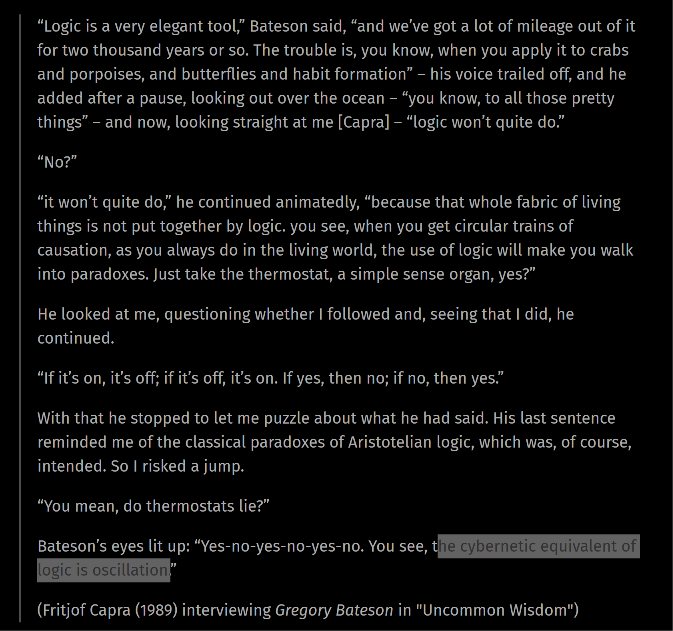
Oh shit that’s right. So the question is what breaks symmetries of oscillation that creates the possibility for paraconsistent logic to gets resolved over linear time when certain external contexts closes its erstwhile open-ended loop through analytic closure, while also creating multiple new forks with their own paraconsistent logic that may gets resolved over linear time.
That’s the question.
Good ideas have an inherent ‘aliveness’ in them that doesn’t fully reduce them to equational reasoning or analytic closures. They are best seen as open ended algorithms
Lead with ideas.
Never lead with math, science, or engineering.
Math, science and engineering are great. Do them. But they are *far* more naive than the information obtained by raw exposure (jumping in with only ideas).
Formalized processes work really well after-the-fact. They help explain and anchor what has happened. But using them in a forward-looking fashion is wasteful, if not disastrous.
Ideas, instinct, pattern recognition; lead with those, absent any reasons beyond making an attempt you want to see happen.
That is the true price of movement. The idea-led mindset is the conduit that makes passing through the barrier possible.
If you're thinking about the steps before you move you're locking yourself into those steps. Nature does not work off steps.
Construct the steps afterward, to give what you discovered meaning.
But always lead with ideas.
I do mean this sincerely even if the phrasing is a bit off. I am interested in where you are the tradeoffs between action without thinking (flow) and thinking without action (rumination/anxiety/analysis paralysis). It seems to me that being in the default mode network for too long hinders action and inward attention and awareness of the self hinders performance and flow, but I also see the need to break automatic reactions and expand awareness.
The sky isn’t any particular ‘thing’ yet it’s something. Nothing in it is blue, yet it is blue. Focussing your eyes on the details of the sky is a futile effort. The sky taught humans to generalize, to abstract, to zoom out for meaning instead of focusing more on the specific. Looking up naturally puts us in a more inductive frame of mind where we expand the space of axiomatic truths, and completeness matters; looking down at the ground puts us in a deductive frame of mind where details, accuracy and consistency matter.
The sky is mankind's oldest guru.
I think adopting a student-teacher relationship to the sky can bear so much fruit.
Tibetan Buddhists often advise people to look to the sky as a model when teaching highest tantra.
The sky's teaching is the teaching of spaciousness.
It makes room for everything and grasps at nothing, without discrimination.
It shows us what perfect clarity looks like.
It also shows us the closest analogy of what true emptiness looks like.
For me, it also shows us how much we can learn from non-human teachers.
I often find I learn more from sitting under an open sky and bathing in its qualities than listening to a dharma talk from a human teacher.
Go down any rabbit hole about reality, and impermanence starts to look obvious.
Everything is process and relation; there's no permanent ground for beings or things.
Psychologically, that's freeing (thanks Buddhism). Philosophically, it just reopens the perennial question: if everything interacts and mutates, what stays invariant?
For existence to mean anything, it has to point to invariant patterns, the information that survives averaging over time.
So we're back to Plato, now in the language of information theory and coarse-graining.
I am very intrigued by the fact that both buddhist phenomenology and process philosophy converge on the idea that "there are no fixed things, only events and processes"
The first sphota might have been when someone said “is it like a river” and the brain would have had to make a novel conceptual shift of pattern recognition from one literal thing to another while maintaining some underlying invariance - first metaphor in the conceptual space, the rest is history - literally, and also metaphorically which actually literally in this context :)
“Meaning” feels like it’s inherently something that we don’t need to have predictive power in the world. We don’t use “meaning” as an input for action, we always find it in our wake of actions.
Hmm this almost makes me wonder if “meaning” is then the mirror image of “feeling” for our consciousness where energy and the ineffable ingress into internal coherent forms.
feelings are bodily energy. they wait for a form. speaking from a feeling spends it, it goes away, the ineffable is dissolved. semantic satiation shows this: repetition spends the energy, so the meaning is lost. which feelings do you want to spend, and which do you want to keep alive by leaving them unsaid?
Which is fine and everything but the trade off is that we are ultimately agents in feeling space and meaning space for co-creating reality, so yes you can hack the matrix with some awakening to meaning-max or feel all the feelings and joy-max but ultimately the Maya is needed for the cosmic order to unfold
ambiguity is definitely a feature when language is instructive as it allows for unlimited context for the same compression algo, but can be a double edged sword when language is purely descriptive.
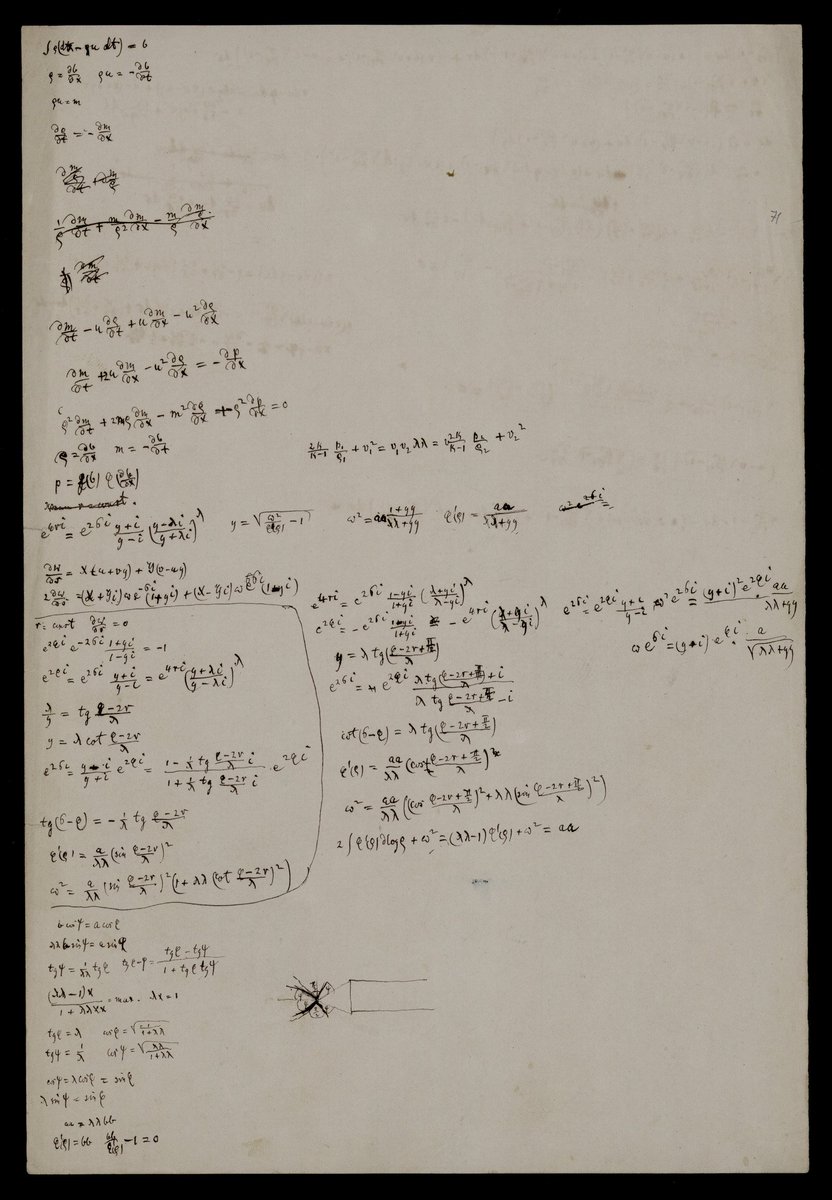
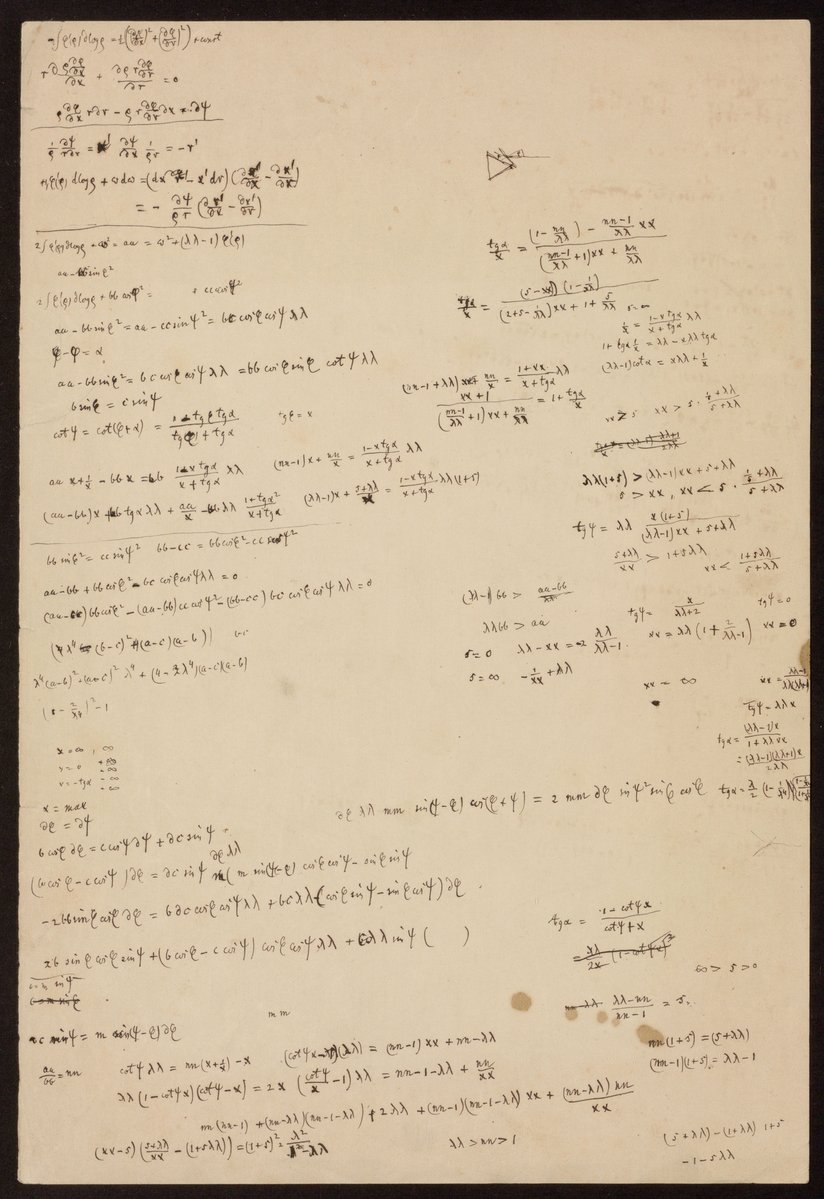
Been running Opus 5.5 agents over the notebooks of Gauss, Riemann, Hilbert and Grothendieck. around 12,000 pages so far. Heres the best finding so far:
Riemann's 1860 shock wave paper is famous for getting the energy part wrong however his unpublished sheets at Göttingen have it right the Rankine Hugoniot conditions a decade or two before Rankine and Hugoniot plus results usually dated 19061937, all in his own notation. A second sheet in another folder has the same physics.
There are probably thousands of potential undiscovered stuff in the research papers of the smartest ever to live imo all of them should be made public and reviewed by ai years of work can probably be transcribed by agents in days