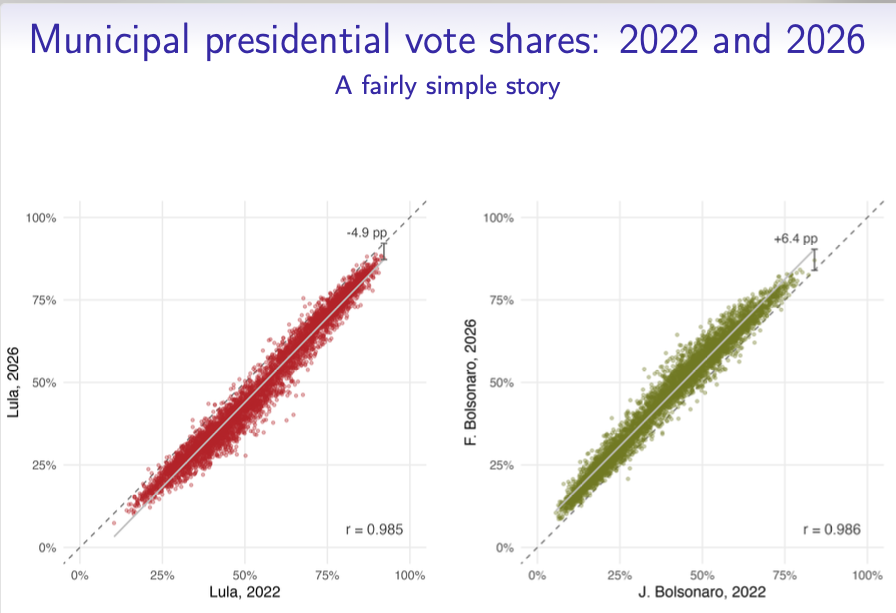
A geografia eleitoral brasileira impressiona pela estabilidade. Entre 2022 e 2026, Lula perde 4,9 pp e o bolsonarismo ganha 6,4 pp, mas a distribuição municipal do voto permanece praticamente intacta (r = 0,985 e 0,986). Mudam os percentuais, não o mapa político do país.
De acordo com os jornalistas da Globo, Lula deveria ter aceitado passivamente a arapuca de debater contra quatro adversários ao mesmo tempo. Sendo que o quarto deles, Zema, entrou via uma ação judicial que, curiosamente, não gerou nenhuma "insegurança jurídica" e nem feriu o processo democrático.
Aí, quando Lula resolveu não ir ao debate, o formato "um contra todos" virou "todos por um" e tudo certo. Estava mantido! Segue o jogo! Viva a democracia!
Pois bem. Bastou o terceiro colocado nas pesquisas, Renan Santos, conseguir uma ordem judicial para estragar a pelada de fim de ano entre Flávio Bolsonaro e Amigos de Flávio Bolsonaro, que o candidato do PL se contradisse (mais uma vez!) e desistiu de participar.
Debate mantido? Nada disso. Vai que Renan causa algum constrangimento ao irmãozão do Vorcaro, não é mesmo? A emissora então cancelou o debate e o discurso mudou: "é o fim do mundo!"; "é a ditadura da toga!"; "interferência jurídica!"; "nunca antes da história deste país!"...
Entendi.
E eu, ingênuo, achando que eles estavam preocupados com a verba publicitária das BETs.
Por que a mídia brasileira normaliza, mais uma vez, um candidato de extrema direita? A eleição de Jair Bolsonaro e seus ataques sistemáticos à Globo, à Folha e a outros veículos de comunicação não deixaram nenhuma lição? A memória política se tornou tão curta ou $$🍎😡?
Por que não se menciona que ele é filho do homem acusado de planejar o assassinato de Lula, que, por negligência, contribuiu para mais de 700 mil mortes, e irmão de quem fez lobby pelo tarifaço? Isso sem falar nas notícias de hoje de encontros com prostitutas.
Pra você que vai votar no Flávio Bolsonaro, ouça o que o Renan Santos, que também representa a direita brasileira, tem a dizer sobre a questão da interferência americana em nossas eleições.
Não, o Renan não é de esquerda e nem petista. Ele só mostra o perigo que o bolsonarismo representa.
Vorcaro cumpriu papel dos financiers do Antigo Regime: homens desprezados em público, capazes de converter dinheiro em prestígio e proteção. https://t.co/NDnayeWcln
Será mesmo que o brasileiro vai votar convencido de que cada candidato pode ser reduzido ao seu leão de chácara do Judiciário? Se a resposta é sim, qual o o papel da imprensa política nesta distorção?
I'm a cardiologist. Hayden Panettiere died at 36. Toxicology is pending, and I won't speculate about what killed her. But I want to say something about what her death should force us to confront, because I think we're going to get this wrong the way we always do.
She had already done everything we tell people to do. She spoke publicly about addiction. She named the postpartum depression. She wrote the memoir. She was told her liver damage could kill her within five years and she said it out loud, in interviews, to an audience of millions. She did the disclosure. She did the reckoning. She got the applause for being brave.
And she died at 36 anyway.
Here's the uncomfortable thing I need you to understand: that is not a contradiction. That is the disease. Addiction is a chronic, relapsing brain disorder with high fatality rates even among people who have insight, support, resources, and genuine periods of sobriety. Relapse is not a moral failure or evidence that someone wasn't really trying. For a substantial percentage of patients, it is the expected clinical course. The body does not care how eloquently you articulated your trauma, or how many people celebrated your journey.
We have built an entire cultural performance around public recovery, and we have quietly confused disclosure with protection. Someone tells their story. We call it progress. We share the interview. We buy the book. And we feel, collectively, that something has been solved. Nothing has been solved. The underlying drivers remain exactly where they were — untreated or incompletely treated psychiatric illness, unaddressed trauma, easy access to potent opioids, the neurobiology of tolerance and craving that does not respond to insight, and the systems and people who enabled it in the first place.
A memoir is not a treatment plan. And I want to say something specific about naloxone, because it's the piece most misunderstood. Naloxone reverses opioid-induced respiratory depression. It is extraordinary. It saves lives when it reaches someone in time, and everyone reading this should have it and know how to use it. In most states you can get it at a pharmacy without a prescription. But naloxone is harm reduction, not treatment. It buys minutes. It does not rewire the circuitry that drives someone back to the next dose after years of trying to stop.
And in my own field, I'll add the part rarely said: opioid overdose kills through respiratory arrest that becomes cardiac arrest. By the time the heart stops, hypoxic injury to the brain and heart may already be irreversible. The window is measured in minutes. Which is precisely why the drug has to already be in the room, and why someone has to be there to give it.
Here is what actually reduces mortality, and it is unglamorous:
Medication for opioid use disorder — buprenorphine, methadone, naltrexone. These substantially reduce overdose death, and they remain badly underused, badly stigmatized, and hard to access. If you take one clinical fact from this post, take that one. Treating the psychiatric illness underneath, properly and continuously — not as an afterthought to the addiction. Naloxone in the home, in the bag, at the workplace, everywhere. And sustained care long after the public has moved on — which is the thing our attention span is structurally incapable of providing.
Hundreds of thousands of people have died of this same physiology, under the same mechanism, without a single headline. We notice when the face is familiar. We extend more grace when there's a redemption arc attached. That selective attention is itself part of the problem — because it means our response is shaped by narrative rather than by mortality data.
Toxicology will eventually clarify the mechanism. It will not answer the harder question: why a woman who had already named the danger, with every resource available to her, still ended here at 36. That question belongs to all of us — to medicine, to an industry that consumed her from childhood, and to a culture that prefers the drama of a fall and a partial recovery over the tedious, expensive, imperfect work of keeping people alive for decades.
Addiction is not a story. It is a high-mortality disease. We should treat it like one — with medication, with sustained care, with naloxone in every home, and with a great deal less applause for disclosure and a great deal more funding for treatment.
Rest in peace, Hayden. Thirty-six.