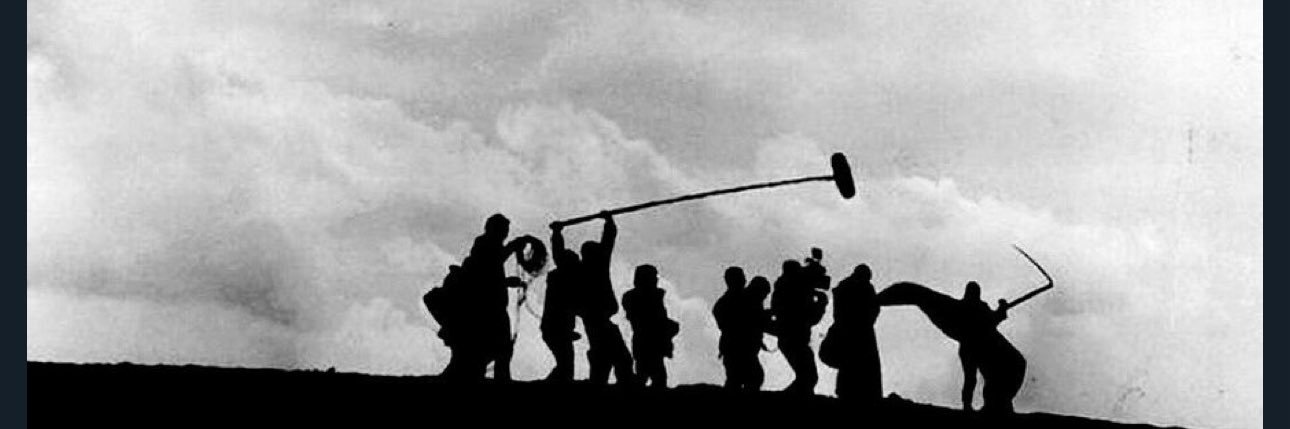
Born #onthisday the legendary cinematographer Michael Chapman (1935-2020) who alongside Bill Butler created some of the most innovative shots in #JAWS.
Here Michael is seen with a young Steven Spielberg on the pulpit of the ORCA.
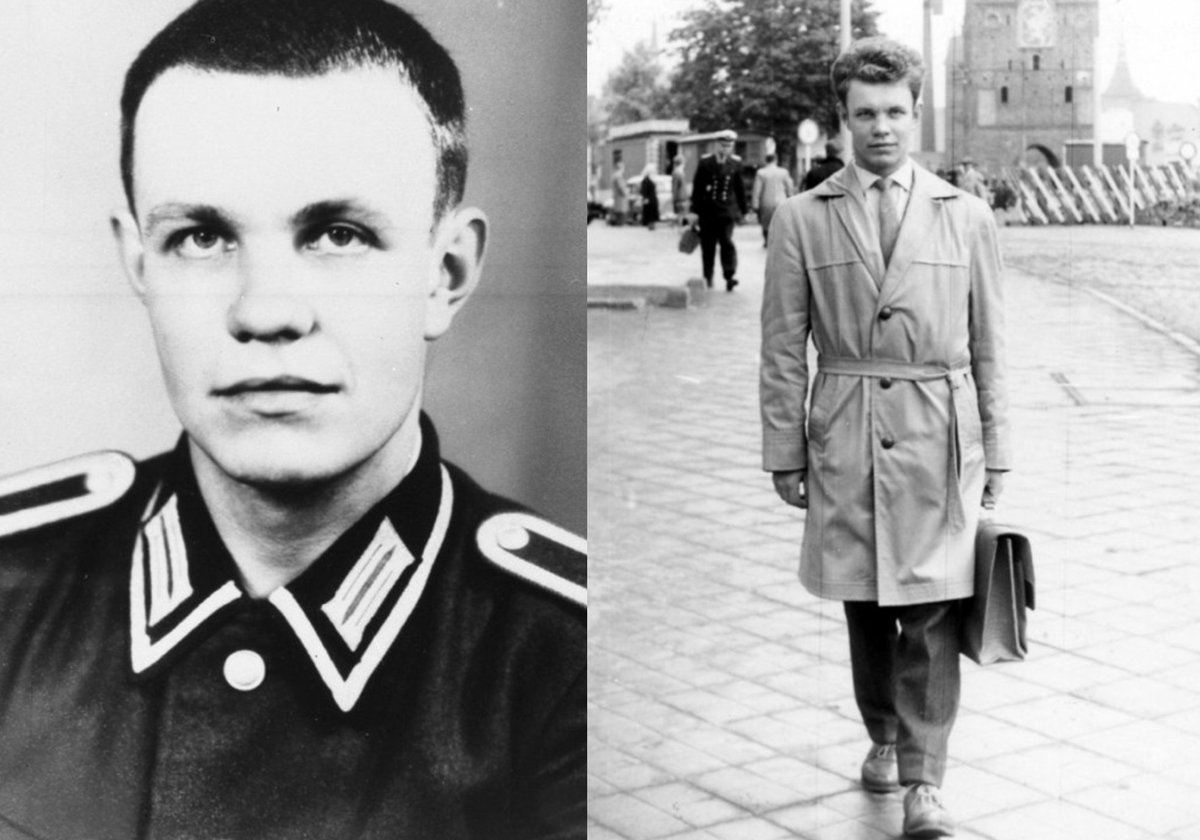
Egon Schultz was a 21-year-old East German border guard killed on October 5, 1964, during the discovery of "Tunnel 57" beneath the Berlin Wall. East Germany made him a state hero and blamed West Berliners for his death, though post-reunification investigations revealed he died from friendly fire....
Between October 3 and 4, 1964, 57 East Berliners escaped to West Berlin through a 145-meter tunnel dug from an abandoned bakery on Bernauer Straße to an outhouse courtyard at Strelitzer Straße 55 in East Berlin. During a nighttime confrontation on the second night, an escape helper fired a shot that hit Schultz in the shoulder. Later investigations after German reunification revealed that the fatal shot came from friendly fire by a fellow border guard's weapon. East German authorities falsely blamed West Berlin "agents" for murdering Schultz, elevating him into a state martyr with streets, schools, and memorials named after him. After reunification in 1990–1991, the true circumstances became public, and most East German state memorials were renamed or removed, though a memorial plaque remains at Strelitzer Straße 55.
. . . .
Shortly after midnight on October 5, 1964, inside a darkened tenement courtyard at Strelitzer Straße 55 in East Berlin, twenty-one-year-old Sergeant Egon Schultz collapsed onto the cobblestones after gunfire erupted in the night. A former elementary schoolteacher from Rostock serving out his conscription in the East German Border Troops, Schultz died in an ambulance before reaching the People's Police Hospital. Within hours, East Berlin's state newspapers and radio broadcasts announced that the young sergeant had been "treacherously murdered" by Western "agents" and "terrorists." Over the next quarter century, the Communist regime elevated Schultz into one of the German Democratic Republic's supreme heroes—naming more than a hundred schools, youth brigades, border regiments, and even the street where he fell in his honor—while locking away top-secret Stasi autopsy and ballistic files proving that the fatal bullets had actually been fired by one of his own fellow border guards.
Beneath the courtyard outhouse at Strelitzer Straße 55 lay the eastern exit of "Tunnel 57," the most ambitious subterranean escape route ever dug under the Berlin Wall. Over six grueling months, a team of West Berlin university students—including engineer Joachim Neumann and future German astronaut Reinhard Furrer—had excavated a 145-meter-long shaft eleven meters underground from the cellar of a disused bakery on Bernauer Straße in West Berlin. Across the nights of October 3 and 4, fifty-seven East German men, women, and children crawled through the damp, narrow passage to freedom in the single largest tunnel escape in the Wall's history.
Just after midnight on October 5, two unscheduled men knocked on the courtyard doorway claiming they needed to bring a friend waiting nearby—and returned moments later accompanied by Stasi officers and an armed squad of border guards called in as backup from the nearby Arkonaplatz command post, including Sergeant Egon Schultz.
Cornered inside the dim passageway as the patrol advanced, West Berlin escape helper Christian Zobel drew a pistol to cover his fellow diggers' retreat into the tunnel shaft. Firing toward the doorway, Zobel struck Schultz in the shoulder—a wound that lodged a bullet in the sergeant's lung but was not fatal. As Schultz fell to the courtyard ground and struggled to push himself back up in the darkness, a Stasi officer ordered the border troops to open fire. Caught in the chaotic crossfire, Schultz was struck repeatedly by automatic bursts from a comrade's Kalashnikov assault rifle, inflicting the lethal wounds that took his life.
#archaeohistories
Two of Bing Crosby's sons shot themselves - the same boys their brother Gary says were beaten with a metal-studded belt, in a home he called "a house of terror." The voice of Christmas died adored and worth $50,000,000, and never answered for a day of it. And when Gary wrote it all down, his own family called him a liar
To the world, Bing Crosby was the sound of home itself. "White Christmas" is still the best-selling single ever recorded, and for a generation his easy, warm voice simply meant family - the good father, the safe house, the perfect holiday. Behind that voice was a man his own eldest son could not survive remembering. In 1983, Gary Crosby wrote "Going My Own Way," and the childhood he described matched no Christmas card ever printed: frozen, silent dinners, summers of hard labour he called the "salt mines," punishment without mercy over the boys' weight, and beatings with a metal-studded belt. "I don't remember a time," Gary wrote, "when terror, bewilderment, anxiety and despair weren't on my shoulders."
Two of his brothers never found a way to carry it. The boys' mother, Dixie Lee, had died of cancer at 42, and it was her money - oil she left behind, not their famous father's fortune - that had kept the four of them afloat. On 30 November 1989, they learned it had finally run out. 11 days later, Lindsay was found dead on his own floor, a gunshot to the head, and the Los Angeles Times tied the suicide directly to the end of that inheritance. Two years after that, his brother Dennis did the same, at 56
In the video below, you can watch the picture that hid all of it, sold live on national television. It is 1954. Edward R. Murrow's cameras are inside the Crosby home, and there is Bing - the gentle widower father - presenting his youngest boy to the country with an easy smile. "This is Lindsay," he says. America melts. That smiling child is one of the two who would later put a gun to his own head, and not a single person watching could have guessed it
Here is the part that should make you angry. Bing Crosby died in 1977 the most beloved entertainer in America, worth some $50,000,000, mourned as a saint - years before his sons' graves and his son's book ever reached the public. He never answered a single question, and never lost an ounce of the world's love. And when Gary finally told the truth, Bing's own family called the boy a liar, and most of the world agreed with them. The father got eternal Christmas; the children got silence; the one who spoke got branded
Here is what it leaves you with, and it is so much bigger than one singer. We decide who is safe by the face they show the world - the warm voice, the easy smile, the reputation everyone already agrees on. And the warmer that face, the less any of us ever look behind it. That is what a fortune and fame truly buy: not safety for the people inside the house, but a wall around the man's name so high that no one he hurt can ever be heard over it. You know the shape of it in your own life. The relative everyone adores at the holidays. The family friend other people call a wonderful man. The home that looks so perfect from the street that no one thinks to ask the quiet child inside if they are alright
Bing Crosby gave the world the warmest sound it will ever own, and - by his son's account - gave his own children a home they did not survive. The world kept the sound, and called the children liars. So before you let a warm, familiar face convince you that a family is fine, sit with the question no one in that house was ever asked in time: whose smile have you trusted so completely that, if the person behind it ever told you the truth, you might not believe them either?
In December 1927, Navy divers outside a sunken submarine tapped hammers on the steel hull to talk to six living sailors they had no way to save.
Inside the dark hull off Massachusetts, those six men tapped Morse code back until winter storms drove help away and their air ran out on the ocean floor.
A submarine officer named Charles Momsen could not get those six trapped men out of his head.
He could not bear the thought of another crew sitting on the bottom of the sea, tapping on steel in the dark and waiting to die.
With fellow officer Allan McCann, he spent years building a steel rescue chamber made to ride a cable down, seal over a hatch, and pull men out dry.
On the morning of May 23, 1939, the new submarine Squalus dove off Portsmouth, New Hampshire, on a test run when a main air valve failed to close.
Freezing seawater flooded the rear rooms and killed 26 men before a crewman slammed the bulkhead door shut.
The hull sank 243 feet to the bottom in total darkness.
Beyond that door, 33 survivors huddled in blankets in the freezing dark and spread chemical powder so their own carbon dioxide would not kill them.
Nobody in history had ever rescued a crew alive from a submarine that deep.
Momsen rushed out aboard the rescue ship Falcon with the steel chamber he had built for this moment.
The next morning, a diver descended 243 feet through icy dark water and fastened a guide cable onto the forward hatch.
Operators lowered the chamber, sealed it tight, passed hot soup down to the freezing men, and lifted 7 survivors up into fresh air.
Two more trips brought up 9 men each, leaving the last 8 survivors waiting in the dark below.
On the fourth climb, with all 8 remaining men sealed inside, the guide cable jammed in the deep.
Pulling harder by machine risked snapping the wire and dropping all 8 men back to the ocean floor.
Momsen sent divers into the freezing water to cut the tangled cable, then lined sailors along the wet deck of the Falcon to haul the heavy chamber up hand over hand.
Just after midnight, nearly 40 hours after the Squalus sank, the chamber broke the surface and the last 8 men stepped onto the deck alive.
More than a decade after six sailors died waiting in the dark off Massachusetts, the officer who refused to forget them brought all 33 survivors of the Squalus home.
He told her he wasn't accustomed to dealing with women.
She apologized, saying she had forgotten to bring her husband—so he would just have to deal with her.
Adolf Eichmann looked across his desk in Vienna at the 42-year-old Dutch housewife and decided to play a cruel joke.
He told her she could take 600 Jewish children out of Austria.
There was just one catch: she had to do it by Saturday. Five days away.
He expected her to drown in paperwork and fail. As she walked out, he muttered, "So purely Aryan and then so crazy."
Five days later, on December 10, 1938, a *New York Times* headline read: **"630 Children Quit Vienna."**
Her name was Geertruida Wijsmuller—known to everyone as Truus.
She wasn't Jewish. She wasn't a diplomat. She held no official title.
She and her husband, Joop, couldn't have children of their own, so she poured her life into social work. And as one historian noted, she had a rare gift: she didn't find powerful men frightening, and she treated impossible obstacles like simple logistics problems.
Just one month before walking into Eichmann's office, she had traveled to the German border after Kristallnacht and smuggled a Polish boy to safety in Amsterdam—hidden underneath her skirts.
So when Jewish and British organizations needed someone to negotiate in Vienna in December 1938, they sent Truus.
The Gestapo arrested her the moment she arrived, holding her for hours before letting her go. She walked straight to Eichmann's headquarters anyway.
He tried to humiliate her. He inspected her hands and ordered her to remove her coat and shoes. When he told her to pull up her skirt and walk around the room, she stopped him cold.
"Enough," she said. "Now let's talk business."
When Eichmann laughed and handed her the five-day deadline, he thought he was rid of her. Instead, Truus walked out and started making phone calls.
She reserved trains. She found 600 children.
At the station, desperate parents handed their sons and daughters over to a Dutch stranger they had met only days earlier—pressing small suitcases into small hands, knowing they might never see their children again.
Truus got every single one of them onto the train. Thirty hours later, she arrived at the Dutch coast. Five hundred children sailed immediately to England; a hundred stayed in the Netherlands.
The British official waiting at the port stared at the hundreds of children in shock.
"But you were only sent to talk?" he asked.
Truus didn't stop there. She went back.
For the next 18 months, she ran a relentless rescue operation. She traveled into Nazi territory multiple times a week, organizing 49 separate transports by train and plane. Whenever a rescue mission seemed impossible, European aid groups had one answer: *"Ask Mrs. Wijsmuller."*
The children called her *Tante Truus*—Auntie Truus. She brought them to her home for Shabbat dinners and arranged swimming lessons so they could feel like kids again.
In May 1940, Germany invaded the Netherlands. With just one hour to spare before the Dutch surrendered, Truus stood at the port of IJmuiden, loading the final group of refugee children onto a cargo ship.
Her own coat and bag were already on board.
At ten minutes to eight, the ship pulled away from the pier. From the deck, the children looked around for Auntie Truus.
She wasn't there. She was standing on the dock, waving goodbye. At the last second, she had realized she couldn't leave her husband behind.
She stayed in occupied Amsterdam, surviving a Gestapo arrest in 1942 without giving up a single name, smuggling food to camps, and helping refugees escape to Spain and France until the war ended.
Truus Wijsmuller died in 1978. A monument in her hometown calls her the "Mother of 1,001 children."
In truth, she helped save 10,000.
All because an ordinary housewife walked into one of history's darkest offices, refused to blink, and told a monster she had forgotten to bring her husband.
Had you ever heard of Tante Truus before today?
I AirDropped a snowy night in Irkutsk into my room. ❄️
I vibe-coded this AirDrop interaction with GPT-6.2 Astra and used @tripoai to generate a few props for the snowy street.The scene itself came from a single photo of Irkutsk that I turned into 3D with ML-SHARP.
I pinch the photo on my iPhone, open my hand, and the whole street unfolds around me on Apple Vision Pro.
Minerva McGonagall was easily the most savage character in the entire Harry Potter franchise.
People talk about Snape's insults, but McGonagall’s dry, polite brutality was on an entirely different level. Telling Peeves how to properly vandalize a chandelier is legendary.
A quick reminder of why she was the goat:
“Harry witnessed Professor McGonagall walking right past Peeves who was determinedly loosening a crystal chandelier and could have sworn he heard her tell the poltergeist out of the corner of her mouth, "It unscrews the other way”
“This boy has as much chance of becoming an Auror as Dumbledore has of ever returning to this school.”
“A very good chance, then,” said Professor McGonagall.
“Now, the Vanishing Spell –“”Hem, hem. “I wonder," said Professor McGonagall in cold fury, turning on Professor Umbridge, "how you expect to gain an idea of my usual teaching methods if you continue to interrupt me? You see, I do not generally permit people to talk when I am talking.”
“I – I didn't think –“”That,” said Professor McGonagall, "is obvious.”
“You look in excellent health to me, Potter, so you will excuse me if I don’t let you off homework today. I assure you that if you die, you need not hand it in”
“I should have made my meaning plainer,” said Professor McGonagall, turning at last to look at Umbridge directly in the eyes. “He has achieved high marks in all Defense Against the Dark Arts tests set by a competent teacher.”
“Certainly I knew, Minerva,” she said quietly.”
“But one does not parade the fact that one is All-Knowing. I frequently act as though I am not possessed of the Inner Eye, so as not to make others nervous.”
‘That explains a great deal,” said Professor McGonagall tartly.”
“There, there, Sybil… calm down… blow your nose on this… it’s not as bad as you think, now… you are not going to have to leave Hogwarts.”
“Hem, hem… Educational Decree Number Twenty-Five.”
“Not another one!” exclaimed Professor McGonagall violently.”
“Well, usually when a person shakes their head,’ said McGonagall coldly, ‘they mean “no”. So unless Miss Edgecombe is using a form of sign-language as yet unknown to humans –’”
It’s high time your grandmother learned to be proud of the grandson she’s got, rather than the one she thinks she ought to have – particularly after what happened at the Ministry.”
And of course,
On November 18, 1980, Grace Jones slapped BBC host Russell Harty again and again, live on air, because he kept turning his back on her. Harty tried to carry on with the show as if nothing had happened, and the clip has been called one of the most shocking moments in British television ever since.
She was there to sing “Love Is the Drug” from her new album, Warm Leatherette, but by her own admission she hadn’t slept in three days. From the start, Harty treated her like a joke. He made fun of her outfit, her hat and her accent, and told the audience that interviewing her was like “climbing the North Face of the Eiger in high-heeled shoes.” Then he turned his back to introduce his other guests: Patrick Lichfield, the Queen’s cousin and a society photographer, and an 89-year-old perfume maker.
In the video below, Harty is asking the old man about perfume, and Grace has had enough. She says maybe she should just go.
“Don’t go right now unless you really want to,” Harty tells her.
“Well, don’t turn your back! I can’t look at you!”
Then she starts hitting him, one slap after another, while he raises his arms and pleads, “Hold, hold, hold on just a moment!” He asks her to move her chair back and turns straight back to the perfume maker. Grace refuses to be ignored. She cuts in to announce that she’s wearing four different perfumes from the night before, and when the next guest walks out, she asks on live TV whether the Queen’s cousin is “a closet queen.”
Five years later she was a Bond villain opposite Roger Moore, and she became one of the most influential icons in music and fashion. Harty never escaped the clip, and it followed him for the rest of his career. He died in 1988 at just 53.
So who was really in the wrong that night: the star who lost it on live television, or the host who spent the whole show making her feel invisible?
On Halloween 1984, Jono Lancaster was born in the UK with Treacher Collins syndrome, a rare genetic condition that affects how the bones of the face develop.
He was just 36 hours old when his parents, horrified by his appearance, left the hospital without him.
Two weeks after that, a foster carer named Jean took him home, and when he was 5, she officially adopted him.
Growing up, Jono was bullied and hated seeing his own face in the mirror.
In his mid-twenties, Jono wrote to his biological parents. He wanted them to know he was doing well and asked if they'd meet him.
They rejected him for a second time, mailing back a cold, one-sentence note signed by both of them that read: "Regarding this subject, we do not want any contact and further attempts will be ignored."
Instead of giving up, he founded a charity supporting people with facial differences and began traveling the world to meet children with the same condition, to show them they weren't alone.
In 1918, shortly before his own death, Wilfred Owen distilled the entire absurdity of war into this devastating short poem.
‘The Last Laugh’, performed by Sean Bean.
A section of the Douaumont Ossuary near Verdun, France, photographed by Alfred Eisenstaedt in 1964...
It holds the unidentified skeletal remains of approximately 130,000 French and German soldiers who perished during the grueling 1916 Battle of Verdun in WWI. Visitors can view the piled bones through small ground-level windows around the base of the monument.
. . .
The Battle of Verdun lasted 303 days, from February to December 1916, making it the longest battle of the First World War. Fought between French and German forces, it became a war of attrition in which both sides suffered staggering losses. Historians estimate there were roughly 700,000 casualties, killed, wounded, or missing, with more than 300,000 deaths.
The Douaumont Ossuary was built after the war to house the remains of soldiers who could not be identified. Behind its walls rest the bones of more than 130,000 French and German soldiers recovered from the battlefield. Through small windows, visitors can see piles of skulls and bones gathered from shell craters, trenches, and shattered fortifications where identification was impossible.
Verdun was subjected to some of the heaviest artillery bombardment in history up to that point. More than 60 million shells were fired during the campaign, permanently altering the landscape. Even today, parts of the battlefield remain within France’s “Zone Rouge” (Red Zone), areas so heavily contaminated by unexploded ordnance and toxic residues that development and farming remain restricted more than a century later.
The ossuary serves as a memorial to soldiers from both armies, reflecting the scale of loss endured by all sides during one of the deadliest battles of the war.
After the war, nine villages around Verdun were so completely destroyed that they were never rebuilt. The French government officially declared them “villages that died for France” (villages détruits). Although no one lives there today, each village still legally exists on maps and has a ceremonial mayor appointed to preserve its memory.
#drthehistories
Two men were stranded in the Arctic for almost two years without seeing another human being. At one point, they stopped speaking because of an imaginary love affair.
This is one of the strangest and most moving survival stories I have encountered.
In 1909, Danish explorer Ejnar Mikkelsen sailed to northeast Greenland aboard a ship called the Alabama.
His mission was to recover documents left behind by an earlier expedition whose leader, Ludvig Mylius-Erichsen, and two companions had died in the Arctic in 1907.
Their lost records contained valuable geographical observations.
Among them was evidence that the supposed Peary Channel, believed by some to divide northern Greenland from the rest of the island, did not exist.
In spring 1910, Mikkelsen set out with the ship's engineer, Iver Iversen, to find the missing documents.
They travelled hundreds of kilometres across an almost unimaginably hostile landscape.
They suffered from starvation, exhaustion and scurvy.
Their sled dogs died.
But eventually, they found the records.
What they did not know was that while they were struggling to return, disaster had overtaken their ship.
The Alabama had been damaged and sunk by the ice.
The remaining crew had salvaged supplies, constructed a small hut from the wreckage and eventually escaped aboard another vessel.
When Mikkelsen and Iversen finally returned to Shannon Island in November 1910, they found the ship gone and their companions gone.
Nobody was waiting for them.
Nobody knew when they might return.
For the next nineteen months, the two men lived in extreme isolation.
They survived on provisions, hunted animals and whatever they could salvage.
Their tiny shelter became almost their entire world.
They endured the Arctic winter, with its long stretches of darkness.
Outside were ice, polar bears, dangerous weather and vast distances separating them from everyone they knew.
Inside were two exhausted men.
They had to depend on each other for almost everything.
And then something extraordinary happened.
Among their few possessions was a postcard showing a group of young women from a Danish school.
To entertain themselves, the men began inventing personalities for the women.
They gave them names.
They imagined relationships.
Mikkelsen developed a particular fondness for one of the imaginary women, whom they called Miss Støt.
One day, Iversen composed a song about her.
Mikkelsen was furious.
He felt that his companion had behaved disloyally toward the woman he had imagined as his own.
The two men stopped speaking.
For two days, silence filled their tiny shelter.
Eventually, Iversen handed Mikkelsen a mock letter, apologizing and offering to surrender not only Miss Støt but all the other imaginary women.
They reconciled.
They promised not to let silence come between them again.
In September 1911, Iversen wrote in his diary about the unbearable slowness of time and his fading hopes that a ship might arrive.
The months continued passing.
Back in Denmark, many believed the men were dead.
But in the summer of 1912, a Norwegian sealing vessel finally reached them.
After nearly three years away from home, Mikkelsen and Iversen returned to Denmark alive.
The records they had rescued helped establish that the supposed Peary Channel did not exist.
The expedition had achieved its geographical purpose.
For nineteen months, two men occupied an almost unimaginably small human universe.
They were each other's entertainment, irritant, companion, witness and best hope of survival.
Even an imaginary romantic betrayal could become a genuine source of pain.
The photograph of the two men after their ordeal shows what the Arctic did to their bodies.
Their story tells us something about what prolonged isolation can do to a mind.
And what friendship, however strained or imperfect, can do to keep it alive.
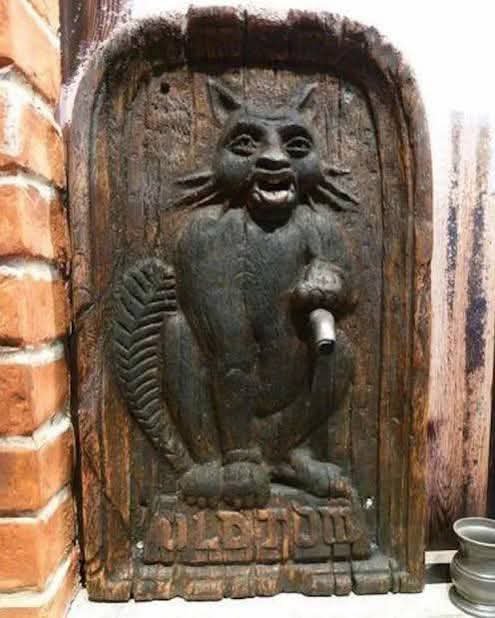
A wooden carving of a cat-like figure, historically known as a Puss-and-Mew machine. Created in 18th-century London (around the 1730s) by Captain Dudley Bradstreet. It acted as an early, covert alcohol "vending machine" to bypass the strict and heavy taxation laws of the Gin Act of 1736.
. . .
During the 18th Century London Gin Craze, the British government passed the Gin Act of 1729 and 1736 to heavily tax and curb gin consumption. But Captain Dudley Bradstreet found a clever way around the law. He hung a wooden carving of a cat (often called "Old Tom") in his window.
The customers would approach the cat, whisper "Puss, give me two pennyworth of gin", and drop a coin into its mouth. If the person inside the house had gin ready, they would meow back, and then pour the gin out through a small lead pipe hidden under the cat's paw. Because the buyer and seller never saw each other face-to-face, authorities could not legally prove who made the sale.
#archaeohistories
Just finished an extraordinary book 'When the Cranes Fly South' by Lisa Ridzén. Quite short, but beautiful, about an old man coming to terms with his son before he dies. Sounds bleak, but it's not. It's a warm, human read about family, food, friends, dogs, and the final journey.
A standing ovation for 50 years of the National Theatre.
It has challenged us, moved us, made us laugh, and brought millions together through the power of storytelling. An honour to join its anniversary celebrations on the South Bank.
Why did God create evil? The answer struck me to the core of my soul!
A professor at the university asked his students the following question:
Everything that exists was created by God?
One student bravely answered:
Yes, created by God.
Did God create everything? - a professor asked.
"Yes, sir," replied the student.
The professor asked:
If God created everything, then God created evil, since it exists. And according to the principle that our deeds define ourselves, then God is evil.
The student became silent after hearing such an answer. The professor was very pleased with himself. He boasted to students for proving once again that faith in God is a myth.
Another student raised his hand and said:
Can I ask you a question, professor?
"Of course," replied the professor.
A student got up and asked:
Professor, is cold a thing?
What kind of question? Of course it exists. Have you ever been cold?
Students laughed at the young man's question. The young man answered:
Actually, sir, cold doesn't exist.
According to the laws of physics, what we consider cold is actually the absence of heat. A person or object can be studied on whether it has or transmits energy.
Absolute zero (-460 degrees
Fahrenheit) is a complete absence of heat. All matter becomes inert and unable to react at this temperature.
Cold does not exist. We created this word to describe what we feel in the absence of heat.
A student continued:
Professor, does darkness exist?
— Of course it exists.
You're wrong again, sir. Darkness also does not exist. Darkness is actually the absence of light. We can study the light but not the darkness.
We can use Newton's prism to spread white light across multiple colors and explore the different wavelengths of each color. You can't measure darkness. A simple ray of light can break into the world of darkness and illuminate it. How can you tell how dark a certain space is? You measure how much light is presented. Isn't it so? Darkness is a term man uses to describe what happens in the absence of light.
In the end, the young man asked the professor:
Sir. does evil exist?
This time it was uncertain, the professor answered:
Of course, as I said before. We see him every day. Cruelty, numerous crimes and violence throughout the world. These examples are nothing but a manifestation of evil.
To this, the student answered:
Evil does not exist, sir, or at least it does not exist for itself. Evil is simply the absence of God. It is like darkness and cold—a man-made word to describe the absence of God. God did not create evil. Evil is not faith or love, which exist as light and warmth. Evil is the result of the absence of Divine love in the human heart. It's the kind of cold that comes when there is no heat, or the kind of darkness that comes when there's no light.
The student's name was Albert Einstein.