OpenAI is now funding the people whose job is to check OpenAI.
Their foundation just committed $ 130M+ to AI safety grants, plus $1B more across programs next year. A big chunk of that goes to the "independent" groups meant to test whether OpenAI's own models are safe.
Independent is their word, not mine. That's the issue.
Electricity went through this exact thing. It killed people for years until a separate body, Underwriters Laboratories, started testing products and refusing to stamp the dangerous ones. Edison didn't pay for them, and that's the whole reason their checks actually meant something.
OpenAI is paying for theirs.
I don't think it's a scam, and I'm glad someone's funding this at all. But there's a real reason OpenAI is the only one writing this check, and it puts the researchers taking it in a strange spot.
Wrote the full thing here 👇
https://t.co/GcheZtADiU
meta wants to sell 10 million wearables in the second half of 2026.
they just outlined an insane internal hardware roadmap.
testing a new AI pendant
dropping an AI agent called Hatch
launching a Wearables for Work subscription
zuck is building a hardware empire to completely bypass the smartphone. a pendant that just listens and remembers everything natively.
targeting 10 massive corporate clients right out the gate is wild.
🚨 ANTHROPIC JUST SAID THEIR AI IS NOW BUILDING ITSELF
over 80% of the code anthropic ships is now written by claude. a year ago it was basically zero.
one of their engineers says he hasn't written a line of code by hand in 5 months. he just reads what claude writes and edits it.
in april, claude fixed around 800 bugs in a single run. it cut an entire category of errors by almost 1000x. the engineer in charge said a human would've needed close to 4 years for that.
here's how it got here, step by step:
- 2021-2023: engineers wrote all the code themselves
- 2023-2025: claude gave them snippets, they copy-pasted them in
- 2025: claude code starts writing whole files on its own
- 2026: claude agents run the code, test it, and hand work to other claude agents
every time a human stepped back, the output went up.
they also gave AI agents an open research problem and left them alone. human researchers solved about 25% of it in a week. the agents solved 97%.
the last step on their own roadmap is drawn with a question mark. they call it closing the loop. it's the point where claude builds and trains the next claude, with no human in the middle.
they say we're not there yet. but they admit the thing they're least sure about is what happens to alignment once AI starts building newer versions of itself. small problems in today's models could quietly grow with every generation and get harder to catch.
and the same report asks whether the world should still have a way to slow this down, or pause it, if needed.
i broke the whole report down, including the part they're most worried about and my own take on whether this loop actually closes.
https://t.co/fZS5OCnKb9
Our internal data shows Claude is accelerating AI development—a possible path to recursive self-improvement, or AI autonomously building a more capable successor.
It’s happening faster than we thought, and the implications deserve greater attention. https://t.co/OVVPJO7VQx
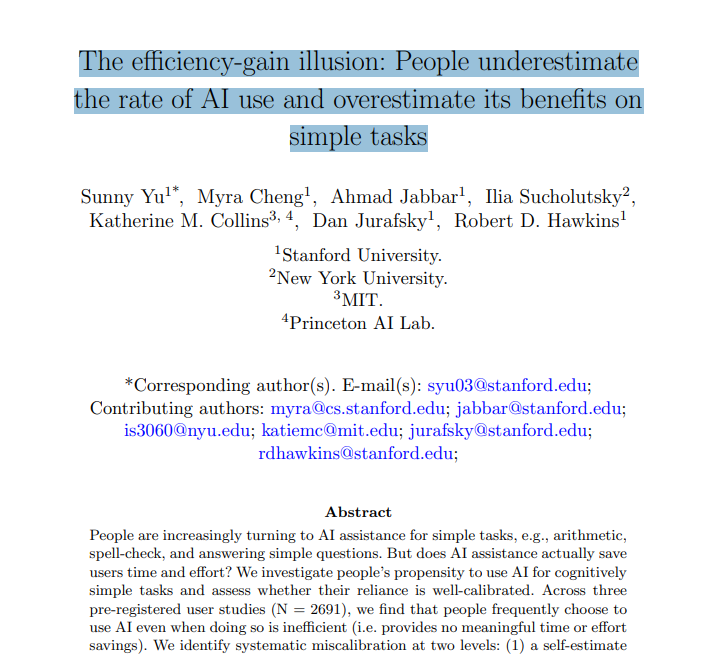
Stanford & MIT ran a study to check if AI actually saves you time on small tasks. it doesn't. and it's worse than just "it doesn't."
they took ~2,700 people and gave them tasks. stuff like "what's 27 + 56" or "a word that means enjoy." things you'd normally answer in your head in two seconds.
first they asked one group to just guess.. how often would you use AI for this, and how much time would it save you?
then a second group actually did the tasks. half with AI, half without. timer running the whole time.
so now you can put what people expected next to what actually happened.
what people guessed:
- they'd use AI on about a third of the tasks
- it'd save them around 56 seconds each
what the stopwatch said:
- they used it on nearly half
- it saved 7.5 seconds, not 56
- on the easy tasks it saved nothing and made them slower
the reason is the good part. every AI task is three steps.. you type the prompt, the model answers, you read the reply. they timed each one.
the slowest step wasn't the model. it was you, typing the prompt.
41% of people didn't even write a real prompt. they copy-pasted the task into the chatbot and waited. on easy tasks that was slower than just doing it themselves.
you'd think people would notice it wasn't helping and stop. they don't. the ones who had just used AI came away MORE convinced it was the faster option.. in the same session the timer showed it was slower for them.
so you never correct yourself. you just get more confident while getting less accurate.
i broke down the rest in the newsletter.. the effort side of it, the one fix the researchers found that actually works (it's not "use it less"), and the type of person who falls for this the hardest.
https://t.co/EOlCMaU51U
Yann LeCun's new lab just dropped a paper proving AI can only learn how the world works under one exact condition.
the real world runs on a few simple numbers. the angle of a shoulder. the angle of a wrist. where something is, how fast it's moving.
but you never see those numbers. a camera doesn't save "shoulder at 40 degrees." it just saves pixels.
so the whole game is.. can a machine look at pixels and recover the actual numbers underneath?
they tested it on a robot arm. two joints, waving around at random. no labels, just raw footage.
the AI figured out on its own that exactly two things were moving. pulled the structure of the arm straight from the pixels. score: ~0.95 out of 1.
then they changed one thing. same arm, same camera. but now the arm reaches for a target.
it failed. score didn't even cross 0.5.
the only difference was the arm now had a goal.
here's why that happens:
when the arm moves randomly, the joint angles spread out evenly into a bell curve. that's the one shape the AI can actually learn from.
when the arm chases a goal, it keeps landing on the same few angles. the bell curve breaks. and the AI loses it.
so the random "noise" everyone would throw away is the good data. the focused, goal-driven movement we'd normally call valuable is what wrecks the learning.
and they didn't just show the bell curve works best. they proved it's the only shape that works at all. every other one breaks the system.
i broke down how the proof actually works, the Plato idea it opens with, the "sideways map" trick that makes recovery possible, and the one assumption the whole thing rests on (that our world is even shaped like a bell curve.. which nobody can confirm).
https://t.co/OcaOx9ihRQ