Learning how to emulate water will be the biggest catalyst for your growth that you’ll ever learn
Always moving. Always finding a way. Regardless of the variables.
Find your way through
It field strips the same way an AR does. Printing another iteration of upper and barrel assembly over the next few days.
Gone through 6-7kgs of PLA doing mockups so far, usually at 15% infil. Won't make any metal parts until everything is finalized.
Let’s start with the obvious. This has been a terrible market. I’m a shareholder too. I feel it. But I think it is important to separate what has changed from what hasn’t.
The cost of capital has changed. Risk appetite has changed. Public market valuations have changed. What has not changed is the demand for compute, the scarcity of power to support it or how difficult it is to bring a large-scale data center online. In fact, I think this market is finally forcing people to look harder at the differences between projects and developers. That’s a good thing.
Here’s my weekly 10.
I find this moment in history almost unbelievable.
We’ve somehow convinced an entire society that prosperity comes from the stock market.
A stock market increasingly dominated by a handful of companies.
And whenever the whole thing gets into serious trouble, the central planners come running into a room, hold an emergency meeting, and figure out how to keep the music playing.
Because it would be crazy the market actually behaves like a market.
Right?
Meanwhile, the average person has watched the purchasing power of their money disappear.
They’re told to invest, take risks, buy stocks, do something, anything, because sitting in cash means slowly getting poorer.
So now you’ve got millions of people being pushed into a casino they don’t understand, because the alternative is watching their savings vanish.
And when the casino blows up, the people who helped create the mess suddenly become the experts responsible for fixing it.
Then they get on television and explain that this is all a perfectly natural part of the business cycle.
Really?
2000.
2008.
2020.
At what point do we stop pretending this is normal?
Come on.
According to Foxe's Book of Martyrs, Timothy, the most faithful and trusted companion of the Apostle Paul, and the first pastor of the church at Ephesus, was martyred in 97 AD for publicly opposing a pagan festival, a debauched parade to the goddess Diana.
So yes, it is quite indeed Christian to publicly oppose public acts of blasphemy, like a Muslim prayer being offered at the start of an American city council meeting.
This is what Christians have done for 2,000 years. Maybe David French would know that if he were a Christian himself.
You are living through one of the rarest statistical events in modern financial history.
Today, the VIX hit 32.
Most retail investors see a 30+ VIX and panic. But if you study market history and derivatives research, a VIX crossing 30 is one of the rarest and most critical macro signals in finance
In normal markets, the VIX lives between 15 and 20. A VIX above 30 only happens in about 5% of all trading sessions in history.
• 1997: Asian Financial Crisis
• 1998: Russian Default & LTCM Collapse
• 2000–2001: Dot-Com Bust
• 2002: Enron & WorldCom Scandals
• 2008: Great Financial Crisis
• 2011: U.S. Credit Rating Downgrade
• 2020: COVID-19 Global Shock
• April 2025: Tariff & Trade War Repricing
• March 2026: Geopolitical Escalation
What do all of these have in common? Forced margin liquidations and structural repricing.
But don't mistake extreme fear for an immediate green light.
A 30+ VIX can mark a generational bottom (like 1997, 2011, or 2020) or it can be a devastating bull trap if credit and fundamentals are broken (like 2000 and 2008).
In 35 years of modern market history, 95% of all trading days live below a 30 VIX.
You are watching an extreme, 1 in 20 statistical event in real time.
Here is the VIX cheat sheet for everyone trying to make sense of this market.
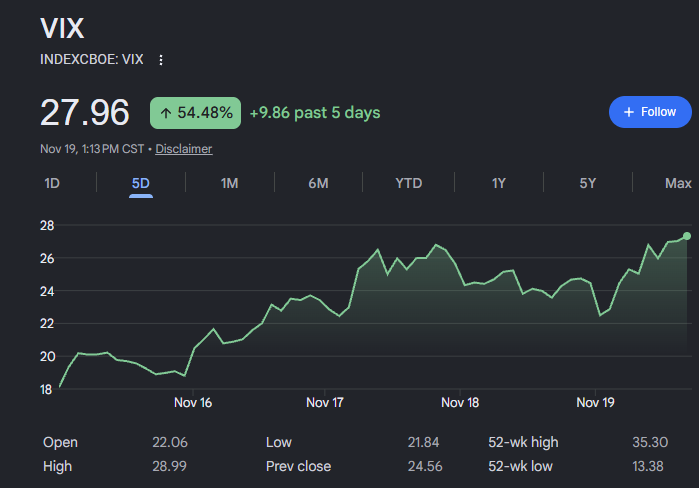
The VIX hit 28 today after rising more than 50% in five days. That number is not just a fear gauge, it’s a forecast. You can translate it yourself with simple division.
Divide the VIX by 16 and you get the expected daily move. Divide by 7 for the weekly. Divide by 3.5 for the monthly.
At 28, that means:
Daily, 1.75% swings in $SPY are the forecast, not the surprise.
Weekly, 4% ranges are priced in.
Monthly, 8% in either direction is considered a normal outcome.
These are one standard deviation numbers, so the market expects to stay inside them about two periods out of three. The third time, it goes further.
This is how you read the tape without the emotion. A 2% red day at VIX 28 is barely above forecast. And a 3% green day isn’t the bottom confirmed either, it’s the same volatility pointed the other way.
Expected move has no direction, only size. The biggest up days in market history all happened inside high VIX regimes, right next to the worst ones.
@pequityresearch I agree with you, not the same. More so noting the sentiment on fintwit. Offering perspective on how much business is actually completed with China