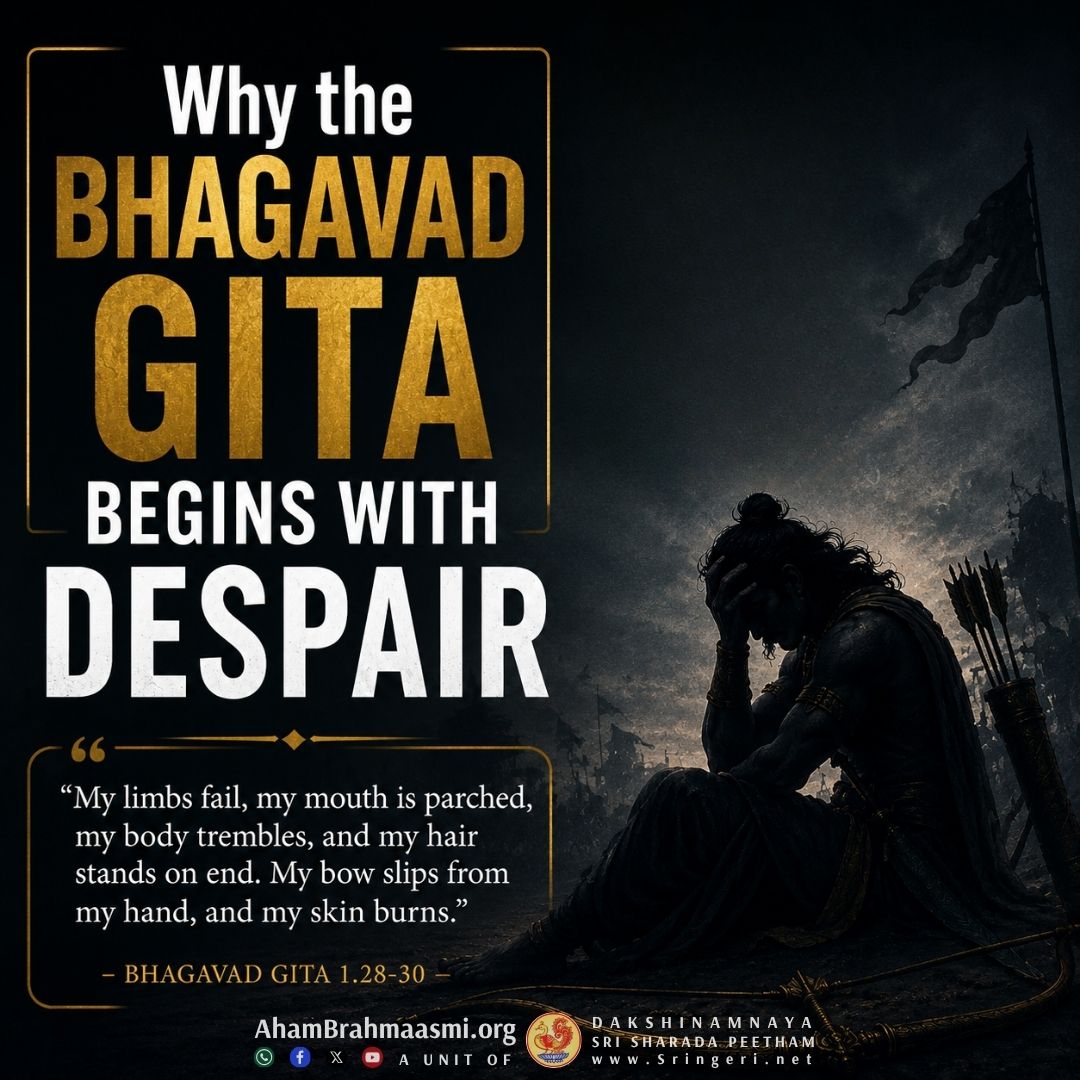
One of the most fascinating aspects of the Bhagavad Gita is how it begins. While most scriptures present transcendent wisdom, the Gita opens with the profound confusion of a great warrior. Most scriptures introduce an already enlightened teacher; the Gita introduces a confused student. Most philosophical treatises start with answers; the Gita starts with a warrior who no longer knows his Dharma.
This premise is easy to overlook because we are so familiar with the iconic image of Krishna imparting spiritual truths to Arjuna. Yet, before Krishna begins his teaching in Sankhya Yoga (Chapter 2) and long before any discussion of Karma Yoga, Bhakti Yoga or Self-realization, something unexpected happens: Arjuna collapses. His famous bow, the Gandiva, slips from his grasp as his mind is overwhelmed by grief.
The entire teaching of the Bhagavad Gita emerges directly from this moment of inner disintegration. At first glance, Arjuna's breakdown is surprising. He is no ordinary man; he is one of the greatest warriors of his age. Having received the finest education, mastered the art of warfare, and overcome countless challenges, he earned the admiration of kings and sages alike. Yet, when confronted with the ultimate test, his strength fails him.
Standing between the two armies on the battlefield of Kurukshetra, Arjuna surveys the scene. He sees his grandfather Bhishma, his teacher Drona, his cousins, friends, and relatives gathered on both sides. Suddenly, the reality of war ceases to be an abstract concept; it becomes deeply personal. Arjuna's physical and emotional response is recorded in vivid detail:
दृष्ट्वेमं स्वजनं कृष्ण युयुत्सुं समुपस्थितम् ।
सीदन्ति मम गात्राणि मुखं च परिशुष्यति ॥ (1.29)
Translation: Seeing my own people gathered here, eager for battle, my limbs fail me and my mouth becomes dry.
He continues:
गाण्डीवं स्रंसते हस्तात्त्वक्चैव परिदह्यते ।
न च शक्��ोम्यवस्थातुं भ्रमतीव च मे मनः ॥ (1.30)
Translation: “My bow slips from my hand, my skin burns, and my mind seems to whirl in confusion.”
न काङ्क्षे विजयं कृष्ण न च राज्यं सुखानि च ।
किं नो राज्येन गोविन्द किं भोगैर्जीवितेन वा ॥ (1.32)
Translation: "Krishna, I do not desire any victory, kingdom, or happiness. O Govinda, of what use to us is a kingdom, happiness, or even life itself when all those for whom we may desire them are now killed on this battlefield?"
On the surface, Arjuna appears to be struggling with a moral dilemma. At a deeper level, he is confronting a crisis of identity. For his entire life, Arjuna knew exactly who he was: a warrior, a prince, a protector of justice, a brother, and a son. These roles provided stability and direction. Now, these identities have violently collided. The duty that defines him as a warrior requires him to fight and kill the people he loves. The mental framework through which he understood himself can no longer reconcile the reality before him.
This is not merely an ancient battlefield problem; it is a universal human problem. Most of us build our lives around fragile, external identities. In Vedanta, these identifications arise from upaadhis – limiting adjuncts with which we mistakenly identify, superimposing them upon our true Self.
• "I am an engineer" or "I am a doctor."
• “I am an entrepreneur."
• “I am successful and intelligent."
• "I am rich.”
While these descriptions are useful for functioning in society, trouble begins when we mistake them for our true nature. Because these identities are dependent on external circumstances, they are inherently fragile. When life erodes these carefully constructed frameworks, intense suffering arises. The deeper challenge in these moments is not just the external event itself, but the realization that the psychological structures we relied upon are no longer adequate.
In that sense, all of us become Arjuna. Each of us encounters a personal Kurukshetra where our fundamental assumptions are tested, and where the answers that once seemed obvious suddenly fail us.
The Birth of the Disciple
One of the great paradoxes of spiritual life is that genuine learning often begins only when certainty ends. As long as we believe we understand ourselves and the world, there is little room for transformation. Eventually, life throws a curveball. Relationships fracture, careers shift, health declines, and external success loses its ability to satisfy. While most people attempt to patch up these crumbling psychological structures as quickly as possible, the spiritual seeker does something different: they begin to investigate.
Arjuna's ultimate greatness lies not in his military skill, but in his willingness to acknowledge his absolute confusion. Instead of pretending to be certain, he admits his ignorance and surrenders:
कार्पण्यदोषोपहतस्वभावः पृच्छामि ��्वां धर्मसम्मुढचेताः ।
यच्छ्रेयः स्यान्निश्चितं ब्रूहि तन्मे शिष्यस्तेऽहं शाधि मां त्वां प्रपन्नम् ॥ (2.7)
Translation: "My nature is overcome by weakness, and my mind is confused regarding Dharma. I ask You to tell me decisively what is truly beneficial for me. I am Your disciple. Please instruct me, for I have taken refuge in You."
This verse represents a profound psychological change. Up to this point, Arjuna was arguing his case, using logic to defend his desire to retreat. Now, recognizing the limitations of his intellect, he stops trying to teach and becomes willing to learn. The disciple is born.
In this sense, the Gita is not merely a historical dialogue, but a symbolic map of the inner human psyche. Arjuna's despair is a necessary stage in his spiritual inquiry. Human beings generally view suffering as an unwanted obstacle, but the Gita suggests it is an essential catalyst for growth. Without dissatisfaction, we would never seek deeper understanding. Without uncertainty, we would never question inherited assumptions.
Arjuna’s pain becomes the exact doorway through which timeless wisdom is revealed. Had he entered the battlefield with unshakeable confidence, perhaps the Bhagavad Gita might never have been spoken.
Kurukshetra in Modern Life
Though separated from Arjuna by millennia, our modern battlefield feels remarkably similar. It may not feature chariots and bows, but our battles are in the mind, filled with ethical dilemmas, internal anxieties, relationship conflicts, and existential dread.
When previous knowledge proves inadequate, our immediate temptation is to rush toward quick fixes. The Gita offers an alternative perspective: sometimes, confusion is the path. True progress often occurs not when comfortable answers are found, but when the right questions finally break through our certainty.
The Bhagavad Gita begins with despair because awakening requires us to acknowledge that something fundamental is missing. Arjuna's crisis is not a detour from his destiny; it is the destination itself. His confusion creates space for wisdom, and his willingness to surrender allows real truth to emerge. Perhaps that is the first lesson of the Gita.
If we reflect honestly on our own lives, our greatest insights rarely come from our moments of success. They come from the professional setbacks, personal losses, and unexpected turns where our certainty collapsed.
Every personal Kurukshetra, painful as it may be, may contain the fertile seed of a greater awakening.
Dr. Niranjan Miganakallu Narasimhamurthy @niranjan_mn
*-*-*
Stay inspired with quotes, dharmic insights, updates, and more on our official WhatsApp channel: https://t.co/hhKhdAJH4N
#Philosophy #Advaita #vedanta #Shankaracharyas #sanatandharma #sringeri #Jagadguru #spirituality #Bhakthi #bhagavadgita #SanatanaDharma #Gita #SelfKnowledge #VedantaLife #SpiritualLearning #Jnana #IndianPhilosophy
A toddler's greatest certainty: "Mom will keep me safe." Seeing that faith shattered is almost unbearable. No child should ever have to experience that kind of fear. Gut wrenching 😢😢😢!!!
Most hated women on internet right now,my blood was boiling looking at her. God forbid why does god give kids to such people!! Little baby still feels safe with his mother.
Doctors munde sariga examine chesthe batike vademo😭
@ManeeManjunath Karnataka BJP has become the most ineffective state BJP unit in the country. No leadership. No vision. No fight for people's issues. Just expecting to rely on Modi's popularity to return to power. Political bankruptcy at its best !!
Shatavadhani Dr R Ganesh, a renowned practitioner of the ancient art of avadhana, polyglot & author from Karnataka, has been conferred the Padma Bhushana, one of India's highest civilian honours, in recognition of his outstanding contributions to art & Indian cultural heritage.
It is important for Delhi Capitals to secure a convincing win in their next match. A narrow loss in their next game - doubts start to creep in, something we have seen with Rajasthan Royals before !!! #DCvsGT#ipl2026
A most well deserved reward. In case people are not aware, a shatavadani is someone who takes questions in Sanskrit and composes a verse in a given meter impromptu as a reply … and does it with a 100 scholars posing questions. This particular individual can do this in multiple languages.
In essence, this is the closest we get to royal court poets of the Kalidasa/Dandi age.
2. Tukaram Omble
A simple, unassuming constable — but a lion in the moment India needed him the most.
His ultimate sacrifice ensured that Indians, particularly Hindus, were spared the burden of lifelong suspicion and blame by Kasab.
He stood between chaos and the country !!!
@IndiaToday@sardesairajdeep Providing platform to a self proclaimed expert who does not even provide his last name to verify his credentials and calls himself Captain Steve. Just Rajdeep Sardesai things !!!