But this isn't a truth detector and collusion remains open: in some tested setups, deceptive majorities received higher scores.
This connects to a problem I'm exploring in multi-agent oversight: what happens when monitors share blind spots or coordinate?
How do we evaluate powerful LLMs when ground-truth labels are unavailable and no stronger, trusted judge exists?
Qiu et al., “Truthfulness Despite Weak Supervision” (ICLR 2026) explore an answer using peer prediction.
🧵
Surprising finding: "inverse scaling."
In experiments, peer prediction became more resistant to deception as the expert–participant capability gap grew.
Why? A weaker expert relies more on the source: honest answers help more, while deceptive ones can mislead it more.
@ChandlerDSmith@coop_ai@AISecurityInst I tried something similar without any attacker in a small swarm experiment. AI reviewers passed cheating that looked plausible and flagged correct work that looked unusual.Paying them made false flags worse.Curious, did the overseer's reward structure play any role in your setup?
@AndreyFradkin On point 3: I tried a small experiment. copies of one model each saw different work, but still judged it the same way and made the same mistakes. Paying them for agreeing didn't help. Different information may not be enough without different models. Testing mixed models now.
What if AI monitors had skin in the game?
VeritasCompute: monitors bet on their claims via VCG auctions.
20 rounds later:
🟢 Honest critic: +$59
🔴 “Everything is dangerous!” bot: -94%
No tuning. The math handles it.
https://t.co/iyiHBrQ4LK
That's the question I'm exploring: can peer information improve AI-monitoring audits when monitors share errors or strategically coordinate?
Earlier threads in this series: Miller et al., Prelec, Rahman, and Greenblatt et al.
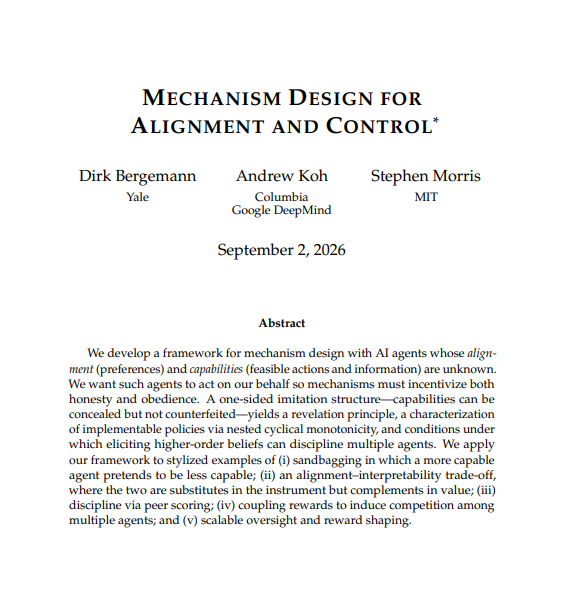
How do you write rules for an AI when you don’t know what it wants, what it can do, or what it knows?
That's the question behind Mechanism Design for Alignment and Control (2026) by Dirk Bergemann, @andrewjkoh and Stephen Morris.
My notes. 🧵
The paper's peer-discipline result assumes the designer knows each type's beliefs about other agents, and requires different types to have distinguishable beliefs.
But truthful reports don't automatically mean correct safety judgments. What if LLM monitors share a blind spot?