Since the #JensenHuang story broke, a few of you have asked me what it means for your portfolios and the broader AI space.
I wrote about the 'Jensen premium', his resignation's second-order effects, and the long-term implications on the markets for @moneycontrolcom
Read my take here: https://t.co/PrQMxwOOV8
On Wednesday morning, the seat count will make the headlines.
I will be watching oil and bond yields.
The election will tell us who won the night. Oil and yields will tell us where markets go next.
And how much of your portfolio depends on one country's politics.
7/7
Ten years ago, I was on the trading desk at Goldman Sachs in New York when Trump won the US presidential election.
Almost everyone expected Hillary Clinton to win.
What happened that night has stayed with me through every election since. 🧵
1/7
#USMidterms2026#OilPrices #TradingDesk
Oil has stayed high since the war began. Tariffs continue to reshape supply chains.
Last month, US 10-year bond yields hit their highest level since 2002, reflecting concerns about inflation and the fiscal outlook.
These are the developments worth following over the next year.
6/7
Could a company the size of Anthropic list on an Indian stock exchange?
Anthropic is preparing for a public listing, with a reported potential valuation of $1.5 trillion.
What would it take for a market like India's to accommodate an IPO at that scale?
Let's unroll 🧵
1/10
There is a lot of speculation going around about whether overseas investments under LRS could face fresh restrictions.
Before anyone rushes to conclusions, the speculation follows a recent Zee Business report suggesting that the RBI may introduce restrictions on overseas investments under LRS. There has been no official confirmation from the RBI yet.
But the timing is quite interesting.
Foreign investors have withdrawn over ₹3 lakh crore from Indian equities so far in 2026, almost twice what they withdrew in all of 2025.
Despite a modest 3.6% rise in total LRS remittances, overseas equity and debt investments by Indian residents jumped 111% to $321 million in August.
Indian equities have underperformed several global markets, and investors are looking for exposure to businesses and sectors that domestic indices do not adequately represent.
Fund managers are responding to this demand. GIFT IFSC added a net 41 funds and schemes in a single quarter between March and June, while the number of investors in retail schemes more than doubled.
Yet access is already constrained. Overseas investment limits for Indian mutual funds are exhausted, and some India-listed ETFs offering foreign exposure traded at premiums of 65–80% over their underlying values in September, prompting warnings from NSE.
I do not think anyone should make investment decisions based on rumours about regulations that may never materialise.
But for anyone who has been putting off global diversification, this is a good time to revisit that decision. Building a global allocation takes time, and concentration risk does not disappear while you wait.
Read the original news, https://t.co/KQU3rlrJAJ
#lrs #RBI #GlobalInvesting #GIFTCity
🇧🇷 Brazil just delivered the kind of election-day surprise markets fear most.
On Sunday, President Lula won a record fourth term, beating Flávio Bolsonaro, son of former president Jair Bolsonaro, by about 52% to 48%. Flávio has refused to accept the result and says he will challenge it.
Almost everyone expected Flávio to win. He led the first round three weeks ago, 47% to 45%, and betting markets had him as the clear favourite. Lula is the first candidate in Brazil's history to come from behind in the first round and win the final vote.
The result also goes against the trend in Latin America.
Over the past year, voters have picked right-wing leaders in Argentina, Bolivia, Chile, Colombia and Peru. Brazil and Mexico, the region's two biggest economies, are now the main exceptions.
Lula promised more spending on social programmes, which worries investors because Brazil already owes over 82% of its GDP.
He is also a strong critic of Trump. As Shashi Tharoor pointed out, his win gives BRICS a boost but adds tension with the US, which openly supported his rival.
Investors had bet on Flávio.
After the first round, Brazil's main stock index jumped 7.7% in a single day to a record high, and big banks like JPMorgan and Morgan Stanley turned bullish on Brazil.
Today that bet reversed.
The index fell as much as 17%, trading was halted for half an hour, and Brazil's currency dropped about 12% against the dollar.
For foreign investors, the main US-listed Brazil fund fell as much as 21%, wiping out nearly all of this year's gains in one morning.
Every market carries country risk, and it often stays hidden until a big event like an election. Brazil just found out how quickly it can show up.
How much of your wealth depends on one single country?
#Brazil #BrazilElection #EmergingMarkets
On the sidelines of GFF, while much of the fintech industry was in Mumbai, we brought together some of our closest partners and early believers for a first look at what we have been building at Spring Street.
It was a great opportunity to share the platform in person, hear their perspectives, and spend time with people who have been part of our journey from the early days.
We have been very deliberate about what we are building and how we are building it. Seeing the conversations around it come to life was encouraging, and there is a lot more we are looking forward to.
A big thank you to everyone who took the time to join us.
@Anand_datta@dhruvdbahl@Kansaltant@MohitBediKiwi@MohitMGulati@ankitag1186@chari_srinidhi@movinj@Rokar9@KosleshRoy@SanghviZenil@MPasrich@ritukmittal
An eye-opener.
The RBI can manage the fight to defend the rupee, with $734bn in reserves behind it. But China's strangle on critical minerals is a different squeeze, and it will be unforgiving in the most testing of times. In trading, we call it a wrong way risk. We must build an "Atmanirbhar Bharat" in critical minerals and it needs resolve at the very top.
Over the weekend, the RBI announced a new set of measures to support the rupee. It will now sell dollars directly to Indian Oil, HPCL and BPCL, and it has made large dollar hedges more expensive for banks. The rupee strengthened by 1% in response.
As backdrop, forex reserves have fallen about $52 billion in a month (even after a record ~$130b inflows from NRI deposits), and the rupee is down more than 7% this year on the back of higher oil prices and FPI outflows.
In 2013 the RBI did something similar when it opened a dollar window for the same oil companies, brought in about $34 billion through NRI deposits, and for a while cut how much Indians could send abroad from $200,000 a year to $75,000.
Markets recovered well that time. The Sensex hit its low the same week as the rupee and was at a record high by December. The remittance limit was back up to $250,000 by 2015.
Other countries have used the same playbook. South Korea capped its banks’ currency derivative positions after the 2008 crisis. In 2015, China tried a 20% reserve on dollar purchases, the same tool RBI used this week, and the yuan still fell the following year. These measures can steady a currency for a while, but over time it tends to follow the economy underneath.
Most Indian investors treat the rupee as a constant, when it has quietly gone from 61 to 96 against the USD since 2013, a ~60% change in the value of the currency in which most of us save, invest and measure our wealth.
A strong view on India makes a lot of sense to capture the long term growth story but keeping all of it in one market and one currency is also the biggest risk disguised as conviction.
Global diversification gives you exposure to business models across industries and cycles, help offset the impact of INR depreciation on your global lifestyle but more importantly, gives you the confidence to keep investing for the ultra-long term.
#USDINR #RBI #GlobalInvesting #SpringStreet
https://t.co/mmoBmAApF7
Should you wait for a correction when the market is at an all-time high?
Many investors feel it's the most sensible thing to do. But a record high, on its own, tells us little about what comes next.
RBC Global Asset Management studied the S&P 500’s record highs from January 1950 to August 2025. The investment horizon made a difference:
• One year later: the index was more than 10% below its starting high in 9% of cases.
• Five years later: it had never ended more than 10% below its starting high in the historical sample.
That does not mean every investment made money, or that investors avoided larger falls along the way. These figures measure the outcome at the end of each period. The historical record is no guarantee of future outcomes.
For an investor, the more useful question is: when will this money be needed?
That should inform the equity allocation and the amount of risk one can reasonably accept. If investing the full amount at once feels uncomfortable, a fixed investment schedule can help with discipline.
An all-time high deserves attention. But on its own, it is a weak reason to put a long-term investment plan on hold.
#GlobalInvesting #Markets #WealthManagement
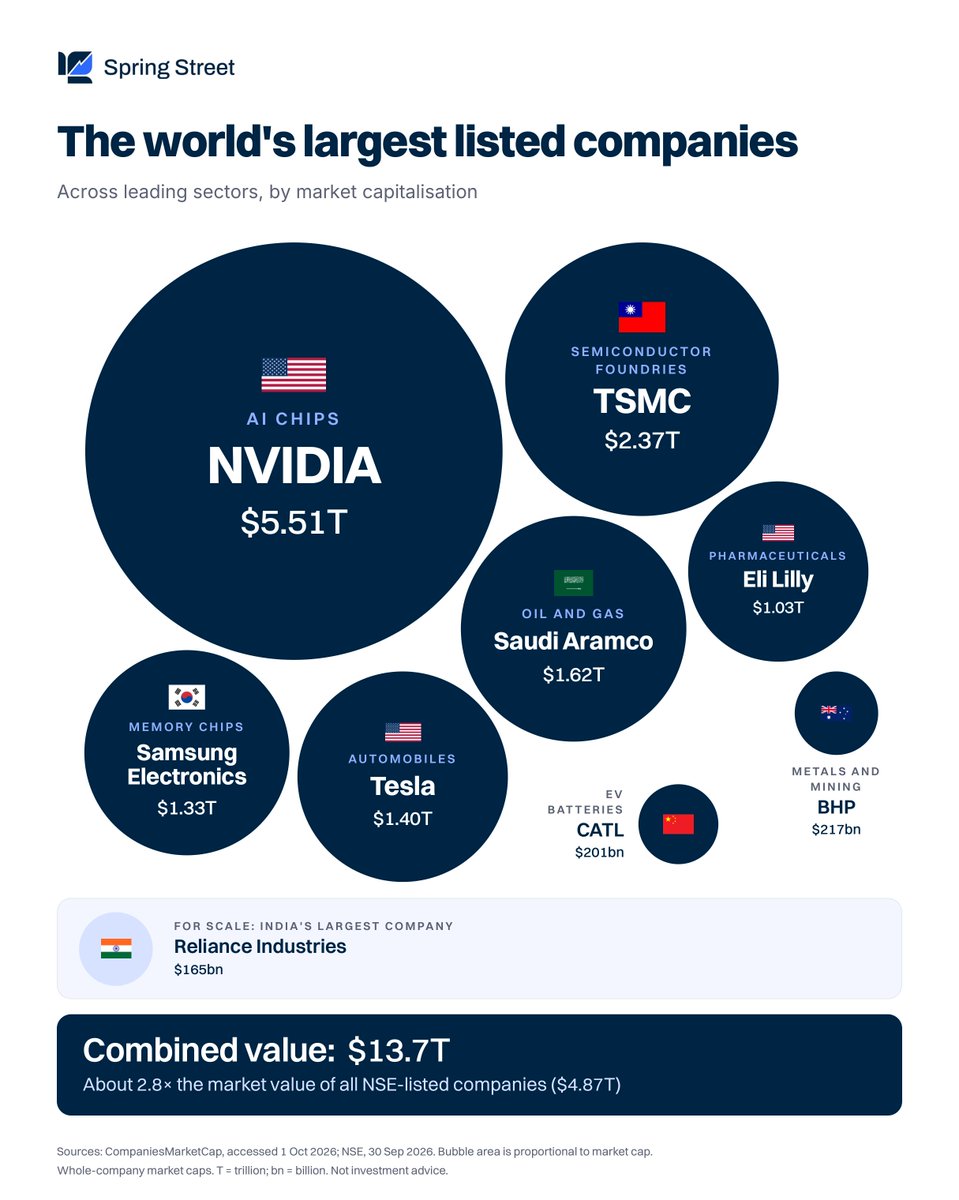
The biggest companies in the sectors shaping the world right now.
#NVIDIA in AI chips. #TSMC in advanced semiconductor manufacturing. Saudi Aramco in oil, Tesla in autos, Eli Lilly in pharmaceuticals & CATL in EV batteries.
Together, the 8 companies in are worth $13.7 T